South Korean Fighter KF-21 Successfully Makes First Flight: In the Air for 33 Minutes
이 글자크기로 변경됩니다.
(예시) 가장 빠른 뉴스가 있고 다양한 정보, 쌍방향 소통이 숨쉬는 다음뉴스를 만나보세요. 다음뉴스는 국내외 주요이슈와 실시간 속보, 문화생활 및 다양한 분야의 뉴스를 입체적으로 전달하고 있습니다.
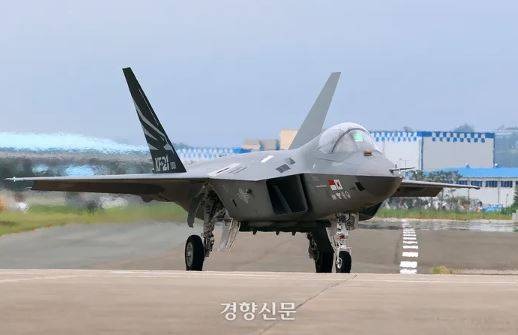
On July 19, the KF-21 Boramae, South Korea’s first homemade fighter, made a successful first flight. The first prototype of the KF-21 departed from the airstrip of the Air Force 3rd Flight Training Wing in Sacheon, Gyeongsangnam-do and successfully completed the test flight.
This day, the Defense Acquisition Program Administration (DAPA) announced, “The South Korean fighter, the KF-21 took off at 3:40 p.m. this afternoon and landed at 4:13 p.m. and successfully completed its first flight.” The administration explained, “After the first prototype was delivered in April 2021, the KF-21 underwent various ground tests. We confirmed that it was ready for a safe first flight in a First Flight Readiness Review in June 2022, and executed the first flight accordingly.”
The administration further explained, “With the successful flight, the development of a South Korean fighter has entered the test flight stage. When we expand the flight envelope and confirm various performances and compatibility with air-to-air weapon systems in the course of over 2,000 test flights, the development of the system will be completed in 2026.”
An official from the DAPA said, “The successful first flight was the moment when the development of a 4.5-generation fighter jet with domestic development capabilities came true,” and added, “We are one step closer to successfully developing a South Korean fighter, and this symbolizes a new leap in South Korean aerospace technology and a jump toward becoming a strong high-tech military.”
The successful test flight this day was the first in 21 years and four months since South Korea announced its fighter development project, the KF-X. The KF-21 project practically began after President Kim Dae-jung declared, “We will develop a domestic fighter by 2015” in March 2001.
Thanks to the successful flight, South Korea is now the eighth country to develop a supersonic fighter. The pilot who successfully flew the fighter was Major Ahn Jun-hyeon (Air Force Academy 54th class) of the Air Force 52nd Test and Evaluation Squadron.
For the test flight this day, the first KF-21 prototype took off from the runway of the Air Force 3rd Flight Training Wing near the headquarters of Korea Aerospace Industries, the developer, in Sacheon, Gyeongsangnam-do at around 3:40 p.m. After takeoff, the KF-21 checked the basic aircraft performance during the flight and returned to the airstrip at 4:13 p.m. Originally, the DAPA had planned the test flight for this morning, but delayed the flight to the afternoon after considering weather conditions and visibility. Despite that the test flight was conducted in private, YouTubers and military fighter aficionados swarmed to the 3rd Flight Training Wing in Sacheon from the morning.
This day, the KF-21 did not fly at supersonic speed, but flew at around 400 kilometers (200 knots) per hour, the speed of a light aircraft.
The Korea Aerospace Industries presented an image of the KF-21 prototype with its landing gear down taxiing on the company strip in Sacheon, Gyeongsangnam-do. The “001” on the vertical tail shows that it is the first prototype.
When the development of the KF-21 is completed in 2026, the Air Force plans to introduce a total of 120 units of the KF-21 fighters by 2032 and replace older fighters like the F-4 and F-5. Mass production of the KF-21 is expected to begin around 2026.
The KF-21 project involves a total of 8.8 trillion won and is the largest project to reinforce defense capacity that this country has ever launched. Different project periods are set according to the blocks (fighter models) for this project. From 2015 to 2026, South Korea will invest 8.1 trillion won along with Indonesia to develop the system (Block I). Then South Korea will solely invest 700 billion won from 2026 to 2028 for additional ordnance tests (Block II).
After its first flight, the KF-21 will engage in more than 2,000 test flights by 2026. In this process, authorities will check the fighter’s flight performance and characteristics in maneuvering the aircraft. While the test flights are being conducted, experts will continue ground tests to detect any minor errors in the equipment that will be loaded onto the KF-21 to maximize the fighter’s performance. When the fighter is assessed as “tentatively appropriate for combat” in the second half of next year and receives a final approval on its appropriateness for combat in 2026, experts will then move on to additional ordnance tests until 2028.
The military is also developing an arms system including long-range air-to-ground missiles that will be loaded onto the KF-21. The weapons that the KF-21 will be equipped with was released at the Korea Aerospace Industries, the developer, on July 6. A total of thirteen items were released including air-to-air missiles, air-to-ground bombs, and air-to-ground missiles.
The KF-21 was loaded with 4 Meteor air-to-air missiles on its first flight. The Meteor missile, developed by six European countries--the United Kingdom, Germany, Italy, France, Spain, Sweden--can reach speeds of Mach 4.5 with a shooting range of over 200 kilometers. South Korea is the first country in Asia to operate the Meteor missile. The KF-21 prototype was not equipped with other major equipment, such as the infrared search-and-track system (IRST).
The air-to-ground missiles that will be loaded onto the KF-21 will be developed in South Korea through the 2nd long-range air-launched cruise missile (ALCM) project. The air-launched cruise missiles are capable of precision strikes on strategic targets from a distance outside the enemy’s shooting range. The military plans to equip the KF-21 with hypersonic missiles more than twice as fast as existing supersonic missiles (Mach 2.5). If these missiles are launched toward the North Korean headquarters in Pyongyang, 250 kilometers away, they can reach the target in a minute and fifteen minutes.
A First Flight Readiness Review of the KF-21 was conducted last month after the first prototype was delivered in April 2021 and on July 6, the image of the fighter taxiing was first released.
Copyright © 경향신문. 무단전재 및 재배포 금지.
- “홍명보 그만 괴롭혀···일본으로 오라” 일본에 번진 동정론, 무슨 일?[이윤정 기자의 소소월
- 서울교육청, 야구대회서 “스타벅스 가야지” 광주일고 조롱한 배재고 조사 나선다
- 이 대통령 “호남 반도체 투자, 지역 차별 운운하지만 조족지혈에 불과”
- [속보]공수처, ‘돈거래 의혹’ 김영환 충북지사 사무실 압수수색
- 정원오 없는 성동구, 새 구청장 1호 결재는 ‘재개발·재건축 신속추진단’ 설치
- “제 등에 칼을 꽂는 심정으로 떠난다” 전북 유일 권역 신생아중환자실 교수가 병원 떠나는 이
- ‘이 보험 팔면 얼마나 받는지’ 다 보인다···7월부터 가입 때 ‘설계사 수수료’ 명시
- ‘음주운전 뺑소니’ 김호중 가석방 출소···5개월 일찍 사회 복귀
- 봉쇄시위 현장 연습용 수류탄 소유주는 20대 자원봉사자···“전역하며 가지고 나왔다” 진술
- 공공차량 5부제로 완화 보고에···이 대통령 “공직자 희생했으니 아예 다 풀어주자”