Nuri rocket's launch to go ahead as scheduled Thursday
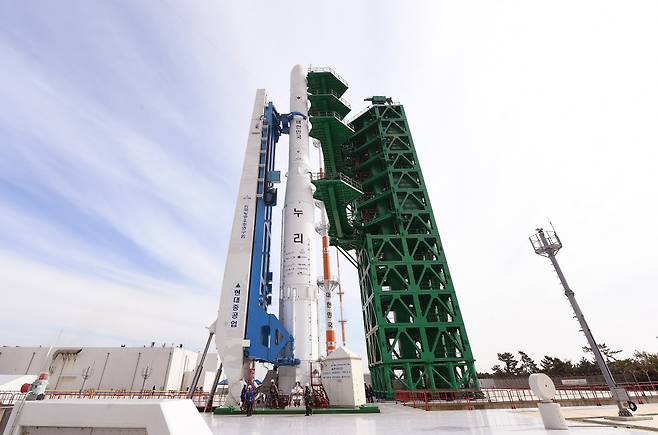
South Korea’s first domestically developed satellite launch vehicle has been moved to the launch pad for liftoff as scheduled on Thursday, the Ministry of Science and ICT said Wednesday.
As favorable weather is forecast for Thursday, the launch will go on as scheduled at the Naro Space Center in Goheung, South Jeolla Province, the ministry added.
The three-stage liquid fuel rocket, also known as Korean Space Launch Vehicle II or Nuri, will blast off at 4 p.m., with the moment to be livestreamed on various platforms including the ministry’s YouTube channel.
At 7 a.m. Wednesday, the fully assembled Nuri was carried out from the hangar and rolled over to the launch pad. The rocket was moved at 1.5 kilometers per hour and arrived at the launch pad in an hour and a half.
It was then erected and fastened to the launch pad to make sure it can withstand winds that might push the rocket.
The bottom part of the rocket was anchored with a set of four holding devices to keep the launch vehicle in place on the launch pad.
Nuri was then connected with umbilicals, which allow the flow of liquids, gases and electric power to the rocket, which is to travel into low orbit.
The Korea Aerospace Research Institute completed its tests Wednesday by checking telemetry and tracking equipment.
The launch-ready rocket will be fueled Thursday, KARI added.
The launch of Nuri, carrying a 1.5-ton dummy payload, is currently scheduled at around 4 p.m. The actual time will be announced an hour and a half prior to the launch.
If weather conditions are unfavorable, the launch could be delayed. Nuri has a launch window of about a week.
Thursday’s launch is the first in a series of tests planned for Nuri.
KARI has scheduled additional launches in the following years, regardless of the success of the current launch. The next launch has already been scheduled for May 19.
Korea started the Nuri rocket project in March 2010. In 2018, the country succeeded in launching a single-stage launch vehicle with a 75-ton liquid-fueled engine from the Naro Space Center. In March this year, KARI successfully completed a comprehensive combustion test of a qualification model of the Nuri rocket.
The current model is boosted by three-stage rockets. The first stage consists of four 75-ton thrust liquid-fueled rockets. This is attached to a single 75-ton rocket forming the second stage. The third stage consists of a 7-ton thrust rocket that will place the payload into orbit 600-800 kilometers high.
If launched successfully, Korea will become the world’s seventh country with independent capabilities to launch a satellite weighing over 1 ton into orbit from its own soil.
By Shim Woo-hyun(ws@heraldcorp.com)
Copyright © 코리아헤럴드. 무단전재 및 재배포 금지.