1 in 3 large companies has 'hereditary employment' rule
Eleven out of the 30 leading South Korean large companies have the so-called ‘hereditary employment’ provision in a collective agreement between labor and management, in which a company must preferentially hire children of union members, an analysis showed.
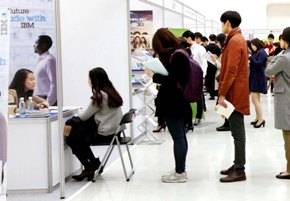
The surveyed companies are 18 manufacturers, five financial companies, four transportation and communications companies and three retailers. The 11 companies are: GS Caltex, SK Innovation, Kia Motors, Hyundai Heavy Industries, Hyundai Oilbank, LG Chem, GM Korea, Daewoo Shipbuilding & Marine Engineering, SK Hynix, Hyundai Steel Company and LG Uplus.
The preferential hiring violates the constitutional equal rights and freedom of occupation for those other than children of union members and goes against a principle of equal treatment under a framework act on employment policy and an employment security law. However, hiring family members of employees who suffer work-related accidents is an exception.
Lim Moo-song, an official of the ministry, stressed, “labor and management alike should take social responsibility for fixing irregularities that hamper fair competition, such as the hereditary employment,”

[ⓒ Maeil Business Newspaper & mk.co.kr, All rights reserved]
Copyright © 매일경제 & mk.co.kr. 무단 전재, 재배포 및 AI학습 이용 금지
- Kia's Gwangju No.1 plant crowned as best quality plant
- Money flood into equity funds on rate cut
- Gov't to open software and IT program to help humanities majors to land a job
- Seoul closer to high level greenhouse gas reduction
- KOSPI, KOSDAQ & FX RATE [06/25 Midday]
- 강경준, 상간남 피소…사랑꾼 이미지 타격 [MK픽] - 스타투데이
- AI가 실시간으로 가격도 바꾼다…아마존·우버 성공 뒤엔 ‘다이내믹 프라이싱’- 매경ECONOMY
- 서예지, 12월 29일 데뷔 11년 만에 첫 단독 팬미팅 개최 [공식] - MK스포츠
- 이찬원, 이태원 참사에 "노래 못해요" 했다가 봉변 당했다 - 스타투데이
- 양희은·양희경 자매, 오늘(4일) 모친상 - 스타투데이