Korean 'Rural-20' sites lure expats
OEAM, South Chungcheong Province No fees, no strict requirements. Just being a foreigner staying in Korea and a willingness to experience traditional customs and activities is all you need when booking a state-funded free trip to Korea's well-known rural villages.
The South Korean government ambitiously launched a rural tourism project called "Rural-20" early this year to promote Korea's representative 20 rural areas to expatriates in Korea, especially in 2010 when G20 Seoul Summit is to be held in the nation.
The Ministry for Food, Agriculture, Forestry and Fisheries, jointly with the Korea Rural Community Corp., has been running a "Rural-20 Supporter Program" since August for 2,100 expatriates until the end of November, giving them a chance to visit rural villages on day or overnight trips.
"Until now, only 1,200 foreigners have joined us. We're still receiving bookings from expats," said Ha Jee-eun, a food ministry deputy director who helped to organize a day-trip program for a group of multicultural families to Oeam Folk Village, located in Asan, South Chungcheong Province, on Nov. 2.
|
|
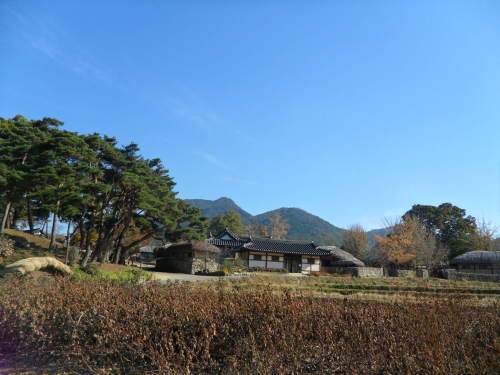
The front view of the Oeam Folk Village in Asan, South Chungcheong Province (Kim Yoon-mi/The Korea Herald) |
"There is no strict requirement. The Rural-20 tour program is open for all foreigners who are currently staying in Korea," she said.
The 20 rural sites were picked in January based on how they best represent characteristics of four themes ― Korea's original customs and cultures through "Experience Travel," magnificent nature and landscapes through "Nature Travel," long history and ancient remains through "Orient Travel" and the healthy food of the countryside through "Wellbeing Travel."
"Rural sites are not just for food production. They can be developed as great tour destinations to show the true aspects of Korean history and culture," said Yoo Jeong-bok, Minister for Food, Agriculture, Forestry and Fisheries, who visited Oeam Folk Village.
|
|
Yoo Jeong-bok (left), Minister for Food, Agriculture, Forestry and Fisheries, participates in a day-trip program to visit the Oeam Folk Village on Nov. 2. (Kim Yoon-mi/The Korea Herald) |
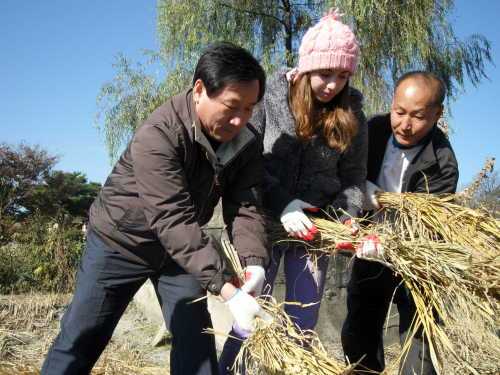
"I heard there are 200 foreigners visiting this village a week. We will enhance foreign language services to promote 'Rural-20' better," he said.
Rice-cake making, thatched roofing
Oeam Folk Village, designated by the government as No. 236 of valuable folk material, is listed as an "Orient Travel" tour destination for keeping its 500 years of history and lifestyle almost intact from the mid-Joseon era.
The small village, known for representing the Yean Lee clan, has 55 tile-roofed and thatched-roofed houses clustered together at the foot of Mount Seolhwa, about 8 kilometers from Asan.
At the mouth of the village sits a water mill, welcoming the foreign tour group.
A short stroll inside the village to the left takes you to a house where you can try your hand at making injeolmi, one of many types of Korean rice cake.
As the group of visitors gathered around the wooden pounding board, two men from the village brought out steamed glutinous rice prepared in advance and placed it on the board.
|
|
Two men demonstrate how to pound on steamed glutinous rice with mallets to make rice cake. (Kim Yoon-mi/The Korea Herald) |
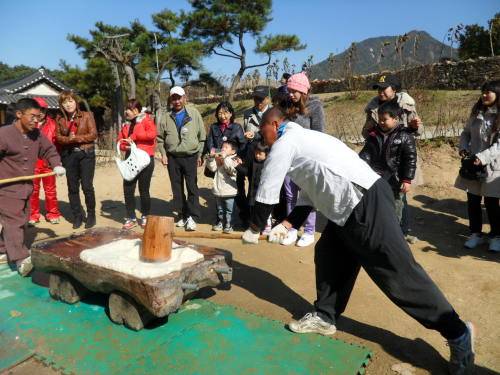
Then, they grabbed mallets and started pounding hard on the white rice.
Trying to imitate what the men just did, the visitors ― who were mostly women ― took turns doing the same.
"It's much harder than I thought. I guess something delicious cannot be easily made," said Sui Lihui, 31, a Chinese woman who joined the tour program with her 7-year-old daughter.
"I wanted to take my daughter out to a rural village before she enters elementary school next year. This is a great opportunity," she said.
When the pounding is done, the rice is transferred to another board covered with finely powdered dried beans. After the rice cake is fully coated, the visitors get to cut the rice cake with the rim of a plate, the traditional way of cutting rice cake. The visitors can taste the just-produced rice cake with a fresh bottle of sikhye, a traditional sweet Korean rice beverage.
Another tour program includes thatching a roof with new rice straw, which must be done every year to prevent leaking from the rain.
After covering the roof with bundles of rice straw in multiple layers, visitors learn how to twist rice straw to make ropes for holding the roof tight.
Then, the visitors are encouraged to help raise the sparring that runs along the top of the thatch, called "Yonggosoe," onto the top of the house to complete the roofing.
Other experiences include threshing rice and making hand mirrors with Korean paper and glue paste.
For information about Oeam Folk Village, visit www.oeammaul.co.kr or call Traditional House Lodging at (054) 541-0848.
For information about Rural-20 tour program or reservations, visit the Rural-20 homepage at www.rural20.kr, which is available in three languages English, Japanese and Chinese.
By Kim Yoon-mi (yoonmi@heraldm.com)
Copyright © 코리아헤럴드. 무단전재 및 재배포 금지.