AI bubble fears trigger W2.5tr foreign 'panic sell' on Kospi
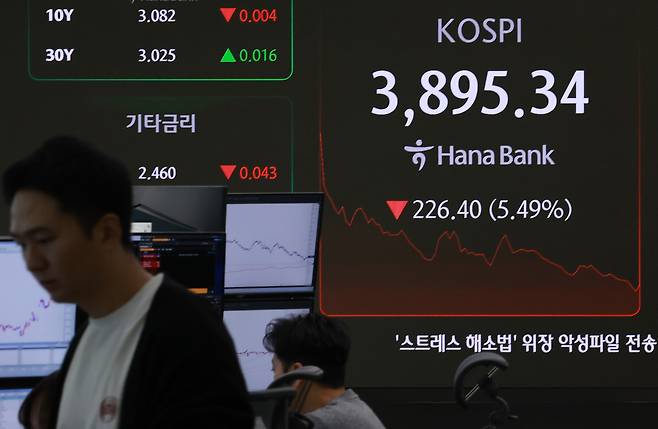
South Korean stocks tumbled Wednesday as foreign investors dumped 2.5 trillion won ($1.73 billion) worth of shares on the benchmark Kospi, spooked by mounting fears that the AI boom has pushed global equity valuations too far.
With offshore investors dumping nearly 5 trillion won worth of shares from the main bourse over just two sessions, chip shares plunged and the local won's value per dollar was dragged to a nearly seven-month low.
The benchmark Kospi closed at 4,004.42, losing 117.32 points, or 2.85 percent from the previous day.
After opening at 4,055.47, down 1.61 percent, as it priced in overnight losses on Wall Street, a wave of panic selling hit the market, dragging the index down to as low as 3,867.81. Foreign investors sold a net 1 trillion won on the bourse in just an hour.
The selling spree triggered a sidecar on the Kospi on the selling side — a five-minute halt on program sell orders — at 9:36 a.m. It was the second activation this year, following the one on April 7, when US tariff threats rattled markets.
Foreign investors led the plunge, dumping a net 2.5 trillion won of shares on the main bourse as of the market's close. Following a 2.2 trillion won sell-off the previous session, overseas traders have offloaded Kospi shares amounting to nearly 5 trillion won in just two sessions.
Institutional investors added downward pressure on the bourse by net selling 79 billion won.
Though retail investors scooped up 2.6 trillion won worth of shares, the buying pressure was not enough to keep the market afloat.
"The massive sell-off suggests that foreigners have begun to take a bearish position on the Korean stock market," Kiwoom Securities analyst Han Ji-young said.
“In the short term, heightened macroeconomic uncertainty and volatility in US AI-related stocks could trigger additional foreign sell-offs, especially in semiconductor shares that have seen sharp gains so far," Han added.
Pricing in the AI bubble fears, chipmakers Samsung Electronics and SK hynix — which had posted strong gains earlier this week — pared some of their recent advances.
Samsung Electronics fell to as low as 96,700 won during intraday trading, marking a sharp drop from its recent high of 112,400 won, while SK hynix slipped to 532,000 won, down from its record high of 624,000 won.
Samsung Electronics and SK hynix both partially recovered as of closing, wrapping up at 100,600 won and 579,000 won, respectively.
The secondary Kosdaq market closed at 901.89, shedding 24.68 points, or 2.66 percent, from the previous session. With the index falling to as low as 871.79 during trading, the bourse operator activated a sidecar on the selling side at 10:26 a.m., marking the first activation in 15 months.
The decline in the local stock market followed overnight losses on Wall Street, where concerns about overvaluation in AI-related stocks weighed on investor sentiment.
Foreign investors' selling frenzy brought down the local won's value against the dollar to its weakest in nearly seven months.
The Korean won was quoted at 1,449.4 per dollar at the close of daytime trading. After opening at 1,443.5 per dollar, the won struggled to keep its value against the greenback, hitting the 1,450 level just before closing.
It was the first time for the won to touch the 1,450 level since April 11, when it depreciated to 1,457.2 per dollar.
“If foreign selling in the local stock market deepens, the won's value per dollar is likely to further weaken to the upper band of the 1,440-won range in the short term," Wi Jae-hyun, an analyst at NH Futures, said, adding that forex authorities are likely to step up in such a case to limit further devaluation of the local currency.
Copyright © 코리아헤럴드. 무단전재 및 재배포 금지.