Patriots, THAAD may be shipped to Middle East. Is South Korea safe without them?
전체 맥락을 이해하기 위해서는 본문 보기를 권장합니다.
"In the past, there were rotational deployments," Park said. "When air defense assets were temporarily relocated, other capabilities such as additional fighter aircraft were brought in to maintain overall combat readiness."
"Even if some air defense systems such as Patriot batteries were temporarily moved, it would not fundamentally undermine deterrence against North Korea."
이 글자크기로 변경됩니다.
(예시) 가장 빠른 뉴스가 있고 다양한 정보, 쌍방향 소통이 숨쉬는 다음뉴스를 만나보세요. 다음뉴스는 국내외 주요이슈와 실시간 속보, 문화생활 및 다양한 분야의 뉴스를 입체적으로 전달하고 있습니다.
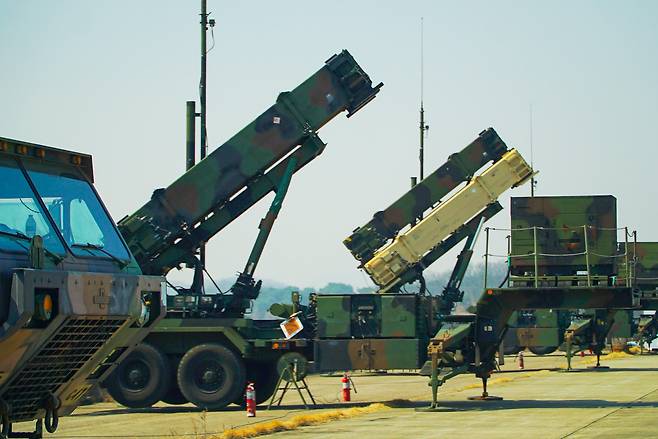
Speculation about the possible redeployment of US missile defense assets stationed in South Korea to the Middle East has been growing, along with concerns about the potential impact such a move could have on the country’s defense posture.
The speculation comes as Washington seeks to reinforce missile defense coverage for US bases and allies in the Middle East, amid a possibly prolonged confrontation with Iran.
The Washington Post reported Monday, citing US officials, that the Pentagon is moving parts of the Terminal High Altitude Area Defense system stationed in South Korea to the Middle East to strengthen its regional missile defense network.
The report follows earlier signs that Patriot air defense systems deployed under US Forces Korea may also have been relocated in recent weeks, with several US military transport aircraft observed departing Osan Air Base in Pyeongtaek, Gyeonggi Province.
The developments have drawn attention in Seoul, as they involve some of the most advanced missile defense assets stationed on the Korean Peninsula. While the government has rejected concerns about weakening defense posture, experts appear divided over the potential impact of such a move.
Yoo In-seok, a professor of military studies at Yeungnam University, told The Korea Herald that the absence of THAAD could significantly reduce South Korea’s upper-tier missile defense capability against North Korean missile threats.
“South Korea’s current Korea Air and Missile Defense system mainly covers lower and midaltitude interception,” Yoo said.
“If THAAD were removed, the upper-tier interception capability would effectively disappear, which could weaken deterrence against North Korea’s missile threats.”
Yoo, a retired Army colonel who previously served in the Joint Chiefs of Staff’s nuclear and weapons of mass destruction response planning division, also warned that Seoul should pay close attention to Washington’s concept of “strategic flexibility,” under which US forces stationed overseas may be redeployed to other regions depending on operational needs.
The Patriot and Terminal High Altitude Area Defense systems play different roles in the layered missile defense architecture on the Korean Peninsula, alongside South Korea’s own missile defense network known as the Korea Air and Missile Defense.
Patriot missile systems, which South Korea and USFK have operated since the 1990s, are designed to intercept short- and medium-range ballistic missiles at lower altitudes.
The THAAD system, deployed in South Korea in 2017 at a US base in Seongju, North Gyeongsang Province, is intended to intercept ballistic missiles at much higher altitudes — typically between 40 and 150 kilometers above the ground — forming the upper layer of missile defense.
According to the Defense Acquisition Program Administration, South Korea currently operates missile defense systems mainly for low- and midaltitude interception, including Patriot missiles and the domestically developed Cheongung series.
A dedicated upper-tier interception capability, however, is not currently operated by South Korea and is largely provided by the US-operated THAAD battery.
Seoul plans to fill that gap in the early 2030s with the deployment of a long-range surface-to-air missile system known as L-SAM, while the Navy is also expected to introduce SM-3 interceptors aboard Aegis destroyers around the same period.
However, other experts say concerns about an immediate weakening of deterrence may be overstated.
Park Yong-han, an associate research fellow at the Korea Institute for Defense Analyses, noted that US military deployments often operate under a rotational concept.
“In the past, there were rotational deployments,” Park said. “When air defense assets were temporarily relocated, other capabilities such as additional fighter aircraft were brought in to maintain overall combat readiness.”
Shin Beom-cheol, former vice defense minister and now head of the Center for Korean Peninsula Strategy at the Sejong Institute, said deterrence on the Korean Peninsula does not rely solely on USFK’s air defense systems.
“USFK consists of a wide range of forces with different roles,” Shin said.
“Even if some air defense systems such as Patriot batteries were temporarily moved, it would not fundamentally undermine deterrence against North Korea.”
Shin added that US military capabilities in the broader Indo-Pacific region, including forces stationed in Japan, also form part of the deterrence architecture against North Korean threats.
“There are multiple layers of deterrence,” he said.
So far, neither Seoul nor Washington has officially confirmed the redeployment, though neither side has categorically denied the reports.
President Lee Jae Myung acknowledged the issue during a Cabinet meeting Tuesday, saying South Korea has conveyed its concerns but ultimately cannot prevent the United States from redeploying its forces based on its own military requirements.
“We have conveyed our concerns regarding the removal of certain air defense systems,” Lee said, according to the presidential office.
“But it is also the reality that the United States may redeploy its assets based on its own military needs.”
Copyright © 코리아헤럴드. 무단전재 및 재배포 금지.