"Trying Out New Technologies Firsthand"
'Best Lawyer' – Jaewoo Kwak, Attorney at Lee & Ko
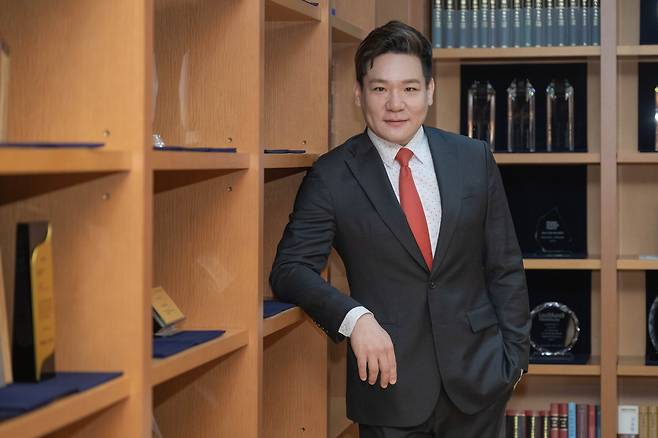
Attorney Jaewoo Kwak is an intellectual property (IP) specialist with an engineering background, having graduated valedictorian from Seoul National University's Department of Industrial Engineering.
He handles civil and criminal litigation related to intellectual property—including patents, trademarks, copyrights, and licensing—and currently serves as Head of the Game Practice Team and Deputy Head of the Discovery Practice Team at Lee & Ko.
He is also actively engaged in unfair competition law and the entertainment sector, having led high-profile matters such as the "BTS Unauthorized Photobook Injunction" case, widely recognized as the landmark Supreme Court ruling on the "unauthorized use of another's achievements" under the Unfair Competition Prevention Act.
In the "2026 Korea Law Firm Consumer Report," he earned 22 votes in the "Best Lawyer" evaluation, recognized for his deep understanding of current issues, fresh perspectives in providing alternatives, and strong client communication skills.
Q: You received high praise for your deep understanding of the IT and IP industries.
A: I majored in industrial engineering. Unlike traditional electrical or computer engineering, industrial engineering examines not only the technology itself but also its business aspects. I naturally grew to analyze not just what a technology means, but what value it holds for a client's business, and what impact legal decisions based on that business model will bring. Since law firm practice is ultimately about finding solutions together rather than merely solving legal puzzles, I think that background translated into positive evaluations.
Q: How do you keep up with new technologies?
A. In the IP field, one must be able to comprehend technical documentation including patents and trade secrets, making it essential to constantly track technological trends. The same holds true for the content industry. Both technology and content evolve so rapidly that clients notice immediately if you miss a trend.
I place great importance on firsthand experience. When a new technology emerges, I try using it myself, and I regularly attend movies, plays, and musicals. Engaging directly with industry professionals is also critical. An IP lawyer's most vital trait is intellectual curiosity. Without curiosity, client visits will inevitably dwindle. Cultural activities not only help in understanding the content itself but also serve as a source of mental energy."
Q: How do you explain complex technical and legal issues in simple terms?
A: Industrial engineering is the study of whole systems; in engineering schools, it is often likened to conducting an orchestra. After becoming a lawyer, I continue to serve as a bridge and coordinator among diverse stakeholders, including engineers, judges, and in-house counsel.
I frequently communicate directly with engineers. I believe that if an explanation sounds overly complicated, it means I haven't fully grasped it myself. Since my background isn't strictly in law, I have developed a habit of explaining legal terminology as simply as possible. Knowledge becomes useless if it fails to help the client understand or persuade the court. Legal terminology must be easy for clients to grasp, while technical terminology must be easy for judges to digest.
To achieve this, I actively utilize visual aids—including 2D, 3D, and video formats—along with appropriate analogies. Analogies allow the listener to understand issues through familiar concepts. While overly philosophical or literary metaphors should be avoided, well-chosen analogies are highly effective in driving comprehension.
Q: What is your secret to assisting corporate decision-making?
A: In corporate legal advisory, single 'right answers' are rare. Option A may be best in one context, while Option B might be ideal in another. To assist clients in their decision-making, I try to present multiple feasible choices without locking myself into a predetermined view that 'it must be thought of this way.' Experiencing a wide range of clients and cases teaches you that problems are rarely that simple. Rigid frameworks lead to self-imposed limitations. I believe law firm attorneys, in particular, need flexible thinking.
Q: How do you deliver prompt, seamless legal opinions?
A: Meeting deadlines is baseline practice in a law firm. Beyond simply keeping time, I strive to deliver optimal solutions precisely when the client needs them. Clients do not come looking for a single lawyer alone; they seek the entire law firm, which operates like a full-service department store. Even for problems I cannot solve individually, I believe it is vital to connect clients with the right internal experts and help them find the solution.
Q: How do you prioritize your workload?
A: Upon returning from meetings, dozens of emails are often waiting in my inbox. I handle quick tasks first—a process of 'pruning'—before focusing deeply on major deliverables. When reviewing contracts or legal briefs, I look at the overall structure first. If a structure is lacking, I draft a table of contents myself to see the forest before the trees. I always advise junior associates to draft a table of contents first upon receiving a contract. While it may seem time-consuming at first, building that habit significantly boosts work efficiency in the long run."
Seo-Ha-Yeon, Reporter