The president’s economic perception that the high exchange rate is temporary and the jeonse housing crunch is natural (KOR)
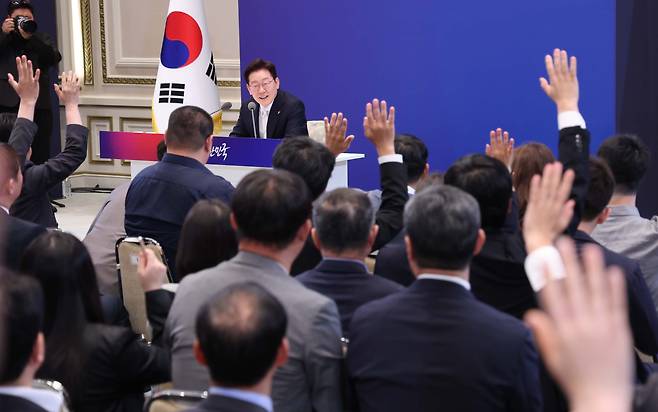
On Monday, President Lee Jae Myung presented an economic vision of making Korea a “global powerhouse in industries with overwhelming technological gaps” at a press conference. He also said he would unveil large-scale investment projects that would help discover and foster next-generation growth engines beyond semiconductors while ensuring the benefits of growth are broadly shared. This is a desirable direction at a time when our economy’s potential growth rate is steadily declining. At the same time, the government should no longer delay and instead must move proactively on regulatory innovation and labor market reform, which are obstructing innovation and growth.
The problem is that the president’s understanding of major economic issues — including the “three highs” of a strong dollar-won exchange rate, high inflation and high interest rates, as well as the jeonse (lump-sum deposit) housing shortage — gives the impression of being overly optimistic or fragmentary. President Lee said of the exchange rate situation, “It is true that it is high, but I believe it is temporary.” He also said, “Rising stock prices have become the reason the exchange rate has risen.” This is similar in context to recent remarks by presidential policy chief Kim Yong-beom, who described the three highs as “the cost of success.” It is true that the recent surge in the valuation of Korean stocks, which has led foreign investors to sell shares day after day in order to rebalance their portfolios, has been the direct trigger for the recent rise in the exchange rate. But underlying the high exchange rate are also structural factors such as the prolonged gap in growth rates and interest rates between Korea and the United States, as well as increased overseas investment by companies.
Moreover, concerns are growing that the shock from the three highs could intensify in earnest as expectations build for a U.S. benchmark rate hike. With the semiconductor rally immediately losing steam, the Kospi plunged 8.29 percent on Monday, collapsing below the 7,500 level in one stroke. The drop was unusually steep compared with the fall in the market in Japan at 3.85 percent and Taiwan at 3.48 percent.
This reflects excessive concentration in semiconductors, along with a surge in debt-financed stock investing and leveraged investments by individuals that have heightened volatility. Yields on three-year and 10-year Korean Treasury bonds also rose to their highest levels of the year on Monday. Along with rising U.S. interest rates, President Lee’s remarks are said to have had an impact as well. Regarding the use of excess tax revenue, President Lee said, “Having no government debt is not an absolute solution,” which the market interpreted as meaning there was no intention to use the extra tax revenue to repay government bonds.
The overall direction of real estate policy, centered on regulations and taxes, also appears unlikely to change much. Regarding the jeonse crisis in particular, which has become a major problem, he said, “Jeonse is a kind of private finance, and it is now disappearing,” adding, “A process of normalization is necessary.” That may prove true in the long run, but it is questionable whether he fully recognizes the plight of ordinary homeless people who are in distress as jeonse prices soar and jeonse listings sharply decline.
The three highs and the jeonse crisis are livelihood issues that inflict particular pain on ordinary people. Rather than appearing relaxed on the assumption that burdens to livelihoods will soon pass, the government should actively manage the risks and come up with closely tailored measures.
고환율은 일시적, 전세난은 정상화라는 대통령의 경제 인식
어제 이재명 대통령은 기자회견에서 ‘초격차 산업 강국’이란 경제 비전을 제시했다. 반도체를 이을 차세대 먹거리 발굴·육성과 함께 성장의 온기가 고루 퍼지게 할 대규모 투자 프로젝트도 내놓겠다고 했다. 우리 경제의 잠재성장률이 갈수록 하락하고 있는 상황에서 바람직한 방향이다.
문제는 고환율·고물가·고금리의 ‘3고’와 전세난 등 주요 경제 현안과 관련된 대통령의 인식이 지나치게 낙관적이거나 단편적이란 인상을 주고 있다는 것이다. 이 대통령은 환율 상황에 대해 “높은 것은 사실이나 일시적이라고 본다”고 말했다. 또 “주가가 오르는 게 환율이 오르는 이유가 됐다”고도 했다. 한국 주식 평가액 급증에 외국인이 연일 주식을 내다 팔고 있는 게 최근 환율 상승의 직접적 트리거가 된 건 사실이다. 하지만 고환율의 근저에는 장기간 이어진 한·미 성장률과 금리 격차, 기업의 해외 투자 증가 등 구조적 영향도 있다. 게다가 지금은 미국의 기준금리 인상 전망에 3고의 충격이 본격화할 수 있다는 우려가 커지는 상황이다. 당장 반도체 랠리에 제동이 걸리면서 어제 코스피 지수는 8.29% 폭락했다. 일본(-3.85%), 대만(-3.48%) 등에 비해 하락 폭이 유난히 크다. 지나친 반도체 쏠림에다 개인의 ‘빚투’와 레버리지 투자가 급증하며 변동성을 키운 영향이다. 어제 국고채 금리도 연중 최고치로 올랐다. 미국 금리 상승과 함께 이 대통령의 언급도 영향을 줬다고 한다. 이 대통령은 초과세수 활용과 관련해 “빚이 없는 게 절대 진리는 아니다”고 했는데, 이에 대해 초과세수를 국채 상환에는 쓸 의사가 없다고 시장이 해석했다는 것이다.
규제와 세금 위주의 부동산 정책 기조 역시 큰 변화가 없을 것으로 보인다. 특히 문제가 되는 전세난에 관해선 “전세는 일종의 사금융인데 지금 사라져가는 추세”라며 “정상화되는 과정이 필요하다”고 언급했다. 장기적으로는 그렇게 될지 모르겠으나 전셋값 급등과 전세 물건 급감으로 발을 구르고 있는 무주택 서민들의 처지를 충분히 인식하고 있는지 의문이다. 3고와 전세난은 서민들에게 특히 고통을 주는 민생 문제다. 곧 지나갈 것이라고 여유를 보일 게 아니라 적극적으로 위험을 관리하고, 촘촘한 대책을 짜야 한다.
Copyright © 코리아중앙데일리. 무단전재 및 재배포 금지.