Can South Korea afford to deploy naval forces to the Strait of Hormuz?
전체 맥락을 이해하기 위해서는 본문 보기를 권장합니다.
"The Dae Jo-yeong destroyer does not carry assets specifically designed to counter those threats."
"South Korea's naval posture is primarily focused on deterrence against North Korea," he said. "Sending assets to a completely different operational theater could place strain on the Navy's force structure."
이 글자크기로 변경됩니다.
(예시) 가장 빠른 뉴스가 있고 다양한 정보, 쌍방향 소통이 숨쉬는 다음뉴스를 만나보세요. 다음뉴스는 국내외 주요이슈와 실시간 속보, 문화생활 및 다양한 분야의 뉴스를 입체적으로 전달하고 있습니다.
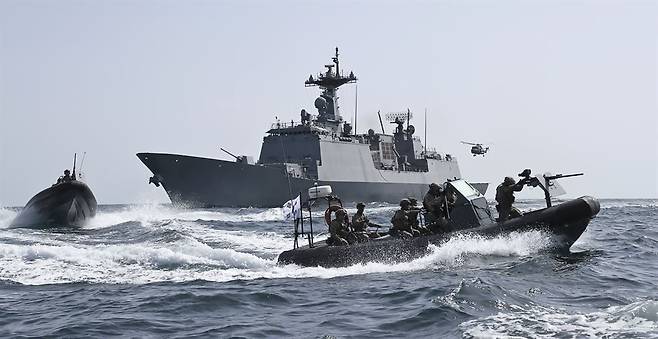
Questions are rising over Seoul’s naval capabilities, as well as its political will, to support US operations in the Middle East following US President Donald Trump’s call for allies’ involvement.
While the South Korean government remains cautious — saying no official request has been made beyond Trump’s remarks — attention has turned to whether the Korean Navy could realistically contribute forces if such a request were made.
The Navy, for its part, has declined to comment on the matter, saying only that any deployment decision would require a government-level policy determination.
Among the options being discussed is the Cheonghae Unit, South Korea’s antipiracy naval task force currently operating in waters near the Gulf of Aden.
The unit has rotated destroyers to the region every six months since 2009 as part of antipiracy operations protecting South Korean and international shipping. Its current contingent is built around the 4,400-ton Chungmugong Yi Sun-sin-class destroyer Dae Jo-yeong (DDH-977), carrying about 260 personnel, including naval special warfare troops.
In January 2020, South Korea temporarily widened the unit’s mission area to include the Strait of Hormuz following escalating tensions between the United States and Iran. However, experts say the unit’s current configuration may not suit the envisioned mission if tensions in the Strait of Hormuz escalate.
Yang Seong-sil, a professor of military studies at Korea Maritime and Ocean University, said the threat environment in the Strait of Hormuz differs significantly from antipiracy operations in the Gulf of Aden.
“If a warship enters the Strait of Hormuz under the current situation, it could be exposed to various Iranian military threats such as naval mines, submarines, drones and missiles,” Yang said.
“The Dae Jo-yeong destroyer does not carry assets specifically designed to counter those threats.”
Yang is a retired Navy lieutenant commander who previously served as an operational analysis officer at the Navy’s Force Analysis, Test and Evaluation Group.
While the destroyer is equipped with air-defense systems including SM-2 surface-to-air missiles, RIM-116 short-range missiles and the 30-millimeter Goalkeeper close-in weapon system, Yang said these are primarily designed to defend against aircraft and limited threats rather than sustained missile attacks.
He also noted that the ship may face limitations in responding to Iranian drone threats, which have become a key component of Tehran’s asymmetric warfare capabilities.
Yang added that while the Cheonghae Unit conducts basic air-defense drills before deployment, systematic counter-drone training has not been a major focus, as pirate groups in the Gulf of Aden rarely use drones.
Deploying more specialized assets such as mine countermeasure vessels or dedicated counter-drone platforms would also be difficult given the distance involved, he said.
According to Yang, it typically takes around 30 days for a South Korean destroyer to reach the Middle East, highlighting the logistical challenges of deploying forces far beyond the Navy’s usual operational radius.
“South Korea’s naval posture is primarily focused on deterrence against North Korea,” he said. “Sending assets to a completely different operational theater could place strain on the Navy’s force structure.”
The discussion comes as Washington continues to step up calls for allies to contribute to maritime security in the Gulf.
Trump on Monday again urged allied countries to send forces to help secure shipping lanes in the Strait of Hormuz, arguing that the United States has long provided security for its partners.
“We have some countries where we have 45,000 soldiers protecting them,” Trump was quoted as saying. “And when we ask, ‘Do you have any mine sweepers?’ they say, ‘Well, we’d rather not get involved.’”
The figure cited by Trump appears to refer to US troop levels in South Korea, which currently stand at about 26,500 personnel.
Seoul has taken a cautious stance on the issue, as previous overseas troop deployments have often sparked domestic debate over the risks of casualties and potential entanglement in regional conflicts.
Yang said participation may ultimately depend on political will.
“If the government decides to proceed, solutions could be found,” he said. “But South Korea would likely participate only as part of a multinational coalition rather than acting independently.”
He added that Seoul must also consider its broader diplomatic balance.
“South Korea does not have a traditional adversarial relationship with Iran,” Yang said. “A degree of strategic distance and balance will be necessary.”
Park Yong-han, an associate research fellow at the Korea Institute for Defense Analyses, said Seoul would ultimately make its decision based on national interests, though the Navy’s operational constraints could limit its options.
“South Korea effectively has only three Aegis destroyers that could be considered deployable assets, and not all of them are available at any given time,” Park said.
"Under normal rotation cycles, roughly one-third of the fleet is operational while others are undergoing training or maintenance. If one were deployed abroad, only two would remain available for domestic missions.”
Still, Park said a limited deployment could be considered if the government determines it serves South Korean interests.
He noted that while South Korea would be unlikely to conduct mine-clearing operations independently, a single Aegis destroyer could still contribute by monitoring maritime activity and deterring additional mine deployment in the strait.
“If the government decides to proceed, the gap could potentially be mitigated through closer coordination with US Forces Korea,” he said. “For example, if South Korea’s air defense posture were affected, additional US reconnaissance or surveillance assets could help compensate.”
Attention is also likely to turn to the National Assembly, which would play a key role in approving any major overseas troop deployment.
A National Assembly official, speaking on condition of anonymity, said the issue requires careful review rather than outright rejection.
“The United States is our closest ally, so we cannot simply dismiss such requests,” the official said. “The first step is to examine what capabilities the military could realistically deploy and then consider the available options.”
Copyright © 코리아헤럴드. 무단전재 및 재배포 금지.