Twenty years on, murder of 8-year-old boy in Ulsan apartment fire remains shrouded in smoke
![The layout of the apartment in Ulsan where eight-year-old Park was discovered on Sept. 6, 2006. [KOREA JOONGANG DAILY]](https://img3.daumcdn.net/thumb/R658x0.q70/?fname=https://t1.daumcdn.net/news/202603/17/koreajoongangdaily/20260317070256159pxlw.jpg)
[KOREAN CRIME FILES #16]
Behind the glitz and glamour seen in pop culture, Korea’s grimmest and most harrowing crime stories, some more well-known than others, continue to haunt society today. The Korea JoongAng Daily takes a deep dive into some of these stories, sharing a glimpse into the darker side of society as well as the most up-to-date known facts. — Ed.
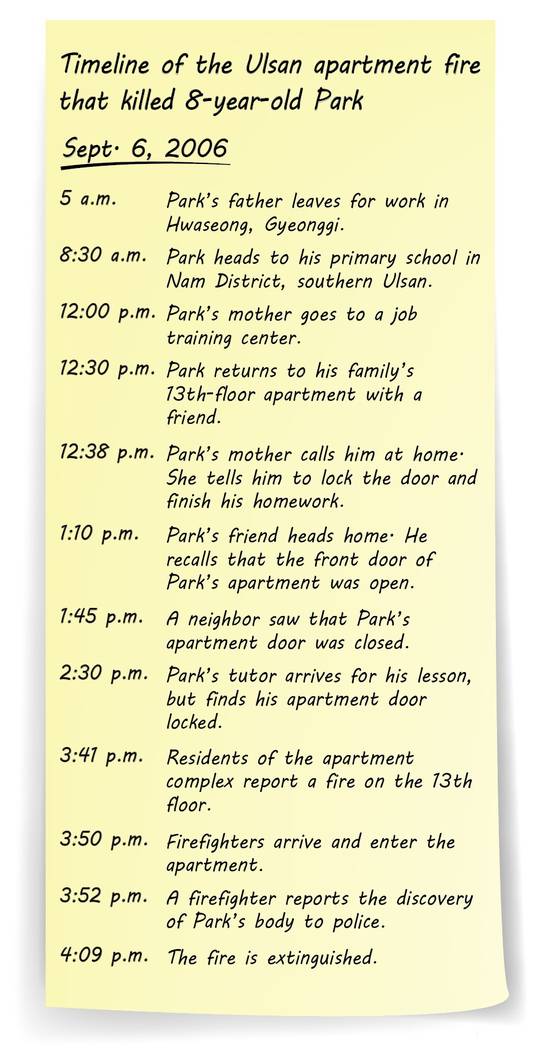
At 12:38 p.m. on Sept. 6, 2006, the mother of eight-year-old Park Jeong-ho (pseudonym) called home from a job training center.
Her husband had left for work in Hwaseong, Gyeonggi, at 5 a.m., leaving their son to his own devices for most of the day. Since Park would be alone in the family’s 13th-floor apartment in Ulsan that afternoon, she wanted to make sure he was safe.
“Don’t forget to lock the door and finish your homework before your tutor arrives,” she told him. Park, who was at home with a friend visiting after school, responded, “Yes, mother.”
It was the kind of everyday conversation between mother and son that suggested nothing was awry. When Park’s mother hung up, she had little reason to think it would be the last time she would hear his voice.
Less than four hours later, firefighters dispatched to the apartment after a fire was reported there made a chilling discovery inside: Park’s body, beaten and bound.
As police began investigating the crime, questions abounded. Why was the boy attacked, and how did his assailant enter the apartment in the first place?
Fire on the 13th floor
The first sign that something was amiss on the 13th floor was smoke emanating from the Park family’s apartment.
Residents of the building reported the acrid smell at 3:41 p.m., just three hours after Park’s mother had called him.
At first, the fire appeared to be accidental — the sort of household blaze sparked by an appliance or gas leak. Firefighters pumped water into the apartment as thick gray fumes billowed into the communal hallway.
Once the flames were under control, firefighters entered to check whether anyone remained inside.
There, in the larger of the apartment’s two bedrooms, they found Park. He was lying on the floor, his wrists tied together and his mouth covered with green tape. Nearby lay a burned baseball bat, a blackened kitchen knife and a roll of tape.
![A police officer ducks under crime scene tape restricting access to the burnt out apartment in Ulsan in September 2006. [SCREEN CAPTURE]](https://img4.daumcdn.net/thumb/R658x0.q70/?fname=https://t1.daumcdn.net/news/202603/17/koreajoongangdaily/20260317070257510ahts.jpg)
When the smoke cleared
The discovery of the boy was reported to police by one of the firefighters at approximately 3:52 p.m.
Initially, Park appeared unharmed by the fire itself. Firefighters carried him out of the scorched apartment and tore away the green tape that bound him. It was only then, as they checked his vitals, that they realized he was already dead.
According to the autopsy, the immediate cause of death was asphyxiation, although the examination also revealed that he had suffered a blunt-force injury to the back right side of his head, along with signs of brain trauma consistent with a strike from a heavy object.
The coroner found soot in Park’s airway, suggesting that the boy had still been breathing — albeit unconscious — when the fire began. Given the items found next to his body, investigators surmised that the unknown intruder likely threatened the eight-year-old with a knife, clubbed him on the head with a bat, restrained him with tape and then set the residence ablaze.
The assailant appeared to have started the fire in two separate places inside the apartment: the large bedroom, where Park was found, and the smaller bedroom close to the front door, which was locked when firefighters arrived.
Investigators later concluded that the assailant used a key, which was found atop a shelf by the entrance, to lock that door — most likely in order to delay notice of the fire.
Narrow gap in time
As investigators pieced together the final hours of Park’s life, witness statements narrowed the likely window during which the assault and arson took place to less than an hour.
The friend who was with Park in the early afternoon told detectives he left the apartment around 1:10 p.m. He recalled that Park was watching television with the front door wide open when he left.
For anyone watching the 13th-floor apartment from outside, it would have been easy to see that it was open. The building — built in the early 1990s — featured open-air walkways with railings that ran the length of every floor, with the entry of each unit facing outward.
This configuration allowed a neighbor living in another building in the same complex to see that Park’s front door was open around 1:45 p.m. But when she looked out her window 50 minutes later, she saw it had been closed.
Likewise, Park’s tutor found the door locked when she arrived for her lesson with the boy at 2:30 p.m. After knocking and receiving no response, she left a note and departed for her next lesson.
Based on these accounts, police concluded that Park was most likely attacked between 1:45 p.m. and 2:30 p.m., a narrow 45-minute window during which he was alone and the apartment was shut.
A crime of opportunity?
What has haunted Park’s parents since his death is the mystery of why their son left their front door unlocked.
Given that multiple witnesses confirmed the door remained open well into the early afternoon, police concluded that the intruder entered the apartment due to Park's lapse in caution.
However, Park’s body showed few signs that he had fought his assailant, such as foreign DNA under his fingernails or injuries indicating resistance.
Investigators considered whether the assailant might have been someone familiar to him — someone whose presence would not have immediately frightened the child.
Police explored personal grudges, school conflicts and family-related disputes but found no viable suspects. By all accounts, the boy was quiet but well adjusted, and his parents were not known to have conflicts that might have led to violence. All visitors to the apartment also had alibis for the 45-minute window during which Park was likely attacked.
Attention then shifted to the possibility that the defenseless Park was set upon by a burglar.
However, the decade-old apartment complex lacked security features commonly found in newer buildings, such as CCTV cameras in communal areas, which would have recorded the entry of any unwelcome visitors. Further, the building’s public entrances could be opened without passcodes or key cards. Anyone entering would have faced minimal obstacles or surveillance.
One sign that the attack took place in the context of a robbery was the disappearance of five pieces of gold jewelry belonging to Park’s mother.
The stolen items, which included an engraved gold bracelet, a gold medallion, a gold cell phone keychain and two gold bracelets, were taken from a dressing cabinet drawer that the intruder had ransacked.
However, other clues suggested that theft had not been the main purpose of the crime. Spare cash in the apartment was left undisturbed, as was the gold necklace around Park’s neck.
To investigators, the selective theft suggested the jewelry might have been taken almost as an afterthought.
Clues dissolved by fire and water
Whatever the motive of the boy’s assailant, firefighting efforts resulted in the loss of most forensic evidence before detectives could properly investigate the scene.
Water from hoses washed away potential footprints, while heat and smoke degraded trace material that might otherwise have identified a suspect.
Although police collected the baseball bat, the kitchen knife and the duct tape used to bind the child, none of these items yielded usable DNA or fingerprints.
Police were also unable to find witnesses who had seen any unusual activity that day in the building, such as a suspicious person entering or leaving the apartment complex during the time frame in question.
As weeks turned into months, detectives narrowed their search for clues to the stolen gold jewelry, valued at roughly 1 million won ($700) at the time. Police distributed notices to pawn shops and jewelry stores across Ulsan and Busan, hoping that the items would surface and lead them to a suspect.
They never did.
Investigators also questioned more than a thousand people — including known offenders in the area and local youths — but the case produced no arrest and eventually no new leads.
![A police officer stands guard at the main entrance of the apartment block in Ulsan where the arson occurred in September 2006. [SCREEN CAPTURE]](https://img2.daumcdn.net/thumb/R658x0.q70/?fname=https://t1.daumcdn.net/news/202603/17/koreajoongangdaily/20260317070300290mwzo.jpg)
No closure
For Park’s parents, the passing of the years did little to soften their loss. They eventually moved from Ulsan to Busan, where acquaintances said they lived quietly and had no more children.
The apartment complex also changed as residents came and went. Over time, most had no knowledge that a child had once perished in a fire there.
Detectives who later revisited the case said that fading collective memory is one of the greatest obstacles in cold cases, especially as small but potentially crucial details slip through the cracks.
The only consolation for Park’s parents is that his case remains open.
Although the 15-year statute of limitations for his case was originally set to expire in September 2021, a 2015 amendment known as “Tae-wan’s Law” — named after the four-year-old victim of a 1999 acid attack by a yet-unknown passerby — removed time constraints on prosecuting murders whose statutes had not yet lapsed.
The change raised hopes that advances in forensic science or renewed public attention might one day lead to a breakthrough.
But so far, none has materialized.
A mystery shrouded in smoke
Nearly 20 years later, the case of the Ulsan apartment fire, and Park’s murder, still revolves around several unanswered questions.
Why did the boy leave the door open despite being told to lock it? Did he know the person who entered? If theft was the motive, why was cash left behind? And why would someone attack an eight-year-old child alone at home?
Criminal psychologists have said the crime carries traces of both panic and intent, leaving investigators uncertain whether they were dealing with a calculated killer or someone whose violence spiraled unexpectedly.
It is not impossible that someone still remembers an unusual jewelry sale, a visitor to the complex or a detail that seemed insignificant at the time. In cold cases, it is often that kind of forgotten fragment that can break years of mystery.
Until then, the apartment fire in Ulsan serves as both a reminder and a warning that, in the absence of surveillance, some murderers can vanish almost completely under the cover of fire and smoke.
BY MICHAEL LEE [lee.junhyuk@joongang.co.kr]
Copyright © 코리아중앙데일리. 무단전재 및 재배포 금지.
- Palisade recall after fatal accident estimated to cost Hyundai Motor 100 billion won
- Hyundai suspends Palisade sales in North America, Korea in wake of fatal accident
- ARMY dresses hanbok-chic, Seoul shops turn purple for BTS comeback
- Kim Jong-un warns of 'destructive strike' on enemies after North's rocket launcher test
- Home of mom charged with fatal child abuse filled with dead dogs, trash heaps
- 'When Life Gives You Tangerines,' 'Harbin' honored at Baeksang Awards — as it happened
- Netflix's 'KPop Demon Hunters' wins Oscar for Best Animated Feature Film
- Britain, Norway enter Korea-Germany bidding for $40B Canadian submarine project
- Trump meets Korean President Lee Jae Myung — as it happened
- Academy Awards faces backlash after cutting 'KPop Demon Hunters,' other acceptance speeches short