Army expands VR-based training for reservists
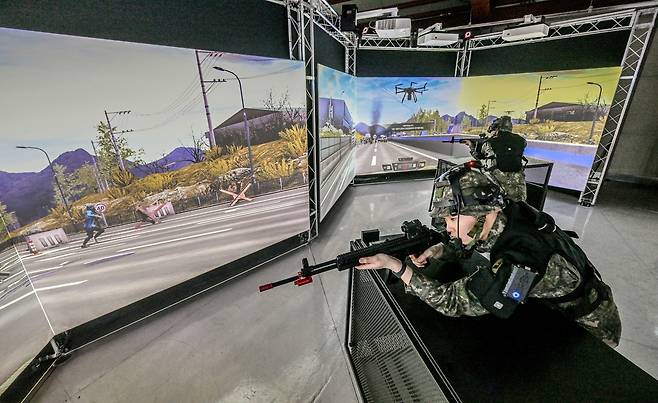
The Korean Army is expanding its use of virtual reality and digital monitoring technologies in reserve force training, as part of efforts to make drills more realistic and improve training effectiveness.
The Army said Friday it had unveiled a range of technology-integrated reserve training programs at the Seocho Reserve Training Center in southern Seoul, operated by the 52nd Infantry Division.
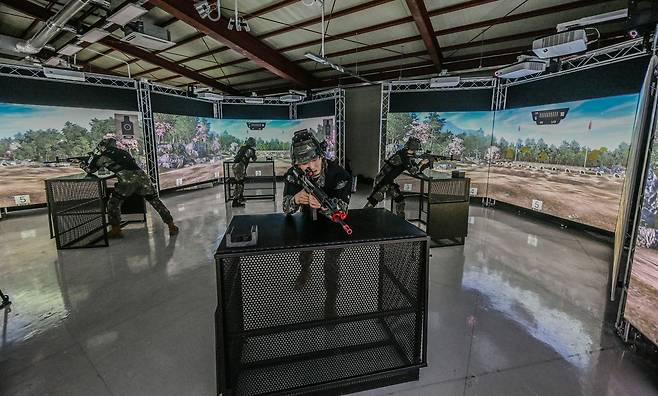
A centerpiece of the new system is a virtual reality shooting simulator that uses a three-sided multiscreen setup to recreate urban combat scenarios.
Reservists wear sensor-equipped helmets and electronic vests while holding mock rifles designed to replicate the recoil of real firearms. The screens display simulated battlefields modeled on real locations in Seoul, including Hannam Bridge, Seocho Station and Coex.
Participants must identify enemy combatants while avoiding civilians appearing in the virtual environment. When trainees are hit during the exercise, the electronic vest produces vibrations in the chest, shoulders or thighs, simulating battlefield injuries.
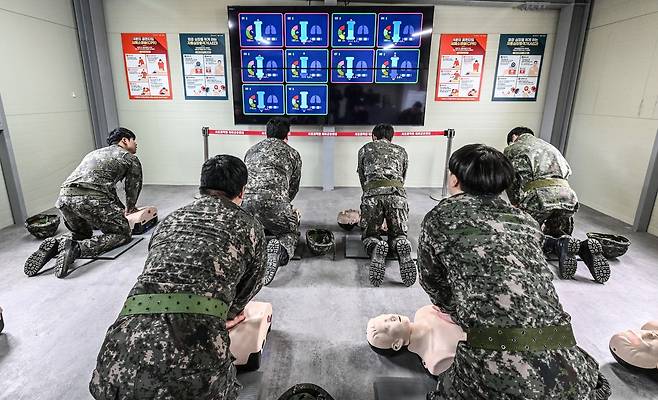
The Army has also upgraded CPR training by introducing digital mannequins equipped with sensors that measure the depth, speed and accuracy of chest compressions.
When trainees perform CPR, the mannequins transmit real-time data via Bluetooth to a central computer, allowing instructors to monitor each participant’s performance on a large screen.
The display shows whether compressions meet recommended standards, enabling trainees to immediately adjust their technique.
In the past, CPR practice relied largely on basic mannequins, making it difficult for trainees to determine whether they were performing the procedure correctly.
Officials said the move reflects the Army’s broader plan to operate reservists not merely as mobilization manpower but as a more capable reserve force amid a shrinking pool of military manpower.
“Reservists are an important pillar of national defense,” Col. Park Hyun-gyu of the Army Headquarters’ reserve training policy division said. “Through technology-integrated training centers, we aim to strengthen combat readiness while creating training environments that can coexist with local communities.”
Other components of the program include urban combat drills using the Multiple Integrated Laser Engagement System, which uses laser transmitters and sensors to simulate combat engagements without live ammunition.
Indoor live-fire ranges have also been introduced with automated target systems and safety features such as firearm locking devices and bulletproof acrylic barriers.
According to the Army, 29 technology-integrated reserve training centers have been established nationwide since the first facility opened in Namyangju, Gyeonggi Province, in 2014.
Five additional centers — in Mokpo, South Jeolla Province; Daejeon; and North Gyeongsang Province’s Chilgok, Yeongcheon and Andong — are scheduled to open this year as part of the Army’s long-term plan to operate 40 such facilities nationwide.
Copyright © 코리아헤럴드. 무단전재 및 재배포 금지.