LG CNS invests in U.S. robotics firm to strengthen physical AI push
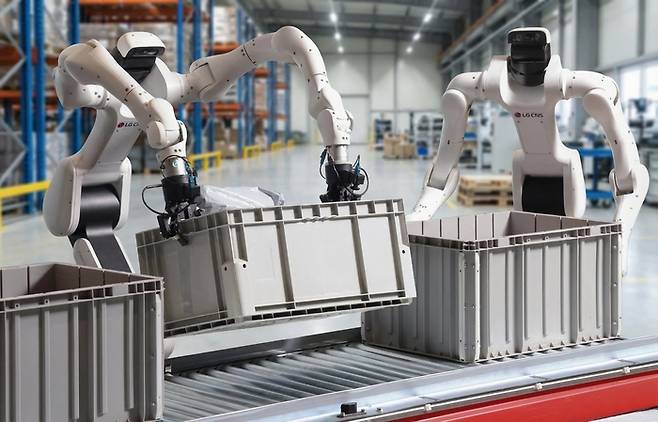
The company said Tuesday it had made a strategic investment in U.S. robotics startup Dexmate to strengthen humanoid robot hardware optimized for industrial environments. The investment was carried out through LG Technology Ventures, LG Group’s corporate venture capital arm, and is estimated to be worth several million dollars.
Dexmate, based in Silicon Valley, develops humanoid robots recognized for their high-quality hardware, which has been adopted by global robotics intelligence developers as a standard research platform, according to LG CNS.
The company’s robots feature a wheel-based design instead of legs, allowing them to maintain humanoid task capabilities while ensuring stable long-duration operation. With more than 36 degrees of freedom, the robots can perform precise dual-arm coordination tasks, support payloads of around 15 kilograms for both arms combined and operate for more than 20 hours on a single charge, making them suitable for immediate deployment in logistics centers and manufacturing facilities.
With the investment, LG CNS has expanded its robotics lineup to include wheel-type humanoids alongside bipedal and quadrupedal robots. The company plans to provide “robot transformation (RX) services,” combining hardware with robot foundation models and operational learning platforms.
The move follows LG CNS’ earlier efforts to build intelligent robotics platforms, including the launch of its Future Robotics Lab in June last year and an investment in U.S.-based robotics AI developer Skild AI.
The company is currently conducting proof-of-concept projects in which robots trained on data from logistics, distribution and manufacturing sites perform tasks such as loading and sorting goods or inspecting ship assembly conditions.
Lee Jun-ho, senior vice president of LG CNS Smart Logistics & City Division, said the investment represents a strategic step to combine robot hardware, foundation models and platforms to enable large-scale robot operations and accelerate adoption in industrial environments. He added that the company aims to lead the era of physical AI by validating humanoid robot business models that can be applied immediately in real-world settings.
LG CNS’ efforts are closely aligned with LG Group’s broader physical AI strategy. LG Uplus is working to embed its call-based AI agent “ixi-O,” currently available on smartphones, into home robots and other devices so that systems can understand context and act autonomously without direct voice commands.
Software capabilities powering the “brains” of robots are being led by LG AI Research. Its next-generation vision-language model, EXAONE 4.5, scheduled for release in the first half of this year, is expected to serve as a core engine enhancing robots’ perception and object manipulation capabilities.
LG Electronics is also building a smart home ecosystem combining AI appliances and household robots. The company recently acquired management control of Bear Robotics to expand its commercial robotics business and has begun developing actuators, key components used in robots.
LG Display is exploring robot display panels using its organic light-emitting diode technology, while LG Energy Solution is expanding battery applications and technology partnerships for robotics, broadening opportunities in emerging businesses.
Copyright © 매일경제 & mk.co.kr. 무단 전재, 재배포 및 AI학습 이용 금지
- 늙어가는 수급자·빈곤한 청년, 복지 사각지대 비상등...기초생활보장 틀 뜯어고친다 - 매일경제
- “들어가기만 하면 대학생활 풀린다”…신입생 200명씩 몰리는 ‘귀족 동아리’ - 매일경제
- 오늘의 운세 2026년 3월 11일 水(음력 1월 23일) - 매일경제
- 트럼프 “기뢰부설용 이란선박 10척 타격…완전 파괴” - 매일경제
- 밤 10시 ‘탈당 예고’→새벽 2시 ‘취소’…전한길 “윤 전 대통령 측 만류” - 매일경제
- “요즘 국장, 코인판 같아요”…변동성 커진 W자 증시, 공포 언제 끝나나 - 매일경제
- “이 귀한 걸 남한테 어떻게 넘기나”…강남 아파트 증여 2배 늘었다 - 매일경제
- 금융·조선주 급등…코스피, 외국인 매도에도 2%대 ‘안도 랠리’ - 매일경제
- “주민들 돈 빼돌려 개인적으로 펑펑”…아파트 관리비 9억 횡령 경리, 결국 - 매일경제
- 한국, 8강 상대 윤곽 드러났다...도미니카 vs 베네수엘라 D조 최종전 승자와 대결 예정 [WBC] - MK스