Lee Se-dol returns to build with AI, not battle it
전체 맥락을 이해하기 위해서는 본문 보기를 권장합니다.
"It doesn't feel like the absolute strongest Go AI available today," he said. "But it's already at a level where a human would find it difficult to win. In my impression, it seems to have surpassed the AlphaGo version I faced in 2016."
"For more than 5,000 years of Go history, every move has contained a player's personality and emotions," he said. "AI doesn't have that. AI is AI. The human game can continue."
이 글자크기로 변경됩니다.
(예시) 가장 빠른 뉴스가 있고 다양한 정보, 쌍방향 소통이 숨쉬는 다음뉴스를 만나보세요. 다음뉴스는 국내외 주요이슈와 실시간 속보, 문화생활 및 다양한 분야의 뉴스를 입체적으로 전달하고 있습니다.
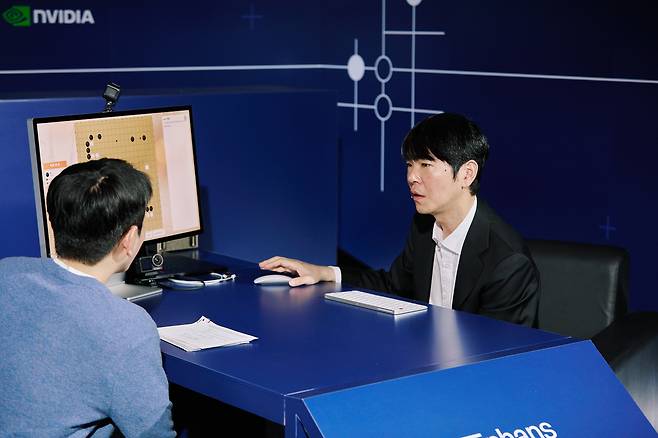
Ten years after his historic game against Google DeepMind’s AlphaGo transformed global perceptions of artificial intelligence, Go legend Lee Se-dol returned to the same venue.
This time, the encounter was not a contest between human and machine but a demonstration of how the two might work together.
The event held at the Four Seasons Hotel Seoul in central Seoul was organized by Korean AI startup Enhans, which showcased a system designed to coordinate multiple AI “agents” to carry out complex tasks autonomously.
During a live demonstration, Lee used voice commands to interact with the company’s AI operating system, which then researched, designed and built a playable Go application in real time. The system conducted web searches, generated interface designs and wrote code before deploying the program for Lee to test on stage.
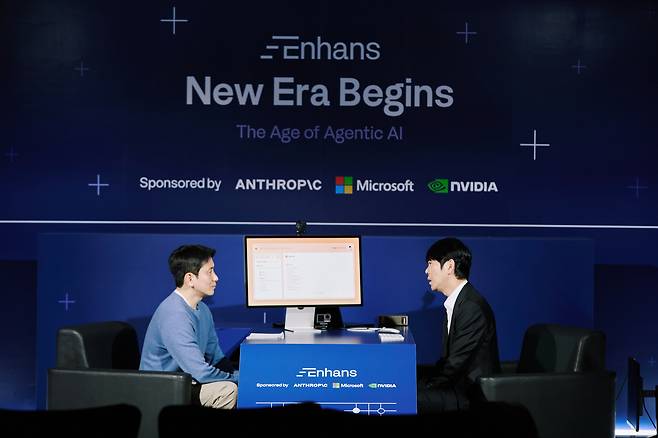
After briefly playing against the program, Lee offered a technical assessment of its strength.
“It doesn’t feel like the absolute strongest Go AI available today,” he said. “But it’s already at a level where a human would find it difficult to win. In my impression, it seems to have surpassed the AlphaGo version I faced in 2016.”
The program was assembled in roughly 20 minutes through conversation alone, without Lee writing any code.
The demonstration illustrated agentic AI, a category of systems designed to break down a user’s instructions into multiple steps and execute them across software tools. Rather than simply generating text responses or images, such systems can perform tasks such as web research, application design and code deployment.
The AI system began by transcribing a conversation between Lee and Enhans CEO Lee Seung-hyun about the future of Go. Lee suggested that AI could help make the game more accessible as an educational tool and recommended features such as beginner-friendly board sizes.
Using that discussion as input, the system’s agents then searched online sources, gathered development resources and assembled a Go application integrating an open-source engine. The finished program included beginner teaching functions and multiple board sizes.
Watching the process unfold, Lee described the implications as far broader than a single board game.
“If the same process works for other things too, the possibilities are enormous,” he said.
Lee also contrasted the experience with attempts to build software using current AI coding tools.
“I’ve tried so-called vibe coding myself, and it didn’t really work because you need some technical knowledge to move forward,” he said. “Today I basically did nothing technically, yet a functioning program appeared. If this becomes accessible to anyone, the change could be enormous.”
Lee’s appearance carried symbolic weight. In March 2016, his five-game match against AlphaGo became a defining moment in the history of AI. The program ultimately won the series 4-1, though Lee’s lone victory in the fourth game remains one of the most celebrated moments in professional Go.
The match sparked global debate about whether machines might surpass human intelligence in complex cognitive domains.
A decade later, Lee said the pace of technological change has accelerated even beyond what he expected at the time.
“Even three or four years ago, this kind of thing would have been unimaginable,” he said during the event. “The speed of change since then has been astonishing.”
But Lee did emphasize the continuing role of human players despite AI’s technical dominance.
“For more than 5,000 years of Go history, every move has contained a player’s personality and emotions,” he said. “AI doesn’t have that. AI is AI. The human game can continue.”
Copyright © 코리아헤럴드. 무단전재 및 재배포 금지.