Korea goes all-out with tariff diplomacy after U.S. Supreme Court ruling
The Ministry of Trade, Industry and Resource said Sunday that Korean Minister of Trade, Industry and Resource Kim Jung-kwan and Trade Minister Yeo Han-koo traveled to the U.S. on Friday, local time, and held meetings with U.S. Commerce Secretary Howard Lutnick and U.S. Trade Representative Jamieson Greer.
The visit was arranged to ease growing uncertainty surrounding U.S. tariff policy after the U.S. Supreme Court ruled that the reciprocal tariffs imposed by the Trump administration under the International Emergency Economic Powers Act (IEEPA) were unlawful. The talks also reviewed the implementation status of tariff agreements between the two countries.
During his meeting with Lutnick, Kim outlined Seoul’s progress in implementing the tariff agreement, including legislative efforts to enact a special law related to investment in the U.S., and discussed ways to expand strategic investment cooperation.
Korea said Thursday that the National Assembly had agreed to establish a state-run corporation for Korea-U.S. strategic investment and plans to pass the measure at a plenary session on March 12 after completing related procedures.
The government also formed a temporary interagency body last month to review investment projects in the U.S.
Kim stressed that existing tariff agreements between the two countries should be effectively maintained as Washington advances tariff policies following the IEEPA ruling, referring to potential measures under Section 122 of the Trade Act and Section 232 of the Trade Expansion Act, the ministry said.
Following the ruling, the Trump administration said it would raise a newly introduced global tariff under Section 122 of the Trade Act from 10 percent to 15 percent. It also plans investigations to consider additional tariffs under Section 232 of the Trade Expansion Act and Section 301 of the Trade Act.
Section 301 authorizes the U.S. administration to impose retaliatory measures such as tariffs against foreign government policies or practices that restrict or disadvantage U.S. trade.
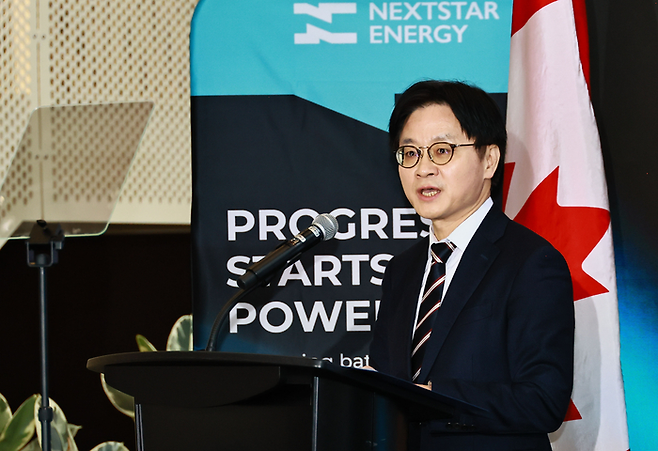
Before traveling to the U.S., Kim attended the opening ceremony of LG Energy Solution Ltd.’s battery plant in Canada on Thursday. He also supported Korea’s bid for Canada’s Canadian Patrol Submarine Project, estimated to be worth about 60 trillion won, before heading to the U.S.
Yeo also met Greer to discuss bilateral trade issues. Yeo is understood to have visited the U.S. on an undisclosed schedule in line with Kim’s trip.
Both sides discussed plans to implement non-tariff measures included in the joint fact sheet announced by the leaders of the two countries and agreed to convene the Korea-U.S. Free Trade Agreement joint committee at an appropriate time to finalize implementation measures.
They also discussed policy developments related to Sections 122 and 301 of the U.S. Trade Act. Yeo conveyed Seoul’s position that a request by U.S. investors in Coupang Inc. for a Section 301 investigation should not negatively affect Korea-U.S. trade relations.
U.S. investors in Coupang earlier asked the Trump administration to launch a Section 301 probe, alleging that the Korean government had taken unfair and discriminatory measures against the e-commerce company.
Copyright © 매일경제 & mk.co.kr. 무단 전재, 재배포 및 AI학습 이용 금지
- “주식계좌 -50%, 3년 버틸 수 있나요?”...안 되면 몰빵하지 말라는 고수 - 매일경제
- 오늘의 운세 2026년 3월 9일 月(음력 1월 21일) - 매일경제
- [속보] 유가 폭등에 또다시 ‘블랙먼데이’…코스피, 7%대 폭락 5200선 붕괴 - 매일경제
- [속보] 코스피 급락에 매도 사이드카 발동 - 매일경제
- “주식시장, 최악은 오지도 않았다”…‘오일쇼크’ 덮치자 글로벌 증시 패닉 - 매일경제
- [속보] 유가 100달러 돌파...4년만에 다시 오일쇼크 - 매일경제
- [속보] 트럼프 “이란 핵 제거되면 유가 단기 급락…바보들만 다르게 생각” - 매일경제
- “죄송하지만 개는 못 들어옵니다”...된다고 했던 식당, 말 바꾼 이유는 - 매일경제
- 이란, 최고지도자로 결국 하메네이 아들...트럼프 “우리 승인 받아야” - 매일경제
- 3G 8피홈런 17실점…흔들리고 있는 한국 투수진, 호주전 반등하며 기적의 8강행 이끌까 [WBC 프리뷰