Seoul readies evacuations for Koreans in the Middle East
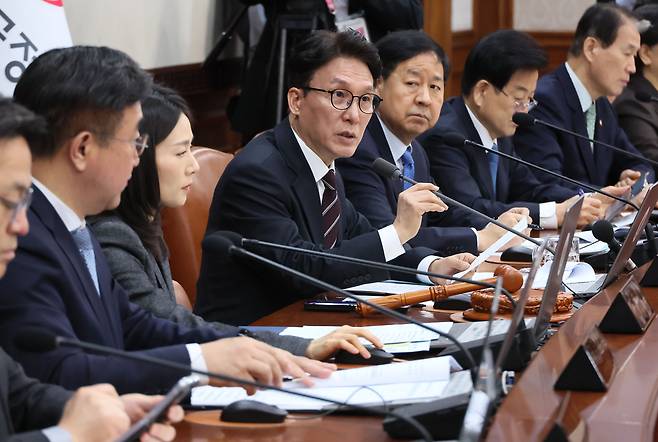
Prime Minister Kim Min-seok on Tuesday ordered ministries to maintain full contingency readiness, including evacuation plans, emphasizing that protecting South Koreans in the Middle East is the government’s top priority.
Kim convened the weekly Cabinet meeting amid the Middle East conflict triggered by a joint US-Israel strike on Iran on Saturday that is rapidly spreading across neighboring countries, with Iran and Israel’s counterattacks widening.
"Right now, protecting overseas nationals is the top priority," Kim said during the meeting he presided over on behalf of President Lee Jae Myung, who is visiting Singapore and the Philippines for summit talks.
"Please make especially thorough preparations for various response measures and evacuation for our nationals residing in the affected countries, as the course of the war is expanding beyond the respective responses by Iran and Israel into Iran’s counterattacks on neighboring countries."
According to Foreign Ministry figures, approximately 4,000 short-term visitors, including travelers, and some 17,000 long-term residents, including expatriates, are currently in 13 Middle East countries, with about 2,000 people stranded in Dubai alone. The Dubai figure likely includes travelers using the city as a transit hub en route to Europe or Africa.
As of Monday, there were 59 South Korean nationals in Iran, excluding embassy personnel. In Israel, there were 616 South Korean nationals, also excluding mission staff.
The figures were shared during an emergency meeting held the same day between the Foreign Ministry and the ruling Democratic Party of Korea lawmakers on the committee to discuss the Iran situation.
Speaking at the Cabinet meeting, Kim called for full readiness, saying, “Please ensure we are ready to respond immediately at any time after the president’s return,” referring to Lee’s four-day trip, which ends Wednesday.
Kim urged the Foreign Ministry to lead in sharing information through diplomatic channels with partner countries, and said the Defense Ministry is maintaining thorough contingency readiness, including military transport aircraft.
Kim also called for proper notice and guidance not only for individual travelers but also for any potential visits by religious groups or other organized delegations.
Kim underscored the importance of implementing one-on-one outreach measures for short-term visitors and travelers — which the Foreign Ministry is currently working on — to ensure the safety of South Korean nationals staying in affected Middle Eastern countries. Kim added that the Foreign Ministry should inform nationals through multiple channels how to send SOS signals and request assistance in an emergency.
On the economic front, Kim noted that, “given the US position, the situation could extend into the medium term.” Kim called for ministries led by the Ministry of Economy and Finance to work with the Korea Development Institute and other state-run think tanks to prepare and respond accordingly.
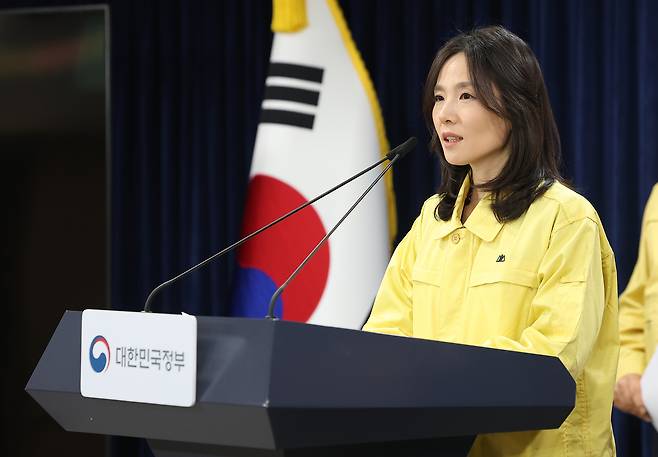
During the Cabinet meeting, Second Vice Foreign Minister Kim Jina reported, “We are identifying information not only on long-term residents but also on short-term visitors.”
“We are reviewing measures at multiple levels, such as relocating nationals to safe areas and arranging return flights,” the vice minister said. “Fortunately, no casualties among South Korean nationals have been confirmed at this time.”
The Foreign Ministry has been operating the Overseas Nationals Protection Task Force since Saturday and has held daily joint situation review meetings between headquarters and concerned overseas missions.
As of 6 p.m. Monday, special travel alerts were imposed nationwide by the Foreign Ministry for the United Arab Emirates, Qatar, Oman, Bahrain, Jordan and Kuwait. In Saudi Arabia, some regions were raised from Level 2 travel caution to a special travel advisory.
Finance Minister Koo Yun-cheol underlined that, “The government is preparing countermeasures with the possibility of a prolonged crisis in mind, given that it is highly uncertain how the current Middle East situation may unfold.”
“While we have secured sufficient domestic oil stockpiles and have the capacity to respond on the supply side, we will respond thoroughly because volatility in domestic and global financial and energy prices could increase due to potential instability in the Strait of Hormuz and other factors.”
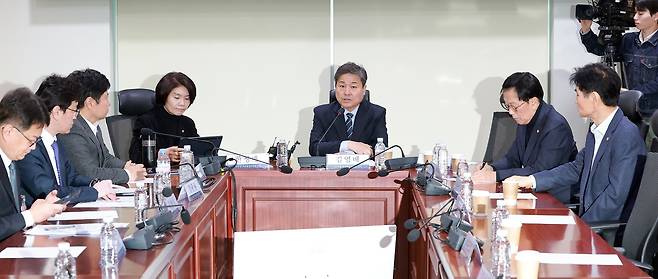
At the National Assembly, Rep. Kim Young-bae of the Democratic Party said, “The most important task is to accurately assess the situation of our nationals and secure communication networks,” following the Foreign Ministry–ruling party meeting on the Middle East situation.
“Because it is still difficult to determine how long the situation may persist, we will first assess conditions and identify demand among travelers who require urgent measures and those seeking immediate relocation,” Kim said. “Based on that, we plan to review whether relocation is feasible, including options that exclude countries whose airspace is currently closed.”
According to Kim, countries that have closed their airspace include Iran, Israel, Bahrain, the United Arab Emirates, Qatar and Kuwait.
Kim further explained that the government is also closely monitoring crude oil shipments.
“At present, we believe about 30 of our transport and crude oil vessels are operating in the surrounding area,” Kim said. “Roughly 70 percent of South Korea’s crude oil imports pass through the Strait of Hormuz, while Japan’s figure is around 90 percent, underscoring how critical the strait’s situation is to our energy security.”
Kim added that the government will “examine measures to secure crude oil — including whether alternative routes are available given current stockpiles — as more information becomes available.”
Kim noted that about 20 percent of South Korea’s natural gas imports also pass through the Strait of Hormuz.
“Gas will be reviewed in the same way. Supply routes are already relatively diversified, so the risk is somewhat dispersed, but we have agreed to discuss additional measures to secure supplies,” Kim said.
Copyright © 코리아헤럴드. 무단전재 및 재배포 금지.