S. Korea vows zero tolerance for fake news ahead of June local elections
Prime Minister Kim Min-seok on Thursday called for swift and thorough investigations into election-related fake news, warning that disinformation and smear campaigns pose a serious threat to democracy ahead of South Korea’s nationwide local elections scheduled for June 3.
Speaking at a government meeting of relevant ministers and agency chiefs on countering fake news, Kim said false information surrounding elections must be dealt with firmly under the law.
“Fake news and smear campaigns that distort government policies, spread false accusations against public officials and malign specific candidates or political parties ahead of elections and primaries are enemies of democracy,” Kim said.
“Actions that create and distribute fake news to disrupt the political or electoral order must be dealt with strictly in accordance with the law and principles,” he added. “Eradicating them without any tolerance is the way to safeguard democracy.”
Kim warned that the scale of harm from fake news is growing as it becomes intertwined with online commercial interests, noting the emergence of artificial intelligence-generated disinformation.
“If artificial intelligence-driven fake news is spread right before an election and affects the outcome, we must respond with a far greater sense of urgency than in the past,” he said.
He also pledged firm action regardless of status or affiliation, saying those who produce politically motivated false information would not be tolerated. Kim called on the public to remain vigilant against misinformation and help foster a more mature democratic society.
Kim urged authorities to strengthen coordinated responses, saying the state media regulator Korea Communications Commission should reinforce its role as the government’s control tower, while prosecutors and police must conduct swift and thorough investigations to root out fake news.
Prosecutors and police also vowed a zero-tolerance approach toward election-related fake news, particularly cases involving the misuse of AI.
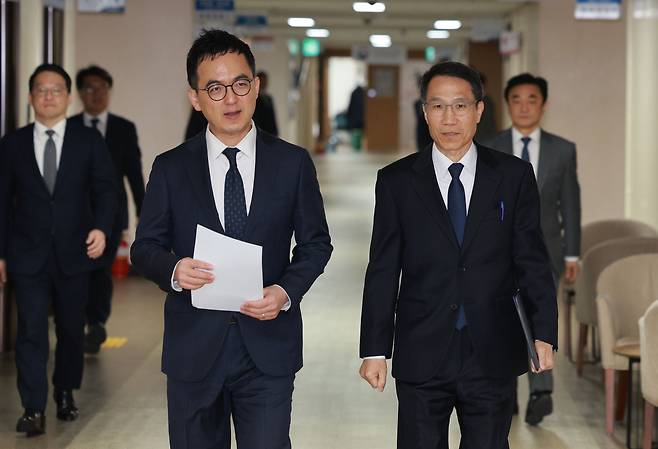
Acting Prosecutor General Koo Ja-hyeon and acting Korea National Police Agency commissioner general Yoo Jae-seong held a joint press conference after attending the ministerial meeting, pledging strict enforcement.
“Ahead of the elections, we will mobilize all available means to respond firmly to election crimes,” Koo said. “We will utilize all investigative techniques, including forensic science, and track crimes involving overseas servers through international judicial cooperation so that such offenses cannot take root in our society.”
Yu echoed the stance, saying, “Fabricated information is a crime that undermines trust across society. We will respond with a zero-tolerance principle to false and manipulated information that damages the fairness of elections and the democratic order.”
Police said they have been intensively cracking down on organized online disinformation since January, including cases involving the use of macros and coordinated digital tools. Since Jan. 1, authorities have apprehended 110 suspects, with six placed under arrest, while investigations are underway in 199 cases.
Authorities have also requested the deletion or blocking of 1,074 pieces of harmful content through relevant agencies. A dedicated election crime investigation task force was formed across police agencies nationwide earlier this month.
A separate task force to combat the spread of false information has been launched and in operation since October last year, with major cases handled directly by provincial police cyber investigation units.
Yu reiterated the agency’s firm stance, saying, “With the local elections approaching, we will respond without tolerance to fabricated information that undermines election fairness and the democratic order.”
South Korea has grappled with election-related disinformation for years, with concerns intensifying as digital manipulation tools become more sophisticated.
Thursday's announcement from officials comes as South Korea’s election fake news problem has evolved from rumor-driven smear campaigns into a sophisticated digital ecosystem involving AI, coordinated online activity and platform-based amplification — prompting increasingly aggressive legal and institutional responses ahead of every major vote.
One of the most notable cases was the “Druking” scandal that surfaced after the 2017 presidential election, in which an online group used automated programs to manipulate comment sections on major news portals to sway public opinion. The operation artificially boosted certain political narratives and suppressed others, prompting a sweeping investigation, multiple convictions and renewed scrutiny over the role of online platforms in elections.
The case is widely cited by policymakers and law enforcement as an early example of how coordinated digital activity — rather than traditional false reporting alone — can distort the electoral environment, shaping current efforts to crack down on fake news and online opinion manipulation ahead of upcoming votes.
Copyright © 코리아헤럴드. 무단전재 및 재배포 금지.