BOK sees limited market downside, property steps effective
In a report submitted to the National Assembly’s Strategy and Finance Committee, the central bank said the benchmark stock index surpassed the 5,000 mark for the first time on Jan. 27, before experiencing heightened volatility in February amid uncertainty over the U.S. Federal Reserve’s monetary policy and concerns about the profitability of artificial intelligence businesses.
Despite the fluctuations, the BOK said the market has maintained an upward trend on improving corporate earnings and expectations for policy support.
“Considering the government’s policy drive and expectations for solid performance in the semiconductor industry, the likelihood of a structural downward shift appears limited,” the central bank said. “However, attention should be paid to the possibility of increased volatility stemming from uncertainties over U.S. tariffs and monetary policy.”
It also cited potential global stock corrections triggered by debates over AI firms’ profitability and high valuations as additional risk factors.
The BOK added that, despite recent market adjustments, the KOSPI’s gains this year have been the highest among major economies. By sector, shares of semiconductors and automakers — buoyed by AI-related growth expectations — as well as financial firms benefiting from capital market reform measures, led the rally.
During the session, Rep. Cha Gyu-geun of the Rebuilding Korea Party asked about the impact of the government’s real estate policies. The BOK responded that the expiration of the temporary suspension of heavier capital gains taxes on multi-homeowners has had some effect in stabilizing the pace of housing price increases in Seoul.
Regarding tighter rules on extending loan maturities for multi-homeowners, the central bank said such measures are expected to slow the growth of household debt while contributing to property market stabilization to some extent.
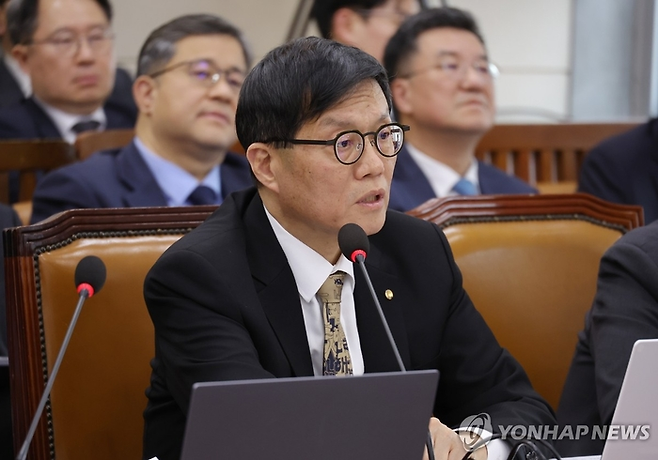
BOK Gov. Rhee Chang-yong said it is difficult to predict whether better long-term outcomes will materialize, noting that policy effectiveness ultimately depends on easing the concentration of population and economic activity in the greater Seoul area.
Separately, he emphasized that household debt — particularly property-related lending — poses a major risk to the overall economy and needs to be reduced regardless of the latest loan regulations.
Rhee also reiterated that tax policy affecting both multi-homeowners and single-homeowners should be improved not only as part of housing measures but also from the standpoint of tax fairness.
On aggregate lending caps, the governor acknowledged criticism but said such controls are necessary, adding that the debt service ratio (DSR) requirement may also need to be strengthened.
Copyright © 매일경제 & mk.co.kr. 무단 전재, 재배포 및 AI학습 이용 금지
- 서울 대치동 은마아파트 화재…10대 여성 1명 사망·3명 부상 - 매일경제
- “한국인들 역겹다”…동남아서 ‘반한 감정’ 확산·불매운동 조짐도, 왜? - 매일경제
- “월1000씩 번다하니, 동창회 못가겠습니다”…대기업·중기 격차최대 - 매일경제
- “이러다 크게 물리는 거 아냐”…코스피 역대급 불장에도 외국인 9조 매도, 왜? - 매일경제
- 대법 “징역 6년은 부족해”…반도체 기술유출 삼성직원 판결 파기환송 - 매일경제
- 이 대통령 ‘다주택 압박’ 통했다…집값 상승 기대 3년7개월만 최대 하락 - 매일경제
- 추격자 된 한국, 첨단산업 중국에 다 밀려…반도체마저 경합 - 매일경제
- “아무래도 지금이 고점 같아서”…‘51대 1’ 분당 청약, 절반이 계약 포기 - 매일경제
- 이 대통령 “시장에 맞서지 말라? 정부에 맞서지 말라는 말도 있다” - 매일경제
- ‘11년 307억 원이라니!’ 노시환, 한화와 역대 최장기+최대 규모 다년 계약 체결…“KS 우승 향해