Reshoring tax scheme loses timing edge as market tide turns
전체 맥락을 이해하기 위해서는 본문 보기를 권장합니다.
"But right now, many investors are in loss territory," said an official at a major brokerage, speaking on condition of anonymity. "If there are no gains, there is little tax benefit to claim."
"While US equities have underperformed global peers, it would be premature to characterize the market as weak," said Park Yoon-cheol, an analyst at iM Securities. "Sector rotation is underway, easing concentration in large-cap technology stocks."
이 글자크기로 변경됩니다.
(예시) 가장 빠른 뉴스가 있고 다양한 정보, 쌍방향 소통이 숨쉬는 다음뉴스를 만나보세요. 다음뉴스는 국내외 주요이슈와 실시간 속보, 문화생활 및 다양한 분야의 뉴스를 입체적으로 전달하고 있습니다.
The government’s Reshoring Investment Account, or RIA, unveiled in mid-December as a rapid response to heavy overseas equity flows and currency volatility, remains stalled in the National Assembly — even as market conditions have shifted significantly.
The tax-incentivized scheme was designed to encourage investors to bring overseas gains back into domestic markets, easing pressure on the won. Officials initially targeted a first-quarter launch, pending legislative approval.
Two months later, that timeline is increasingly uncertain.
“The framework itself has not changed, but implementation depends on discussions in the National Assembly,” a senior Finance Ministry official said, declining to confirm whether a first-quarter rollout remains feasible.
Industry officials now expect passage no earlier than the beginning of March. Even if approved, drafting enforcement decrees and building brokerage systems could delay the launch further.
The delay also complicates the incentive structure. Under the original plan, investors would receive a 100 percent tax exemption on eligible overseas gains realized in the first quarter, with the benefit reducing by 20 percentage points each subsequent quarter. If the legislative schedule slips, the phased structure will likely require revision.
More fundamentally, the market conditions that shaped the RIA’s design have changed.
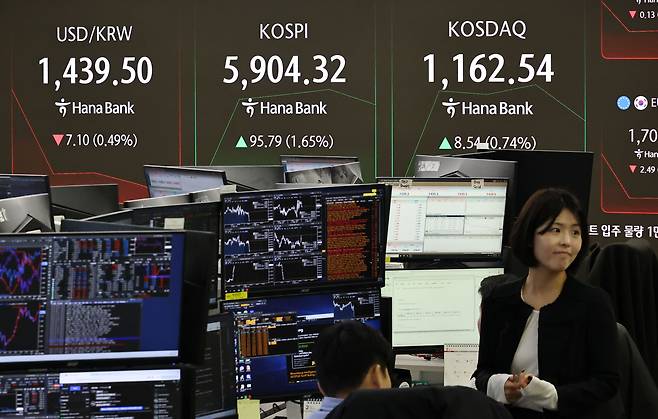
When the program was announced, the won was approaching 1,500 to the dollar, amid sustained depreciation, while retail investors continued pouring funds into US equities despite the elevated exchange rate.
Since then, performance has diverged sharply. The Kospi has surged roughly 40 percent in under two months, topping 5,900 points on Monday. By contrast, US benchmarks have lagged: The S&P 500 is up just 0.9 percent year-to-date, while the Nasdaq has fallen 1.5 percent.
The scheme’s structure further narrows its appeal. Tax relief applies only to realized gains, capped at 50 million won ($34,700) in overseas sale proceeds, and requires investors to hold domestic assets for at least one year. In practice, it targets investors sitting on substantial profits abroad who are looking to lock in returns.
“But right now, many investors are in loss territory,” said an official at a major brokerage, speaking on condition of anonymity. “If there are no gains, there is little tax benefit to claim.”
Meanwhile, the won has stabilized in the mid-1,400 range after briefly strengthening to around 1,430 per dollar following the policy announcement.
Retail overseas investment has regained momentum despite the RIA delay.
Net purchases of US equities by Korean investors peaked at $6.85 trillion in October before falling to $1.8 trillion in December, around the time the RIA was announced. Flows rebounded to $5 trillion in January and had already reached $4 trillion in February as of last week — despite the Lunar New Year holiday — putting the month on track to surpass January’s total.
For some investors, recent US market softness presents an opportunity rather than a reason to exit.
“While US equities have underperformed global peers, it would be premature to characterize the market as weak,” said Park Yoon-cheol, an analyst at iM Securities. “Sector rotation is underway, easing concentration in large-cap technology stocks.”
The one-year domestic holding requirement adds another layer of risk. Designed to prevent short-term arbitrage, it also commits investors to a market that has already rallied sharply.
“If you sell overseas assets and buy domestic stocks now, you are effectively locking in a one-year position near a high point,” another brokerage official said. “A sharp correction could easily outweigh the tax benefit.”
Officials acknowledge that policy timing cannot anticipate every market swing.
“It is not possible to predict every shift, so such changes were not built into the design,” the Finance Ministry official said. The primary goal, the official added, was to ease currency pressure by converting dollar-denominated assets into won during a period of rapid depreciation.
“Market conditions evolve,” the official said. “Investment decisions ultimately rest with individuals.”
Brokerages tasked with operating RIA accounts say they are stuck in preparation mode.
System development and internal testing have progressed at major securities firms. Some even launched marketing campaigns assuming accounts would open as early as March, only to withdraw them after the Korea Financial Investment Association advised caution amid legislative delays.
Without finalized legislation and detailed guidelines, firms say they cannot move forward.
“Legislation must come first,” the brokerage official said. “Until the framework is finalized, it is difficult to provide clear guidance.”
Copyright © 코리아헤럴드. 무단전재 및 재배포 금지.