Korean chip industry faces uncertainty as Trump announces 15% tariff plan
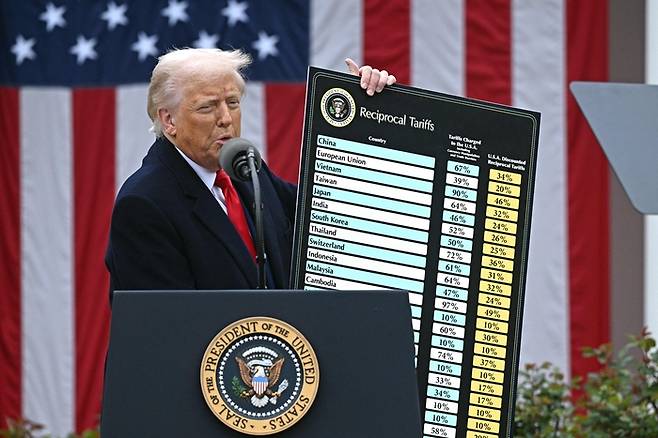
Following the announcement of the new tariff plan, concerns rose on Sunday within the Korean chip industry over whether semiconductors could become subject to tariffs.
Semiconductors have so far remained tariff-free under the reciprocal tariff system. While U.S. tariff schedules list a 25 percent duty on certain semiconductors and derivative products, the U.S. government has not enforced those measures in practice.
The continued exemption has been widely interpreted as a strategic decision, as the U.S. seeks to secure stable semiconductor supplies while expanding artificial intelligence infrastructure.
The U.S. has also maintained incentive policies that grant tariff exemptions to foreign chipmakers that build manufacturing facilities in the U.S.
Uncertainty has intensified after Trump also said he would overhaul the tariff regime by invoking Section 232 of the Trade Expansion Act and Section 301 of the Trade Act, following the Supreme Court ruling that struck down his reciprocal tariff measures.
“Since the U.S. government has not announced any official detailed guidelines or formally notified companies, and policy directions are frequently changing even through social media, we are closely monitoring the actual scope of application,” said an industry official.
The Korean government views the proposed 15 percent global tariff under Section 122 as a replacement for reciprocal tariffs and expects it to be applied mainly to items that were previously subject to those measures. Under that interpretation, semiconductors are likely to be excluded from direct tariff coverage.
“We understand that items exempt from tariffs under Section 232, such as pharmaceuticals and semiconductors, will also be excluded from tariffs imposed under Section 122,” said an official from the Ministry of Trade, Industry and Energy.
Under the same framework, products such as automobiles that are already subject to a 15 percent tariff are expected to retain that rate even if the global tariff system is introduced, as current rules prohibit overlapping tariffs on items already facing product-specific duties.
Still, the Korean auto industry is increasingly uneasy.
The U.S. government threatened late last month to raise automobile tariffs from 15 percent to 25 percent, citing delays in Korea’s National Assembly approval process related to U.S. investment.
Industry insiders worry that Trump, whose reciprocal tariff plan was blocked by the court ruling, could instead raise auto tariffs through presidential authority under Section 232.
Automakers say the risk is compounded by the fact that they have already adjusted pricing strategies, export volumes, and local production plans in response to earlier policy shifts.
Product-specific tariffs imposed under Section 232, including 50 percent duties on steel and aluminum, are expected to remain in place as a separate system. Existing tariffs will also continue to apply to copper semi-finished and derivative products at 50 percent, mid- to large-sized vehicles at 25 percent, buses at 10 percent, and lumber at 10 percent.
Some analysts, however, suggest the new measure could be somewhat favorable to Korea.
The Korea International Trade Association (KITA) said on Sunday that the U.S. tariff structure is likely to shift to a combination of most-favored-nation tariffs plus a 15 percent duty under Section 122.
Although Korea had been subject to the same 15 percent tariffs as other countries despite being a free trade agreement partner, the revised structure could allow Seoul to benefit again from preferential treatment under the Korea-U.S. FTA.
“Under the new tariff framework, Korea has room to partially regain price competitiveness to the extent of MFN tariff exemptions under the FTA,” it said.
The government said it will coordinate closely with the private sector as uncertainty grows.
On Saturday, the trade ministry held an emergency meeting chaired by Minister Kim Jung-kwan, attended by senior trade officials and commercial attachés from Korean embassies in the U.S. and Japan.
A public-private joint response meeting is also scheduled for Monday to assess sector-by-sector impacts and discuss strategies. The ministry said it will continue monitoring U.S. policy developments to limit uncertainty for Korean industries.
Copyright © 매일경제 & mk.co.kr. 무단 전재, 재배포 및 AI학습 이용 금지
- “성관계할 시간에 차라리 이거 할래”…달라진 Z세대의 우선순위 - 매일경제
- “포스코 주주입니다, 오래 기다렸어요”…악재 턴 저평가주 더 있다는데 - 매일경제
- "주가에 비해 실적이 더 좋다"… K저평가株 달릴 준비 - 매일경제
- “사고 안 나는게 이상”…1만명 몰린 ‘日 알몸’ 축제서 의식불명 속출 - 매일경제
- “상장 후 주가 80% 폭락, 실직자 속출하네요”...역대급 ‘거품’ 기업은? - 매일경제
- [100세 시대 컨설팅] "국민연금으론 부족"… IRP 연1800만원 납입해 두세요 - 매일경제
- “월140만원 옵션료 내세요”…씨마른 전세매물 ‘꼼수 임대료’ 등장 - 매일경제
- “수도권 공급 비상등 켜졌다”…김포·하남 사실상 입주 ‘제로’ - 매일경제
- 하이닉스도 한수 접는 미친 수익률…70% 찍었다는 ETF 뭐길래 - 매일경제
- 봅슬레이 원윤종 국제올림픽선수위원…동계종목 최초 - MK스포츠