Wrong flag at Olympics? Why Taegeukgi is tricky — and how to get it right
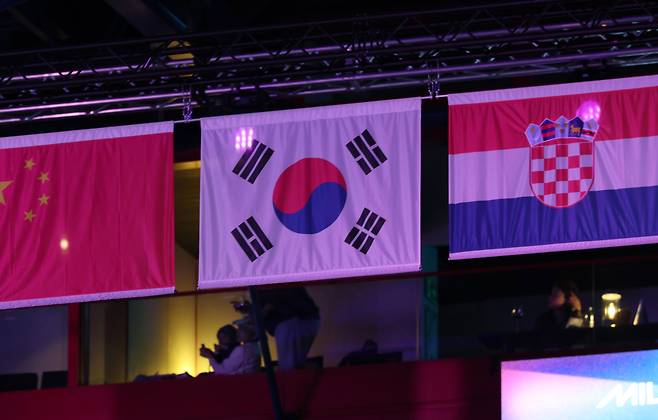
A medal ceremony mishap at the 2026 Milan Cortina Winter Olympics has sparked complaints from South Korea, as a misprinted national flag was discovered to have been used repeatedly throughout the games.
A Taegeukgi that had its red-and-blue Taegeuk symbol in the middle improperly tilted counterclockwise was raised during the women's 3,000-meter short track speedskating relay medal ceremony. The incorrect version of the flag was also found to have been used in several earlier events as well.
The International Olympic Committee apologized for the oversight and vowed to take immediate corrective action, according to the Korean Sports & Olympic Committee.
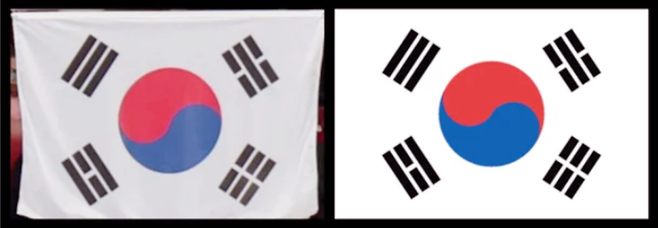
Each element of the flag represents values important to the Korean nation, and the Taegeukgi follows strict rules regarding orientation, proportion and color arrangement. Any deviation is considered a significant breach, with national symbols to be treated with precision on the global stage.
Errors involving national flags are rare, which is why the mishap triggered questions about oversight and protocol in international sporting events.
Despite its clean and minimal appearance, the Taegeukgi can be surprisingly difficult to draw accurately.
Koreans themselves often admit to confusion, especially as to the exact layout and order of the four black trigrams (geon, ri, gam and gon) placed in each corner, or whether the top or bottom of the Taegeuk is supposed to be red.
The alignment of the bars, the symmetry and the rotation of the Taegeuk all must follow exact guidelines.
The flag consists of a white background, the central Taegeuk and four trigrams, each representing cosmic and natural principles.
At the center is the Taegeuk, the red-and-blue circle that represents the eternal harmony of yin and yang. The upper red half symbolizes yang — active, bright and creative energy — while the lower blue half embodies calm, receptive and stabilizing elements of yin.
Their swirling shape suggests movement and coexistence, with two forces constantly shifting but always maintaining equilibrium.
To get the central Taegeuk right, Koreans grow up learning to visualize a natural scene: the sun shining above the sea. The red half of the circle goes on top, symbolizing warmth, energy and brightness. The blue half sits at the bottom, representing depth, calmness and water.
This simple mental image prevents the common mistake of switching the colors.
While the Olympic controversy focused on the Taegeuk's rotation, the part most Koreans typically find difficult is recalling the correct order of the four trigrams.
The four trigrams surrounding the Taegeuk, also called "gwae," are arranged in each corner of the flag. These trigrams come from ancient East Asian philosophy and describe natural elements and cosmic principles.
Geon, positioned in the upper left, represents heaven. Its three solid bars reflect strength, creation and the beginning of life's cycle.
Ri, found at the lower left, symbolizes fire. Its central broken bar suggests radiance, vitality and upward energy.
Gam, in the upper right, represents water. Its solid bar between two broken bars conveys wisdom, adaptability and the ability to flow through obstacles.
Gon, placed at the lower right, signifies earth. With its three broken bars, it reflects receptiveness, stability and the nurturing qualities that sustain life.
A typical guideline teachers give is to follow a path starting from the upper left to the bottom left before moving onto the right side and down again.
In that order, the total number of bars in each trigram forms a numerical sequence that is easy to memorize: three, four, five, six.
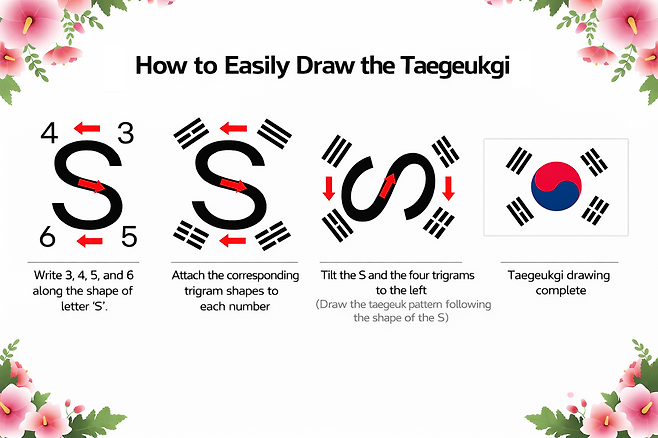
Another trick, popularized in classrooms and on social media, uses the shape of the capital letter S.
A learner draws a large S, marks the four outer edges with the Nos. 3, 4, 5 and 6 — in the order the letter is formed — and attaches each corresponding trigram. When the S is rotated a quarter-turn counterclockwise to match the flag's orientation, the trigrams fall into their correct positions and the yin and yang are formed together, enclosed in a circle.
This approach helps with both symmetry and sequence, eliminating the guesswork that can lead to mistakes.
Beyond its geometric precision, the Taegeukgi is a philosophical symbol — a visual expression of how Koreans understand balance, nature and the universe. Each element carries a distinct meaning, and together they create a unified worldview rooted in centuries of tradition.
The white background symbolizes purity, peace and the Korean tradition of appreciating simplicity.
Together, these elements express a worldview in which heaven, earth, fire and water — along with the yin-yang balance — are interconnected and constantly influencing one another.
Copyright © 코리아헤럴드. 무단전재 및 재배포 금지.