N. Korea test-fires upgraded large-caliber rocket system ahead of party congress
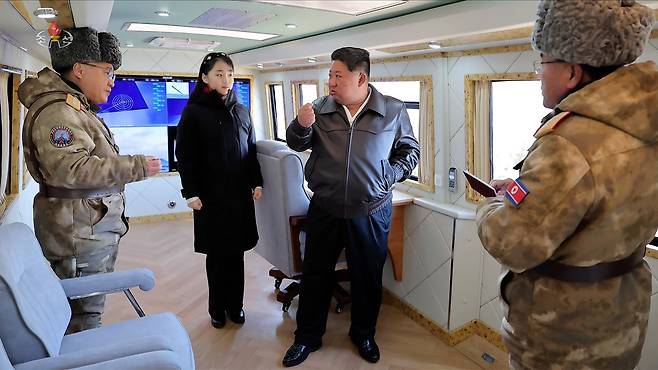
North Korea has conducted a test launch of an upgraded large-caliber multiple rocket launcher system under the supervision of leader Kim Jong-un, state media reported Wednesday, underscoring Pyongyang’s continued emphasis on strengthening its military deterrence ahead of a major political gathering next month.
According to the North's state-run Korean Central News Agency, Kim oversaw Tuesday’s test and described it as “of great significance in improving the effectiveness of our strategic deterrent,” adding that the system could be used for “specific attacks.”
The launch came as North Korea is widely expected to convene its first ruling Workers’ Party congress in five years early next month. The upcoming congress -- the ninth of its kind -- “will clarify the next-stage plans for further bolstering the country’s nuclear deterrent,” Kim was quoted as saying by KCNA.
The test followed South Korea’s announcement a day earlier that it had detected multiple short-range ballistic missiles launched from an area north of Pyongyang toward the East Sea.
KCNA said Kim stressed that the upgraded system had seen broad performance improvements. “All the indexes have been improved to maximize its strike capability, and the mobility, intelligence and hitting accuracy of the rockets, in particular, have remarkably been upgraded,” he said.
Kim also highlighted the weapon’s “self-steered, precisely guided flight system” as a major advancement, describing it as evidence of “the steady improvement and uninterrupted evolution of our defense technology.”
He emphasized that the test activities were conducted solely to enhance the country’s “deterrent against a nuclear war,” adding that “to build up the most reliable offensive capability and enforce the deterrence strategy based on it is the invariable line of our party’s national defense policy.”
State media photos showed Kim attending the launch alongside his daughter Ju-ae, as well as senior officials including Kim Jong-sik, first vice department director of the Workers’ Party Central Committee, and Jang Chang-ha, head of the Missile Administration.
KCNA said the test involved the launch of four MRLS rockets equipped with new technology, striking a target 358.5 kilometers from the launch site.
Hong Min, a senior research fellow at the Korea Institute for National Unification, said the system tested appears to be the same wheeled, five-tube super-large rocket launcher first unveiled during Kim’s on-site inspection of a key munitions industrial facility in December last year.
“The reference to an ‘upgraded’ or ‘renewed’ version suggests that North Korea is emphasizing enhanced capabilities by adding new functions to its existing super-large rocket launcher system,” Hong said.
He noted that while Pyongyang previously referred to the weapon as a “600mm multiple rocket launcher,” the shift to the term “large-caliber rocket launcher” may be intended to highlight diversification.
“This could reflect an effort to distinguish different derivatives equipped with autonomous guidance capabilities, while also emphasizing newly upgraded features such as long-range strike capability, resistance to jamming, and enhanced multiple-launch performance,” Hong said.
Hong said that the test appeared deliberately timed and framed to signal North Korea’s ability to penetrate advanced electronic and cyber defenses. He added that firing four rockets in succession aligns with Kim’s previous statements that multiple rockets could be used to devastate airfields and military facilities, potentially including “tactical nuclear saturation attacks” against key targets even under jamming or electronic warfare conditions.
“By publicizing this test, North Korea may be demonstrating that it can conduct saturation launches and break through US-style jamming, cyber and electronic warfare,” he said, noting that the launch occurred around the time US Undersecretary of Defense for Policy Elbridge Colby was departing South Korea. Colby visited the country from Sunday to Tuesday for security talks, including discussions on Seoul’s push to develop nuclear-powered submarines, before departing for Japan.
Yang Moo-jin, chair professor at the University of North Korean Studies in Seoul, explained that the emphasis on nuclear deterrence and self-defense should be viewed in the context of the 2026 US National Defense Strategy, which identifies North Korea as a threat to the US homeland. In the document released last week, North Korea is described as a direct military threat not only to US allies such as South Korea and Japan but also as posing an increasing risk to the US homeland itself due to its expanding missile and nuclear capabilities.
“By test-firing a rocket system capable of striking South Korean territory, Pyongyang is effectively sending a message of ‘try to stop us if you can,’” Yang said.
The display was also widely seen as closely tied to the upcoming 9th Congress of the Workers' Party of Korea in February.
“Kim Jong-un’s on-site supervision serves as a showcase of defense achievements ahead of the 9th Party Congress,” Yang said. “At the congress, North Korea is expected to lay out plans to further strengthen its nuclear war deterrent, including pursuing nuclear-powered submarines, launching reconnaissance satellites, developing multiple-warhead guidance technology, deploying tactical nuclear warheads and advancing hypersonic missiles.”
Copyright © 코리아헤럴드. 무단전재 및 재배포 금지.