Cost-savvy shoppers turn to warehouse stores in Korea
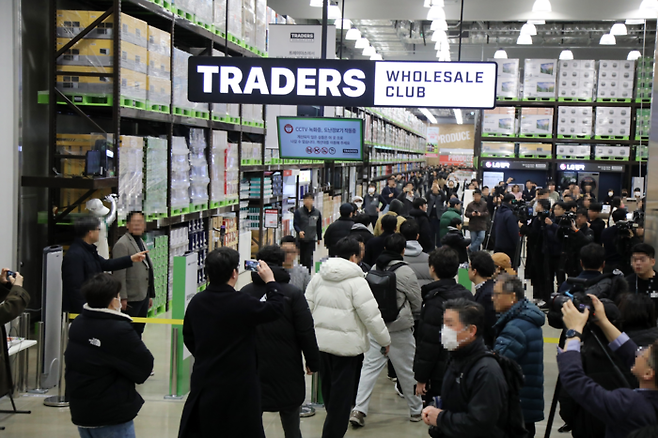
According to data from WiseApp·Retail, the estimated net payment index for Warehouse club retail stores in December rose to 147.1, nearly twice the level recorded in December 2021. The index compares payment volumes relative to large supermarkets, with December 2021 set at 100.
Over the same period, payment volumes at hypermarkets moved in the opposite direction.
Their estimated net payment index peaked at 122.9 in December 2022, before slipping to 111.4 in 2024 and 87.5 in December last year.
WiseApp’s estimates are based on sample surveys of Koreans’ credit and debit card transactions and exclude cash, bank transfers, and gift card payments.
While supermarkets still account for the second-largest share of retail payments at 26.5 percent, their share has fallen sharply from 33.2 percent in 2021.
Bulk-packaged retail stores, on the other hand, increased their payment share to 10 percent from 7 percent over the same period.
Analysts attribute the shift to structural changes in consumer behaviour.
Wholesale club retailers attract shoppers with bulk purchases and lower unit prices, as online delivery services and quick commerce reduce visits to traditional hypermarkets.
Traders Wholesale Club, a wholesale club chain run by Emart Inc., posted total sales of 1 trillion won ($687 million) in the third quarter of last year. Operating profit for the first nine months rose 27.2 percent from a year earlier.
Copyright © 매일경제 & mk.co.kr. 무단 전재, 재배포 및 AI학습 이용 금지
- “사회복무요원, 왜 현역이랑 차별하나”…소송 걸었던 공무원 결국 - 매일경제
- 李 다주택자 최후통첩에…강남은 증여, 강북·경기권은 단기급매 가능성 - 매일경제
- “목욕탕 수건, 비행기 담요에 자식 물건까지”…엄마 도벽에 골머리 사연 - 매일경제
- 펀드매니저 10명 중 9명 “코스피 연내 10~20% 조정 가능성” - 매일경제
- [속보] 국제 금값 온스당 5000달러 사상 첫 돌파 - 매일경제
- 신림 고시촌 서점 주인서 ‘사이다 총리’까지...‘민주 거목’ 이해찬 별세 - 매일경제
- 두쫀쿠 대신 쫀득빵 안되겠니…카페·편의점 ‘가성비 디저트’ 승부수 - 매일경제
- “독방 끌려가, 신발 던지고 난리”…슈, ‘미국 공항 난동’ 연예인 폭로 - 매일경제
- “엄마 배가 너무 아파”…복통 호소 여아, 위장 속 보니 ‘이것’ 뭉치 가득 - 매일경제
- ‘배구여제’ 신인감독 김연경의 뜨거운 인기, 은퇴 후에도 ‘올스타전 최고 함성’…배구 저변