KOSPI at 5,000 is a milestone — but without growth, it won’t last
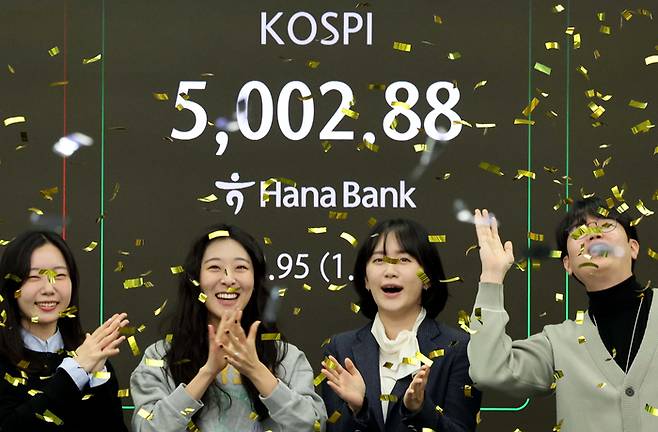
The index surged more than 1.6 percent shortly after the opening bell, topping 5,000 for the first time before retreating to close at 4,952.53. The pullback does little to diminish the significance of the move. As a forward-looking barometer of economic expectations, the rally sends a clear signal: optimism toward Korean assets has returned, reinforcing the government’s push to lift annual growth closer to 2 percent.
History provides useful perspective. After collapsing during the 1997 Asian financial crisis, the KOSPI reclaimed momentum in the 2000s on the back of the information technology boom, finally breaching 2,000 in July 2007. What followed, however, was a long stretch of stagnation. Political uncertainty, including last year’s emergency rule episode, dragged the index down to the low 2,300s by April. Since then, the rebound has been swift and decisive. Over the past three months alone, the KOSPI has gained nearly 30 percent, far outpacing Japan’s Nikkei.
Several forces have converged to drive the rally. The global artificial intelligence boom has propelled memory-chip giants such as Samsung Electronics and SK hynix, key suppliers of high-bandwidth memory that has become the “oil” of the AI economy. Korea’s shipbuilding industry has also regained investor attention amid protracted trade negotiations with the U.S. under U.S. President Donald Trump, while Hyundai Motor Group’s push into humanoid robotics has strengthened the narrative around “physical AI.”
Policy has played its part as well. President Lee Jae-myung’s administration has set an explicit target of reaching KOSPI 5,000 during its term and backed it with sweeping capital market reforms. Measures ranging from separate taxation of dividend income to amendments strengthening shareholder rights have helped bolster market sentiment. Meanwhile, targeted incentives — including special domestic re-entry accounts — are contributing to an improved environment that is gradually refocusing some individual investors’ attention on the domestic equity market after years of favoring U.S. stocks.
Yet this is precisely the moment for caution. The surge to 5,000 should be read as a vote of confidence, not a declaration of victory. Much of the recent rally has been fueled by liquidity and sentiment, concentrated in a narrow group of sectors — semiconductors, autos, shipbuilding and defense. Just three companies — Samsung Electronics, SK hynix and Hyundai Motor — now account for roughly 40 percent of the KOSPI’s total market capitalization. Meanwhile, the tech-heavy KOSDAQ has lagged badly, underscoring distortions beneath the headline number. A soaring index does not mean the broader economy is booming.
The structural challenge remains low growth. South Korea expanded by just 1 percent last year, slipping into contraction in the fourth quarter. Forecasts for this year from the International Monetary Fund and major investment banks cluster around the high-1 to low-2 percent range. Traditional pillars such as petrochemicals and steel are losing competitiveness, while polarization between flagship firms and the rest of the corporate sector is widening. Heavy regulation continues to weigh on investment and hiring, and the pipeline of new innovative companies remains thin.
If corporate earnings fail to broaden and economic fundamentals do not improve, investors can — and will — redirect capital abroad just as quickly as they returned.
Reaching KOSPI 5,000 is not the finish line. It is a warning sign as much as a celebration. The priority now should be structural reform: revitalizing growth through labor reform, restoring fiscal discipline and accelerating the transition to a more transparent, shareholder-friendly market. Only when earnings growth becomes broad-based and the economy’s underlying strength is restored can Korea credibly aspire not just to defend 5,000, but to move toward 6,000 and beyond.
Copyright © 매일경제 & mk.co.kr. 무단 전재, 재배포 및 AI학습 이용 금지
- “로봇 한 대도 못 들어온다”…현대차 노조, ‘아틀라스’ 현장 투입에 결사반대 - 매일경제
- [단독] “직장에선 잘 참다가 집에 오면 폭발”…병인줄도 모르고 사는 지독한 병 [심층기획, 아
- “교통비 등 월 23만원 파격 할인에 아저씨들도 우르르”…무슨 카드길래 - 매일경제
- “아파트만 집인가”…규제로 막히자 주택수요 여기로 우르르 - 매일경제
- [단독] 이 대통령 만난 코스피5000특위…‘디지털자산 활용한 코스닥3000 달성’ 제안 - 매일경제
- 한 돈 100만원 찍은 금값…“여윳돈 생길 때마다 계속 금 사모은다” - 매일경제
- 극도로 보수적이던 이 남자, 갑자기 마음 바뀌었다…AI 전쟁에 애플 ‘가세’ - 매일경제
- 3년반만 걸려 3000선, 4개월만에 4000선…가팔라지는 코스피 상승세, 6000도? - 매일경제
- “야쿠르트 아줌마 아닌 영웅입니다”...고독사 노인 마지막 길 지켜준 60대 여성 - 매일경제
- “뭔가 서류를 잊은 거 같다” 이정후, LA 공항에서 구금됐다 풀려났다 - MK스포츠