Samsung Electro-Mechanics delivers record revenue on AI and EV demand
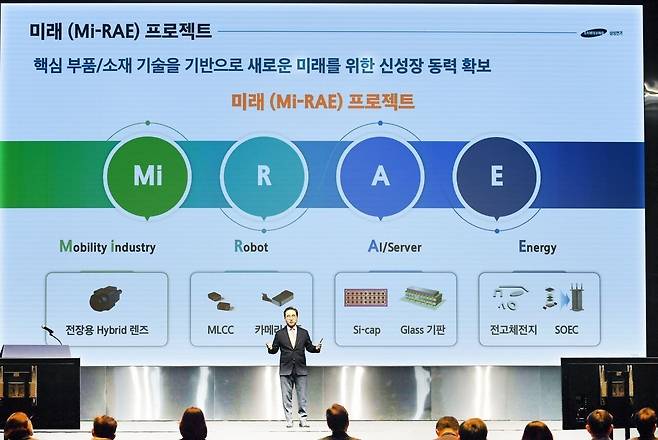
Samsung Electro-Mechanics capped 2025 with its highest-ever annual revenue as demand from AI servers and electric vehicles pushed sales of its high-performance components to new highs.
The South Korean electronics parts maker announced Friday that full-year revenue rose to 11.31 trillion won (about $7.7 billion), up 10 percent from 2024. Operating profit climbed 24 percent year-on-year to 913.3 billion won, its highest since 2021. Samsung Electro-Mechanics credited the growth to stronger shipments of multilayer ceramic capacitors, or MLCCs, for AI servers and power systems, as well as FC-BGA substrates used in high-end processors and autonomous driving systems.
Fourth-quarter results showed a similar pattern. Sales reached 2.9 trillion won, up 16 percent from a year earlier but flat sequentially. Operating profit for the quarter more than doubled year-on-year to 239.5 billion won, but fell 8 percent from the previous quarter, hinting at production and scaling challenges even amid strong demand.
Based on disclosed figures, Samsung Electro-Mechanics posted an operating margin of approximately 8.1 percent for the full year, with the fourth-quarter margin at about 8.3 percent. That marks a recovery from 4.6 percent in the same quarter of 2024. But it still remains modest by industry standards, especially during what is widely seen as a high-growth phase for AI infrastructure. Murata Manufacturing, the global market leader in MLCCs, reported an 18.3 percent operating margin for the first half of the fiscal year ending March 2025.
By segment, the clearest gains came from products tied to AI and automotive applications. The component division, home to MLCCs, recorded fourth-quarter revenue of 1.32 trillion won, up 22 percent from the previous year but down 4 percent from the third quarter, which the company attributed to year-end inventory corrections. MLCCs are microscopic capacitors that regulate voltage near processors. They are vital in AI servers, where electrical loads and heat are far more intense than in consumer electronics.
Package solutions, which includes FC-BGA substrates used to mount and connect advanced chips, saw revenue rise to 644.6 billion won in the fourth quarter, up 17 percent year-on-year and 9 percent sequentially. Optical solutions, which includes camera modules for smartphones and vehicles, also grew steadily, reaching 937.2 billion won, up 9 percent from the same period last year.
Samsung Electro-Mechanics said it expects demand in AI, server and vehicle-related markets to remain strong in 2026, and plans to expand its offerings of high-performance components accordingly. It also highlighted future bets on glass substrates — an emerging alternative to conventional circuit boards — and actuators for humanoid robots, describing them as part of its long-term technology roadmap.
At CES 2026 earlier this month, CEO Chang Duck-hyun said the company’s FC-BGA production lines are expected to operate at full capacity in the second half of the year, citing rising orders from global data center builders.
Copyright © 코리아헤럴드. 무단전재 및 재배포 금지.