Kospi gains on strong tech, auto, defense stocks
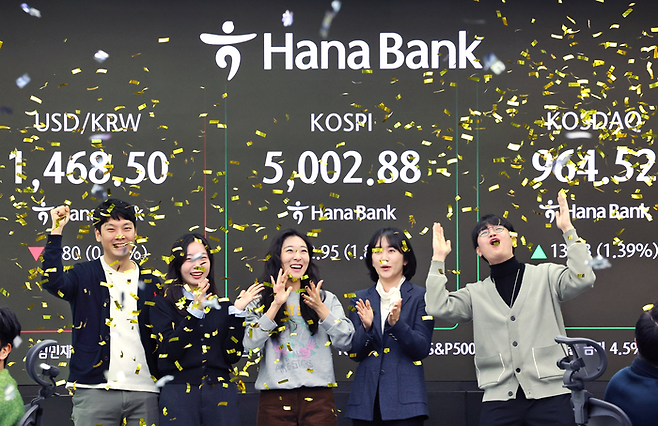
According to the Korea Exchange on Thursday, the combined market capitalization of the top 10 Kospi stocks has increased by 1,254.26 trillion won ($856.15 billion) since the launch of the Lee Jae-myung administration.
The amount accounts for 61.28 percent of the Kospi’s entire market cap increase over the period.
The combined market value of Samsung Electronics common and preferred shares reached 992.38 trillion won at the close and briefly exceeded 1,000 trillion won intraday, marking the first time a single listed company in Korea crossed that threshold.
Samsung Electronics’ market capitalization has risen by 565.33 trillion won since the current administration took office in June 2025. Its stock price has climbed 168.14 percent over the same period. Including preferred shares, Samsung accounted for 30.21 percent of Kospi‘s overall market cap increase.
Samsung Electronics is viewed by some analysts as undervalued relative to global peers despite forecasts that its operating profit this year could exceed 150 trillion won.
IBK Securities Co. estimates operating profit at 155.59 trillion won, while UBS has raised its forecast range from 135 trillion to 171 trillion won.
Globally, only a small number of companies, including Nvidia Corp., Alphabet Inc., Apple Inc. and Microsoft Corp., generate more than $100 billion in annual operating profit.
FnGuide data showed Samsung’s consensus price-to-earnings ratio stood at 9.88 as of the previous session, compared with Micron Technology Inc.’s 12.09.
SK hynix and Hyundai Motor, ranked second and third by market capitalization.
SK hynix, a leading supplier of high-bandwidth memory, benefited from expectations of a semiconductor upcycle, with its market capitalization rising by 398.58 trillion won to 549.64 trillion won since June last year.
Hyundai Motor added 70.64 trillion won in market value this year, moving into third place amid renewed investor interest tied to robotics-related growth prospects.
Several stocks that were not among the top 10 a year ago have also emerged as market leaders.
Hanwha Aerospace Co. climbed to seventh place as heightened geopolitical tensions following the launch of the Donald Trump administration in the U.S. supported defense stocks.
HD Hyundai Heavy Industries Co. entered the top 10 after its shares nearly doubled over the past year on expectations linked to the Making American Shipbuilding Great Again initiative aimed at revitalizing the U.S. shipbuilding industry.
Market participants caution, however, that policy continuity will be critical for the Kospi to stabilize above the 5,000 level.
The index has risen by more than 600 points in January alone, raising concerns about short-term overheating, while gains have been concentrated in large-cap stocks, widening sectoral disparities.
“For the Kospi to settle at 5,000, momentum needs to spread across a broader range of industries,” said Jung Yong-taek, a head researcher at IBK Securities.
The tech-heavy Kosdaq also rebounded, reviving expectations of a return to the 1,000 level. The Kosdaq index closed at 970.35 on Thursday, up 2 percent, from the previous session.
Sentiment in the Kosdaq market remains mixed. Since the start of the year, the index has risen about 2 percent, compared with gains of more than 16 percent for the Kospi.
Over the past three months, the Kosdaq’s increase has remained below 10 percent, extending a pattern of failing to reclaim the 1,000 level for more than five years.
Liquidity gaps have also widened, with average daily trading value on the Kospi rising by more than 17 trillion won since the end of last year, compared with an increase of about 5 trillion won on the Kosdaq.
Sector and stock-level divergence has become more pronounced.
On sessions when declines in large-cap biotechnology stocks such as Alteogen Inc. weighed on the index, shares of robotics, machinery and some battery-related companies still posted gains.
Analysts say policy measures, including tighter listing and delisting rules, efforts to activate venture capital and steps to attract institutional investors, could influence confidence in the Kosdaq, while some expect profit-taking in the Kospi to rotate into the Kosdaq if the benchmark enters a consolidation phase after surpassing 5,000.
Copyright © 매일경제 & mk.co.kr. 무단 전재, 재배포 및 AI학습 이용 금지
- “로봇 한 대도 못 들어온다”…현대차 노조, ‘아틀라스’ 현장 투입에 결사반대 - 매일경제
- [단독] 이 대통령 만난 코스피5000특위…‘디지털자산 활용한 코스닥3000 달성’ 제안 - 매일경제
- "로봇 1대도 현장투입 안돼" 아틀라스 거부한 현대차 노조 - 매일경제
- “1주택자 보호하겠다”…이 대통령 발언에 ‘다주택자’ 셈법 복잡해지나 - 매일경제
- 한 돈 100만원 찍은 금값…“여윳돈 생길 때마다 계속 금 사모은다” - 매일경제
- 은행자금 증시로 대이동…‘개미 빚투’ 29조 사상 최대 - 매일경제
- “삼성전자 아직도 저평가…올해 ‘20만 전자’ 간다” - 매일경제
- [단독] “1·2세대 실손 웃돈주고 사라”…재매입 제도 학을 떼는 보험사들 - 매일경제
- 트럼프가 조롱하더니…마크롱 ‘탑건’ 선글라스 ‘대박났네’ - 매일경제
- “뭔가 서류를 잊은 거 같다” 이정후, LA 공항에서 구금됐다 풀려났다 - MK스포츠