From 12 listings to 5,000 points: Korean market reaches historic peak
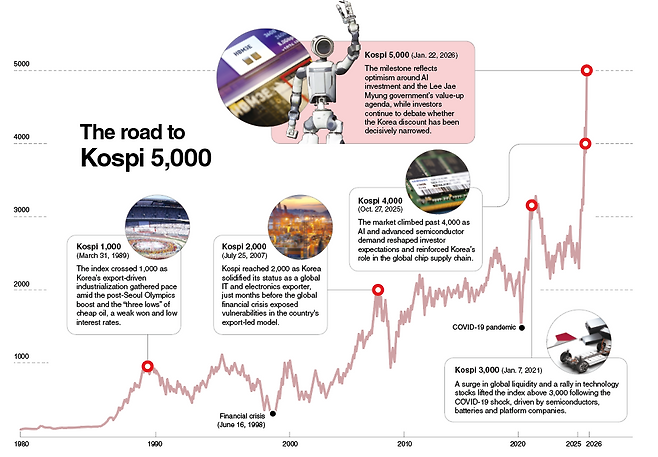
South Korea’s benchmark Kospi crossed the 5,000 mark on Thursday, a symbolic milestone that coincided with the 70th anniversary of the country’s stock market and capped a powerful rally fueled by policy optimism and last year’s sharp gains.
From just 12 listed companies at its launch, the Korean stock market has expanded to 2,659 firms across the main board and the tech-heavy Kosdaq. Combined market capitalization now stands at about 4,518 trillion won ($3.1 trillion) — nearly 300,000 times larger than in its early years.
The market traces its origins to March 3, 1956, when what was then called the Daehan Securities Exchange opened with 12 listed companies following efforts by the Korea Securities Dealers Association, founded in 1953, to establish a modern capital market.
Trading in the early years relied on open outcry, and total stock turnover in the first year amounted to about 390 million won in today’s terms.
Growth accelerated after the government enacted the Securities and Exchange Act in 1962, but the market soon suffered its first major crisis when speculative excesses led to a settlement failure later that year. The episode forced a prolonged trading halt and dealt a blow to investor confidence.
Policy support in the late 1960s and early 1970s — including laws aimed at promoting capital markets and encouraging initial public offerings — spurred a surge in listings. The number of listed firms surpassed 100 for the first time in 1973, cementing the stock market’s role in financing Korea’s industrial expansion.
The Kospi index was first published on Jan. 4, 1983, with a base value of 100 tied to market capitalization in 1980. It crossed 1,000 for the first time in March 1989, as rapid economic growth ahead of the Seoul Asian Games and Olympics broadened retail participation. The boom was reinforced by the “three lows” — falling oil prices, interest rates and a weak dollar.
Korea fully opened its stock market to foreign investors in 1992, deepening global integration but also increasing exposure to external shocks. During the Asian financial crisis, the Kospi plunged to a low of 277.37 in June 1998 as corporate failures mounted amid an IMF-led bailout.
The index recovered to reclaim the 1,000 level in 1999 but slid again in the early 2000s following the collapse of the technology bubble and the impact of the Sept. 11 attacks. It rose above 2,000 in July 2007, before the global financial crisis sent it back below 1,000 the following year.
A semiconductor-led upcycle lifted the index above 2,500 in 2017, though gains later faded amid US-China trade tensions. In March 2020, the COVID-19 shock pushed the Kospi below 1,500, before a surge in retail buying and unprecedented global monetary easing drove a rebound that culminated in the index breaking 3,000 in January 2021.
Political uncertainty weighed on the market just over a year ago, dragging the Kospi down to 2,399.49 at the end of 2024. Sentiment improved after President Lee Jae Myung took office, with investors betting on measures to boost shareholder returns and revitalize the equity market. The index reclaimed 3,000 in June, entered the 4,000 range in October and reached the 5,000 milestone in January this year.
Copyright © 코리아헤럴드. 무단전재 및 재배포 금지.