Kospi tops 5,000, raising hopes Korea discount is easing
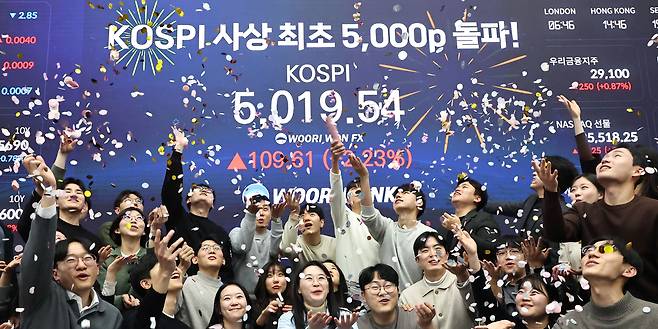
South Korea’s benchmark stock index Kospi surged past the 5,000-point mark for the first time during trading Thursday, raising expectations that the long-standing “Korea discount” — a term referring to the relatively low valuation of domestic stocks — may finally be fading.
The Kospi soared past the 5,000 mark shortly after the opening bell and reached as high as 5,019.54 during trading. The index later pared some of its gains and closed at 4,952.53, up 0.87 percent from the previous session and setting a new high on a closing basis.
With the Kospi climbing to a fresh high, blue-chip stocks also hit new records. Samsung Electronics shares surged to a record-high of 157,000 won ($107) during intraday trading, briefly touching 160,000 won during premarket hours. Hyundai Motor topped 590,000 won for the first time, while SK hynix climbed to an intraday high of 773,000 won.
The Kospi first crossed the 3,000-point threshold in January 2021, but remained stuck in the 2,000-point range for more than four years thereafter.
Following the inauguration of the new administration in June, the index has staged a sharp ascent, underpinned by government-led initiatives, including amendments to the Commercial Act, the separate taxation of dividend income and various tax incentive schemes.
The Kospi reached 4,000 points for the first time last year on Oct. 28, and less than three months later, it made history in soaring past 5,000.
The 5,000-point milestone carries particular significance, as President Lee Jae Myung had pledged during his presidential campaign to lift the Kospi above the figure as part of his commitment to eliminate the Korea discount.
Though the Kospi has nearly doubled over the past year, rising from 2,547.06 on Jan. 22, 2025, exactly a year earlier, experts say the Korea discount is far from over, with lingering challenges still to be addressed.
“Following the impressive rally, Korean equities’ valuation has improved but remains relatively lower than global peers,” said Sue Lee, Asian-Pacific head of Index Investment Strategy at S&P Dow Jones Indices.
She pointed out that the one-year forward price-to-earnings ratio for the S&P Korea Broad Market Index, tracking the overall performance of Korean equities, stands at 17 times, well below that of the global benchmark at 21 times and economic peer Taiwan at 24 times.
“This suggests there may be further upside potential for Korean companies’ valuations, provided ongoing efforts by the government and corporations continue,” Lee said.
Lee Hyo-seob, senior research fellow at the Korea Capital Market Institute, contended, "The Korea discount has eased significantly, but it is still too early to say it is over."
Lee explained that addressing the Korea discount is not simply about the stock index reaching certain milestones, but is more deeply rooted in resolving long-standing shortcomings in the capital market, including shareholder-unfriendly corporate governance.
“In that sense, the Korea discount has yet to be fully resolved. I would say Korea has only just begun to truly tackle the discount,” he said.
Experts agreed that the undervaluation can only be fully eliminated through further commitment of corporates.
Lee noted that the government has largely done its part to support the equity market, adding that the onus now lies with companies to follow through. With strong corporate commitment to tackling the Korea discount, the Kospi could climb to 6,000 points and beyond, he said.
“For a true resolution of the Korea discount, corporates must demonstrate concrete implementation of governance reforms, including principled retirement of treasury shares and broader shareholder return measures,” he said.
“Progress is evident in certain areas — for instance, increased focus on shareholder returns has resulted in higher dividend payouts over recent years — though further enhancements are needed for Korea to fully align with developed market standards,” Sue Lee said.
Market analysts viewed the Kospi’s rally as sustainable, though moderation in its pace is warranted for the time being.
“With earnings and liquidity continuing to drive the market, the Kospi’s medium-term upward trajectory is expected to remain intact,” said Choi Jae-won, an analyst at Kiwoom Securities.
“The sharp rally since the start of the year has resulted in technical overheating, and amid heightened external uncertainties, a period of volatility is likely, warranting short-term moderation in the Kospi’s pace,” Choi said, adding the market is likely to shift toward broader stock diffusion.
Copyright © 코리아헤럴드. 무단전재 및 재배포 금지.