Right-wing bill to combat influence operations sparks debate
This is the second in a series of articles exploring how key foreign and security issues are politicized, how political issues spread beyond South Korea’s borders, and the costs this carries for South Korea’s national interest. -- Ed.
South Korea’s National Assembly is facing another round of “anti-China, pro-China” finger-pointing, this time over a bill pushing for the disclosure of internet users’ locations.
The conservatives, who proposed the bill earlier this year, say that the proposed change will help the country fend off foreign influence operations, but opponents say it is rooted in the opposition bloc’s anti-China ideologies, while others point out that incomplete technology could lead to false accusations.
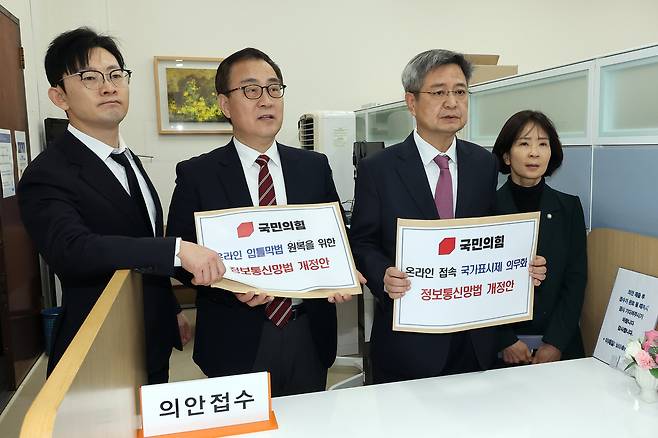
On Jan. 15, Rep. Kim Jang-kyom of the main opposition People Power Party proposed the revision of the Act on Promotion of Information and Communications Network Utilization and Information Protection.
The bill is designed to instruct major web portals and social media outlets at home and abroad to disclose on their platforms where each user's account is based, where they are active and whether they have changed their internet protocol address to obscure their location.
South Korea's media watchdog would also be given the authority to require these platforms to submit relevant data upon its request.
The bill introduced by Kim, former chief of Munhwa Broadcasting Corp., was in part inspired by US social media outlet X's move to display the location a user's account was created in, as well as its plan announced in November to warn other users when a commenter is connected via a proxy.
Mandating such disclosures would enable South Korean users to defend against foreign attempts not only to deceptively promote a specific political campaign, but also efforts to dupe them via spoofing or phishing, Kim's office says.
The bill set off a round of accusations between the two main parties. The Democratic Party of Korea claimed that it would incite hatred toward a specific country and undermine efforts to restore Seoul-Beijing ties. The conservative party hit back by accusing the ruling bloc of covering up foreign influence operations and colluding with those behind such actions.
In response, the Democratic Party's senior deputy spokesperson Kim Min-joo told The Korea Herald that the bill could engender a political campaign to falsely accuse ordinary individuals of being part of a broader influence operation by arbitrarily linking their views expressed online with their country of origin.
"If I speak ill of (US President Donald) Trump, am I interfering in US politics and becoming part of the influence operations against Trump?" the spokesperson said.
The back-and-forth between the progressive and conservative blocs echoes an earlier spat over a proposal to revise the Criminal Act. That revision, proposed by Democratic Party lawmakers, would make protests that incite hatred toward specific groups punishable by law. At the time, the bill’s sponsors cited a series of anti-China rallies that were held late last year.
While the revision would apply to any protests targeting specific groups or nationalities, conservatives here attacked the bill as being “pro-China” and violating freedom of expression.
The bickering continues, but experts point to the questionable accuracy and transparency of IP-based geolocation technologies like those of X.
According to Olga Belogolova, director of the Emerging Technologies Initiative at Johns Hopkins University's School of Advanced International Studies, such technology is not always reliable.
"Sophisticated threat actors cannot always be located using IP addresses," Belogolova said, adding that there could be cases of innocent users traveling abroad being implicated as "foreign actors."
Luca Luceri, research assistant professor specializing in information science at the University of Southern California, said that the accuracy of these technologies is hard to guarantee unless X publicly discloses its methodology, data sources or validation procedures.
"Without transparency, external researchers cannot independently verify performance claims," he said.
While public sentiment appears to be leaning toward disclosing user locations, experts say related measures could lead to false accusations or diplomatic hiccups.
According to a joint survey by Seoul National University's Institute for Future Strategy and Hankook Research, some 64 percent of respondents supported disclosing online commenters' locations. The support level was high regardless of the respondent's political affiliation. Among those who identified themselves as conservatives, 71 percent were in favor, while 64 percent of liberals were also supportive of the idea.
“If the focus (of the media manipulation debate) goes to a specific country for political purposes, the country will feel intimidated,” said Lim Jong-in, professor emeritus of cybersecurity and information protection at Korea University.
Moreover, such legislation could cause the international community to misunderstand that South Korea is trying to restrict freedom of speech, and the government's possible reverse discrimination against South Korean internet firms in applying its new regulation, Lim said.
Lim also raised the possibility that enforcing an imperfect detection technology by law could backfire and invite more sophisticated foreign influence operations.
"(Foreign operatives) could disguise themselves as Japanese users if their mission is to disrupt ties between South Korea and Japan, while some others might pretend to be Chinese or US users," he said.
"As with climate change, we need to discuss this issue with the international community to make (the move to counter influence operations) realistic,” Lim said, going on to say that without international cooperation, the bill's mechanism could be exploited for political purposes and end up triggering unnecessary conflict with neighboring countries like China.
Luceri of the University of Southern California said the use of geolocation data could be a double-edged sword, because there is room for manipulation and misuse by those in power to target dissidents.
"Without strong safeguards, that information could be used for broader surveillance or political monitoring," he said.

South Korea, one of the most wired countries in the world, is no stranger to influence operations on the internet.
History shows online posts are powerful tools for shaping the political view of online users here and reinforcing their beliefs based on their political inclinations.
From 2009 to 2012, the National Intelligence Service and the Ministry of National Defense under the conservative Lee Myung-bak administration undertook a covert operation to make public opinion favorable to the conservatives. On the other hand, the liberal Democratic Party members colluded with a man using the handle Druking to manipulate opinion in a way favorable to the liberal party from 2014 to 2018.
Moreover, there have been suspicions of a growing threat of China's psychological warfare against South Korea.
According to a 2024 study analyzing online posts from 2023 and 2024 by Kim Eun-young, professor of crime, law and society at Catholic Kwandong University, and Hong Suk-hoon, professor of international relations at Changwon National University, at least 77 accounts on Naver and 239 accounts on YouTube were suspected to be operated in an organized manner by Chinese entities.
The researchers claimed these accounts had consistently posted malicious comments about South Korean-made goods and services in response to news content about industries in which South Korea and China are competitors.
An earlier study in 2023 by Yun Min-woo, professor of police science at Gachon University, concluded that some 50 accounts on Naver had posted tens of thousands of online comments from September to November 2023 on news content about South Korea's foreign affairs, in a suspected influence operation to promote China's cultural supremacy and trigger social division in South Korea.
However, neither study could confirm where these accounts were actually based. Yun suspected that their features resembled transnational campaigns confirmed to have been led by Chinese actors by authorities in the United States and the European Union.
South Korea's rival political parties have used self-serving logic to defend their stances on the recent survey and findings.
The conservative People Power Party has claimed that Chinese operatives aided the Democratic Party in previous elections, which was dismissed by the Democratic Party as a baseless "far-right incitement."
Belogolova of Johns Hopkins University, who formerly led policy efforts to counter influence operations at US social media operator Meta, suggests government intervention.
She said the government could support platforms' investigations into suspected influence operations or consider sanctioning individuals identified as having masterminded influence operations.
"There is never a way to completely eliminate influence operations by foreigners or domestic actors," she said. "But companies and governments and members of civil society can create deterrence and make it more difficult for threat actors to run these kinds of campaigns."
Copyright © 코리아헤럴드. 무단전재 및 재배포 금지.