Lee's comment exposes rift in ruling bloc over prosecution reform
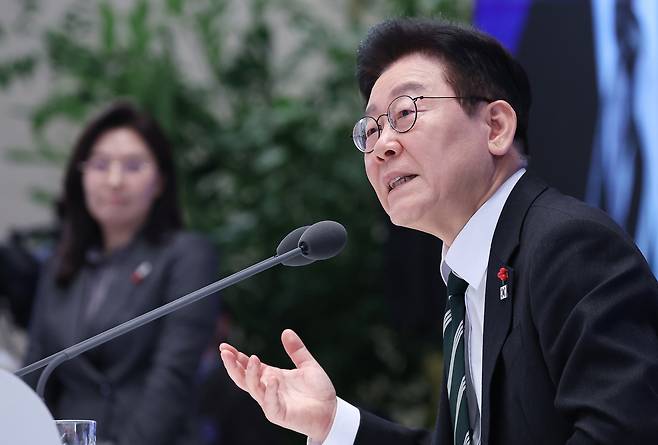
President Lee Jae Myung’s suggestion that prosecutors should retain some authority to request supplementary investigations has exposed divisions within the ruling bloc, as hard-liners push for a strict separation between investigation and indictment.
At the center of the debate is supplementary investigation authority — the power of prosecutors to request additional investigative work after police have transferred a case, or when they determine that key facts remain unclear.
The discussion over whether to abolish this authority entirely or allow narrowly defined exceptions was reignited after Lee, at a New Year’s press conference on Wednesday, warned that a blanket ban could cause practical problems.
“I believe, in principle, that supplementary investigations should not be conducted,” Lee said — his first public comments on the issue since the government introduced draft legislation in mid-January to dismantle the prosecution office. “But there are exceptional cases where it may be necessary.”
Lee cited cases transferred just days before the statute of limitations expires, where a simple factual check could determine whether prosecution is possible. Under a total ban, even basic confirmations could be delayed by formal request-and-response procedures, potentially allowing such cases to lapse.
Lee’s remarks quickly drew backlash from hard-line lawmakers in the ruling Democratic Party of Korea, who reiterated calls Wednesday for the complete abolition of prosecutors’ supplementary investigation powers.
“In any circumstance, investigation and indictment must be separated. I am absolutely opposed to supplementary investigation authority,” said Rep. Park Jie-won, a member of the National Assembly’s Legislation and Judiciary Committee, during a Thursday forum titled “What Does the Completion of Prosecution Reform Mean?”
Referring to Lee’s comment about the need for exceptions, Park added that the president’s concerns could be addressed through more precise legal drafting. “Personally, I believe the issues the president raised can be resolved by writing the law more carefully,” he said.
Rep. Choo Mi-ae, a former justice minister, rejected the argument that prosecutors need this authority due to their superior investigative capabilities or due to shortcomings in police investigations.
Choo pointed to mishandled evidence during a bribery probe involving former first lady Kim Keon Hee. She cited an investigation by the Seoul Southern District Prosecutors’ Office into alleged illegal political donations involving Jeon Seong-bae, also known as Geonjin, during which paper bands and stickers used to bundle cash were reportedly lost while in prosecutorial custody.
Rep. Kim Seung-won, a former judge, echoed this sentiment, drawing lessons from past reform efforts. “Now is exactly the time to remain faithful to that demand and sense of duty. This feels like the final tug-of-war.”
After the Assembly seminar, President Lee underscored that reform “should be guided by practical and effective considerations” — specifically, “which approach would help protect citizens’ human rights and guarantee their substantive rights.”
“A reform cannot be called reform if, instead of improving people’s lives, it clings to slogans and lofty causes while only deepening pain and confusion,” Lee said during a senior aides’ meeting.
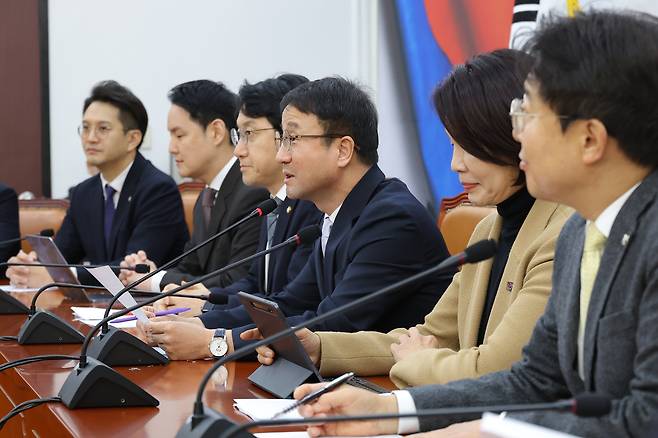
However, within the ruling party, a more cautious faction has begun to emerge, echoing President Lee’s call for nuance.
The Democratic Party held a policy general meeting on Thursday to discuss the government’s draft legislation to split the prosecution service into a Public Prosecution Office and a Serious Crimes Investigation Agency.
The party began formal deliberations at a policy general meeting on Jan. 15, and held a second session Tuesday — which also served as a public hearing — to gather expert opinions.
Rep. Kim Han-kyu, the Democratic Party’s senior deputy floor leader for policy, said Thursday after the policy general meeting that “opinions were split on supplementary investigation authority.”
“Several lawmakers expressed views consistent with President Lee Jae Myung’s, saying the authority should be permitted in exceptional cases,” Kim said. “Our goal is to consolidate the views expressed today, gather additional input from various party bodies — including the leadership — and communicate that to the government.”
“Discussions will move toward narrowing differences, as we ultimately share responsibility with the government for producing a unified bill,” Kim added.
Presidential spokesperson Kang Yu-jung said President Lee was not trying to box the discussion into an either-or argument.
In a radio interview with CBS, Kang said Lee did not mean to treat supplementary investigation authority as simply “necessary” or “unnecessary,” citing cases approaching the statute of limitations as an example.
“If a case is passed around with only two days left before the statute of limitations expires and ends up vanishing, the victim is left with nowhere to turn — not within the investigative system, not within the judiciary, not anywhere in Korea’s institutions,” she said.
Copyright © 코리아헤럴드. 무단전재 및 재배포 금지.