Korean economy contracts 0.3% in Q4 amid sluggish domestic demand
According to preliminary figures announced by the Bank of Korea on Thursday, Korea’s real gross domestic product (GDP) shrank 0.3 percent in the October-December period from the previous quarter.
Korea’s economy grew 1.2 percent in the first quarter of 2024 before contracting 0.2 percent in the second quarter. It rose 0.1 percent in the third and fourth quarters, respectively, followed by another contraction of 0.2 percent in the first quarter of 2025.
The economy rebounded in the second quarter, expanding 0.7 percent, and 1.3 percent in the third quarter, but contracted in the fourth quarter.
The fourth-quarter result was 0.5 percentage point below the BOK’s forecast of 0.2 percent growth released two months earlier, marking the weakest performance since the fourth quarter of 2022, when the economy shrank 0.4 percent.
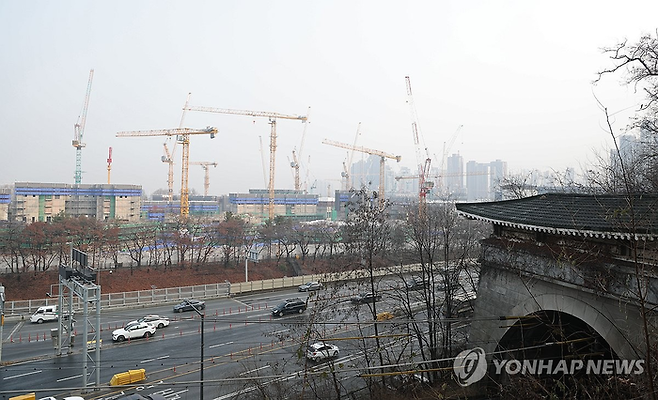
The BOK cited base effects following strong growth in the third quarter and a downturn in construction investment as key factors behind the fourth-quarter slowdown.
However, the wide gap between the forecast and the actual outcome is likely to fuel criticism that the BOK’s outlook was overly optimistic.
By sector, private consumption rose 0.3 percent from the previous quarter, supported by services such as healthcare, despite weaker demand for goods including passenger cars.
Government spending increased 0.6 percent, driven mainly by higher national health insurance benefit spending.
Construction investment, on the other hand, fell 3.9 percent as both building and civil engineering activity remained weak. Facilities investment declined 1.8 percent, led by transport equipment such as automobiles.
Exports shrank 2.1 percent due to reduced shipments of automobiles, machinery, and equipment, while imports fell 1.7 percent, reflecting lower purchases of natural gas and automobiles.
In terms of contributions to growth, domestic demand shaved 0.1 percentage point off fourth-quarter growth, while net exports, or exports minus imports, reduced growth by 0.2 percentage point.
The contribution from domestic demand dropped sharply from the previous quarter, falling 1.3 percentage points from a positive 1.2 percentage points in the third quarter.
Within domestic demand, construction investment and facilities investment reduced growth by 0.5 percentage point and 0.2 percentage point, respectively. Private consumption and government consumption each added 0.1 percentage point.
By industry, manufacturing output fell 1.5 percent amid weakness in transport equipment, machinery, and equipment. Electricity, gas, and water utilities declined 9.2 percent, led by the power sector, while construction output dropped 5 percent. Agriculture, forestry, and fisheries grew 4.6 percent, and services expanded 0.6 percent.
Real gross domestic income (GDI) rose 0.8 percent in the fourth quarter, exceeding the contraction in real GDP.
Copyright © 매일경제 & mk.co.kr. 무단 전재, 재배포 및 AI학습 이용 금지
- “중고거래 하고 받은 돈에, 이럴수가”…나도 모르게 당하는 ‘이것’ - 매일경제
- “여보, 돈 없어도 벤츠는 타야죠”…‘모닝 값’에 나오더니, 불티나게 팔렸다 [최기성의 허브
- "스마트폰 시대 끝난다 … 요리·길 안내 'AI 안경'이 대체할 것" - 매일경제
- [속보] 코스피, ‘꿈의 오천피’ 시대 열렸다…삼전·SK하닉 3%대 급등 - 매일경제
- "조합원 70%가 이주비 대출 0원" 날벼락 - 매일경제
- 동남아 현지직원 자녀 한국초청…K문화 풀코스 대접한다는 이 기업 - 매일경제
- 트럼프, ‘그린란드 관세’ 철회…“그린란드 논의 틀 마련해” - 매일경제
- ‘영업익 1조’ 달성 2년만에 2조 찍었다…새 이정표 세운 삼성바이오 - 매일경제
- [단독] 삼성전자 ‘특허전담조직’ 직원이 회사기밀 빼돌렸다가 구속 - 매일경제
- “누군가에게는 일생일대의 기회” 김하성·송성문 빠진 WBC 대표팀은 대안 고민중 [MK현장] - MK스