From national icon to global contender, Pororo’s producer eyes next chapter
전체 맥락을 이해하기 위해서는 본문 보기를 권장합니다.
"I majored in design and started out in UI (user interface) work before moving into animation," Woo said during an interview with The Korea Herald on Jan 12. "From the beginning, I've always worked across both creative and business roles. In the Korean animation IP (intellectual property) business, you simply can't separate the two."
"Japan began making comics and animation as early as the 1920s and 30s. The US had Mickey Mouse and Snow White long before that," Woo said. "Korea went through Japanese colonization, the Korean War and reconstruction. Content creation only really began to take shape in the 1960s and 70s."
이 글자크기로 변경됩니다.
(예시) 가장 빠른 뉴스가 있고 다양한 정보, 쌍방향 소통이 숨쉬는 다음뉴스를 만나보세요. 다음뉴스는 국내외 주요이슈와 실시간 속보, 문화생활 및 다양한 분야의 뉴스를 입체적으로 전달하고 있습니다.
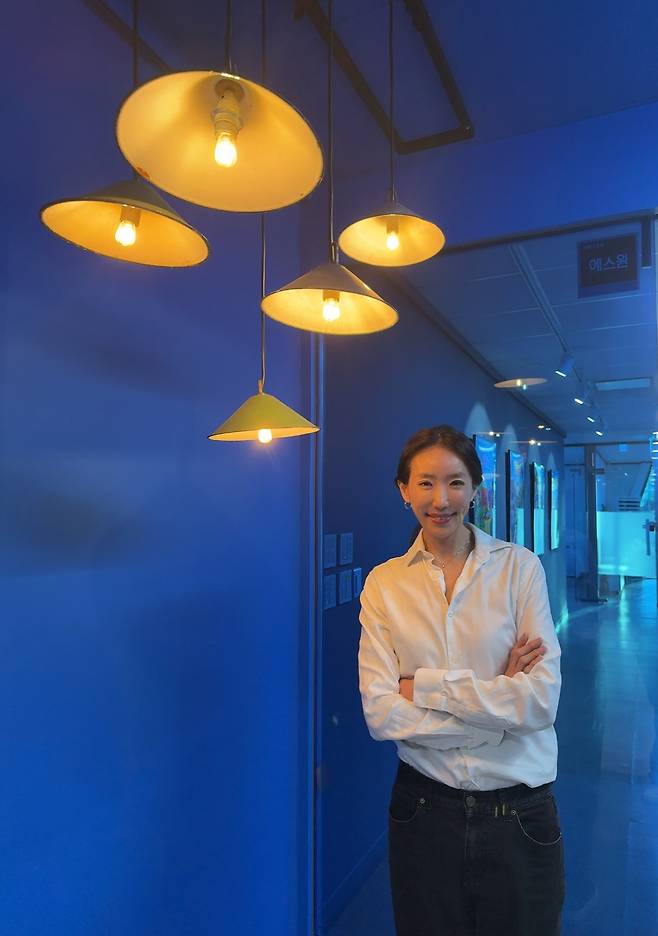
By any measure, “Pororo the Little Penguin” is one of South Korea’s most recognizable characters. Since debuting in 2003, the blue penguin has anchored a domestic animation industry that previously struggled to prove commercial viability.
Yet two decades on, even Pororo has found it difficult to achieve the kind of global cultural breakthrough recently accomplished by the Netflix animated hit “KPop Demon Hunters.”
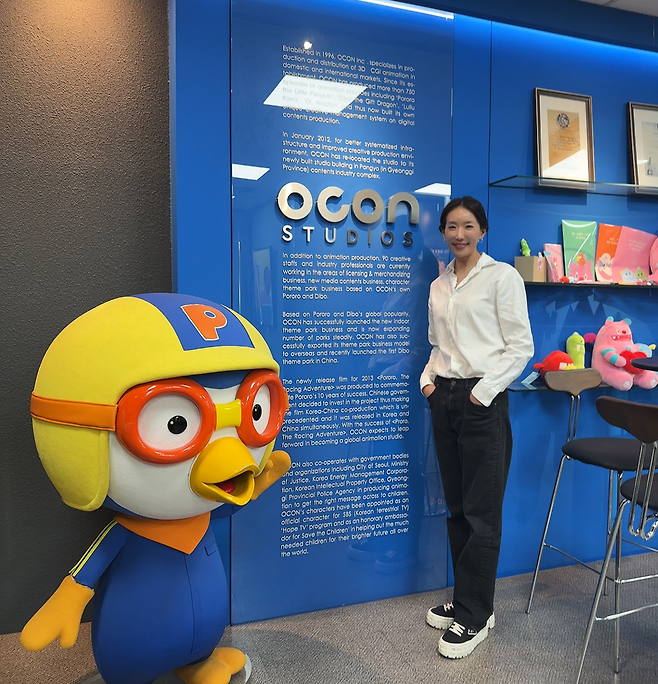
For Woo Jee-hee, CEO of animation studio OCON, the gap is not about effort or longevity. It is structural — rooted in how Korea has historically built its character intellectual property ecosystem. With stronger business practices and further deregulation of the local animation industry, she said, Pororo could still emerge as the next Korean animation phenomenon.
“I majored in design and started out in UI (user interface) work before moving into animation,” Woo said during an interview with The Korea Herald on Jan 12. “From the beginning, I’ve always worked across both creative and business roles. In the Korean animation IP (intellectual property) business, you simply can’t separate the two.”
Woo, who has spent more than 25 years in the industry, argues that Korea remains a global latecomer in character-based content. While the US and Japan built deep libraries of source material across decades — then expanded them through secondary and tertiary productions — Korea lacks that accumulated foundation.
“Japan began making comics and animation as early as the 1920s and '30s. The US had Mickey Mouse and Snow White long before that,” Woo said. “Korea went through Japanese colonization, the Korean War and reconstruction. Content creation only really began to take shape in the 1960s and '70s.”
Even then, most Korean animation professionals worked as subcontractors for US and Japanese studios rather than developing original IP. Pororo, Woo said, was among the first Korean animation projects to demonstrate that original characters could generate sustained business.
“Before Pororo, there really wasn’t a case that could be called an industry-scale business,” she said. “Pororo changed perceptions. People began to think, ‘You can actually make money with animation.’”
Yet the structural problems never disappeared. Domestic broadcasters, Woo said, paid a fraction of production costs — sometimes less than one-twentieth — and strict advertising regulations limited sponsorships and product placement.
“Even today, animation production costs around 2.6 billion won ($1.76 million), but broadcasters pay under 100 million won,” she said. “Advertising barely attaches. Product placement advertising in children’s animation is restricted by law. Toys are almost the only option.”
From children’s TV to ‘participatory’ content
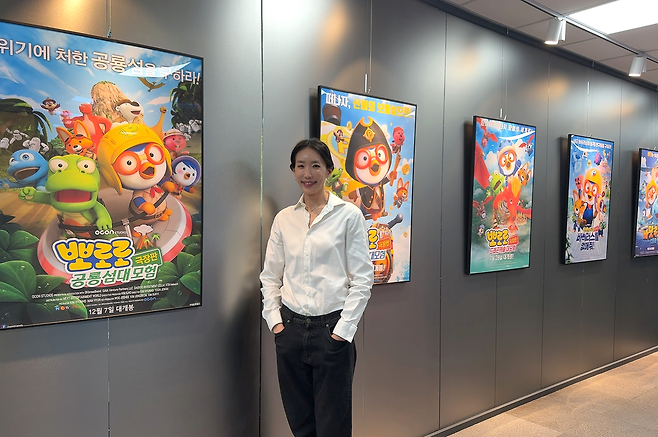
OCON has tried to expand Pororo beyond its preschool origins. Last month’s theatrical release, “Pororo Movie: Sweet Castle Adventure,” was positioned as participatory content, with collaborations extending into convenience stores and offline promotions.
“These were short-term, film-centered collaborations — not large-scale,” Woo said. “Domestically, Pororo already works with food brands, toys, stationery and theme parks. There are eight or nine Pororo theme parks in Korea.”
Overseas, however, expansion remains far harder.
“Foreign markets are not easy,” she said.
One of Pororo’s most unexpected successes came not from official planning, but from fandom. Zanmang Loopy — a mischievous, meme-driven offshoot of Pororo’s gentle character Loopy — exploded in popularity among adults, particularly in China.
“Loopy was originally a very mild, well-behaved character with little presence in the main series,” Woo said. “Fans started mocking that sweetness online, and it went viral.”
The result was lucrative licensing deals, including with Chinese retailer Miniso, and collaborations that extended to adult-oriented brands.
“When fans grow the character themselves, the chance of success is much higher,” Woo said. “That’s why we separate trademarks — to target adults with different personas, platforms and products.”
The strategy reflects Woo’s broader view: Korea’s character industry must escape its confinement to the infant market.
“To sell key rings to women in their 20s and 30s, you need entirely different content,” she said. “Staying only in the preschool space limits market size.”
Why “KPop Demon Hunters” was different
Woo does not dismiss the success of “KPop Demon Hunters,” but she contextualizes it.
“It reportedly received 80 billion to 90 billion won in investment,” she said. “In Korea, even securing 10 billion won is rare.”
Animation, she added, requires long-term commitment — often three years or more — before any value emerges. Few investors are willing to wait.
“Everyone hesitates because there’s no experience,” she said. “You learn by failing, by testing repeatedly. Animation doesn’t allow that easily.”
Looking ahead, Woo sees international co-production, particularly with US studios, as the most realistic way forward.
“We know how to produce efficiently. The US knows original storytelling and marketing,” she said. “If they handle the script and marketing, and we handle production, it could work.”
Pororo, she emphasized, remains a stable IP with extensive data across merchandising and licensing.
“That’s why co-developing products with US partners makes sense,” she said. “We already have decades of accumulated experience.”
Missing ingredient is sincerity
Ultimately, Woo believes Korea’s character industry lacks emotional depth, not talent.
“Korean characters are cute. That’s our strength,” she said. “But long-lasting IP needs sincerity.”
She contrasted Japanese animations targeting adults — often infused with introspection and emotional resonance — with Korea’s reliance on provocative webtoon trends.
“Provocation sells fast, but it doesn’t create true fans,” Woo said. “To last, a character must move people.”
She recalled how characters from Japanese sports manga series “Slam Dunk” or the American animated sitcom “The Simpsons” remain vivid across generations.
“You remember their personalities, their pride, their struggles,” she said. “That’s what creates lifelong attachment.”
For Korea to produce its own multigenerational icons, Woo argued, creators must be given time and freedom to tell stories with genuine emotional weight.
“Five years to make a work and decades for it to live on,” she said. “That’s how real IP is born — not from quick success, but from sincerity.”
Copyright © 코리아헤럴드. 무단전재 및 재배포 금지.