Lee downplays US threat of 100% semiconductor tariffs
전체 맥락을 이해하기 위해서는 본문 보기를 권장합니다.
He added that in "intense confrontational and unstable phases," unexpected variables often emerge, cautioning that "if we react too strongly to each individual issue, we lose our sense of balance."
Referring to Taiwan, Lee said Seoul is already prepared for such scenarios, adding that "we have already reached agreements to ensure that South Korea will not be placed at a disadvantage compared to Taiwan in such cases."
이 글자크기로 변경됩니다.
(예시) 가장 빠른 뉴스가 있고 다양한 정보, 쌍방향 소통이 숨쉬는 다음뉴스를 만나보세요. 다음뉴스는 국내외 주요이슈와 실시간 속보, 문화생활 및 다양한 분야의 뉴스를 입체적으로 전달하고 있습니다.
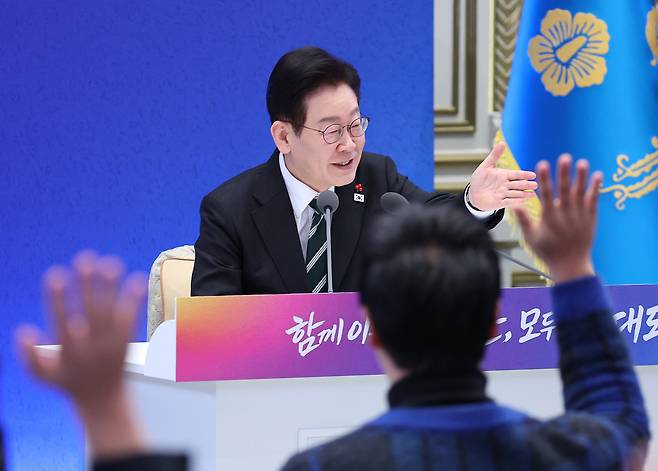
President Lee Jae Myung said Wednesday he is not overly concerned about warnings of a possible 100 percent US tariff on semiconductors, describing such remarks as part of routine trade pressure that tends to surface during periods of heightened uncertainty.
Speaking at a New Year's press conference at Cheong Wa Dae, Lee addressed growing concerns over US-led tariff threats, saying, "There has been talk of imposing a 100 percent tariff on semiconductors, but I do not view it as something to be taken too seriously."
He added that in "intense confrontational and unstable phases," unexpected variables often emerge, cautioning that "if we react too strongly to each individual issue, we lose our sense of balance."
His remarks were made during a question-and-answer session with reporters.
Referring to Taiwan, Lee said Seoul is already prepared for such scenarios, adding that "we have already reached agreements to ensure that South Korea will not be placed at a disadvantage compared to Taiwan in such cases."
He cited the joint fact sheet agreed upon at last year's South Korea-US summit, saying it established "commercial reasonableness" as the most important standard guiding South Korea's trade engagement with the US. "When we do something, ensuring commercial viability will be the most important criterion," he said.
Lee stressed the importance of what he called "pragmatic, national interest-centered diplomacy," saying the current global trade environment makes such an approach more critical than ever. "The tariff issue is only one part of a much broader picture," he said.
The president said the US faces mounting internal challenges, including fiscal and trade deficits, domestic polarization and the decline of manufacturing, prompting Washington to take measures that "inevitably translate into pressure on other countries."
"We have been significantly affected by this and, as a result, have had no choice but to engage in prolonged tariff and trade negotiations," Lee said, characterizing past talks as efforts "not to gain benefits, but to give up as little as possible."
Lee's remarks came amid escalating rhetoric from Washington. US Commerce Secretary Howard Lutnick on Friday issued a blunt ultimatum to global chipmakers, saying, "Everyone who wants to build memory has two choices: They can pay a 100 percent tariff, or they can build in America."
While no country was explicitly named, few in Seoul doubted that the comments were aimed at major Asian semiconductor producers, including South Korea.
Copyright © 코리아헤럴드. 무단전재 및 재배포 금지.