Kospi slips as sell-off hits U.S. stocks overnight
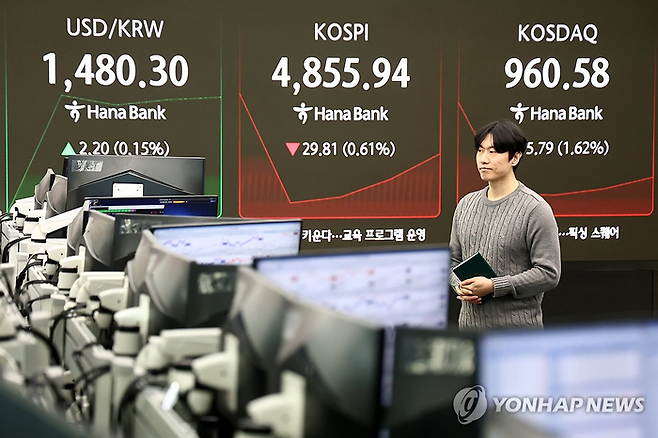
The benchmark Kospi stood at 4,856.87 as of 9:18 a.m. on Wednesday, down 0.59 percent from the previous session.
The index opened sharply lower, down 1.57 percent at 4,808.94, as has since pared some of its losses while remaining in the negative territory.
In the main bourse, individuals and institutions were net sellers of 229.9 billion won ($156.3 million) and 51.4 billion won, respectively, while foreigners were net buyers of 274.3 billion won worth of shares.
Overnight, Wall Street’s three major indices plunged across the board as the United States and the European Union exchanged tariff threats over Greenland.
U.S. President Donald Trump said he would impose a 10 percent tariff on European countries if no agreement is reached on securing Greenland for the U.S.
He also threatened to slap a 200 percent tariff on French wine and champagne while pressuring French President Emmanuel Macron to participate in a Gaza peace committee.
In response, the EU announced countermeasures, unveiling a 93 billion euro package of tariffs against the U.S. and considering activation of the Anti-Coercion Instrument (ACI).
The CBOE Volatility Index (VIX), often referred to as “fear gauge,” rose to 20.09 near the close of the New York market, its highest level in about two months since November 2025.
The yield on the 10-year U.S. Treasury note climbed 6 basis points from the previous session to 4.29 percent, the highest level in more than four months.
“The domestic market opened lower after the sharp decline in U.S. stocks driven by uncertainty surrounding President Trump,” said Han Ji-young, an analyst at Kiwoom Securities Co.
Losses were partially offset after data showed Korea’s exports from the first 20 days of January rose 14.9 percent on year, led by a 70.2 percent surge in semiconductor shipments.
Among blue-chip stocks, secondary battery makers led losses, with LG Energy Solution Ltd. down 2.23 percent, POSCO Holdings Co. falling 2.66 percent, and Samsung SDI Co. retreating 2.3 percent.
Other heavyweights also tumbled, including Hanwha Aerospace Co. (0.46 percent) and Doosan Enerbility Co. (3.57 percent).
Large-cap semiconductor stocks, on the other hand, supported the benchmark, with Samsung Electronics Co. rising 0.69 percent and SK hynix Inc. gaining 0.67 percent.
The tech-heavy Kosdaq index dropped 1.64 percent to 960.32, retreating to the 960 range a day after topping 980 for the first time in four years.
It opened 1.88 percent lower at 958.05 and remained under pressure.
The Kospi closed at 4,909.93 on Wednesday, up 0.49 percent from the previous session while the Kosdaq fell 2.57 percent to 951.29.
Samsung Electronics finished at 149,500 won and Hyundai Motor at 549,000 won.
Copyright © 매일경제 & mk.co.kr. 무단 전재, 재배포 및 AI학습 이용 금지
- [단독] 삼성전자 ‘특허전담조직’ 직원이 회사기밀 빼돌렸다가 구속 - 매일경제
- 분식집하다가 ‘극단 선택’ 50대 의사…면허 박탈된 사연에 부글부글 - 매일경제
- “중고거래 하고 받았는데, 이럴수가”…나도 모르게 당하는 ‘이것’ - 매일경제
- “집값만 보면 강남인줄”…평당 1억 거래 속출한다는 경기도 ‘이 동네’ - 매일경제
- MSTR, 올해 5조원 투자했는데 벌써 2500억원 손해 [매일코인] - 매일경제
- [단독] “제13차 연평해전, 들어보셨나요?” … 참전영웅에게 날아온 어이없는 ‘초청장’ [심층
- [속보] 한덕수 ‘내란 중요임무 종사’ 1심 징역 23년 - 매일경제
- [단독] 시동 걸린 현대차 자율주행 재건 플랜…박민우 AVP 본부장 “상용화 속도 낸다” - 매일경
- “연비 20㎞/ℓ 기름 냄새만 맡아도 달린다”…하브 원조맛집의 위엄 - 매일경제
- 벨트란·존스, 美 야구 명예의 전당 입성 확정...추신수는 아쉬운 탈락 - MK스포츠