Lotte, Hyundai join race for zones at Incheon International Airport
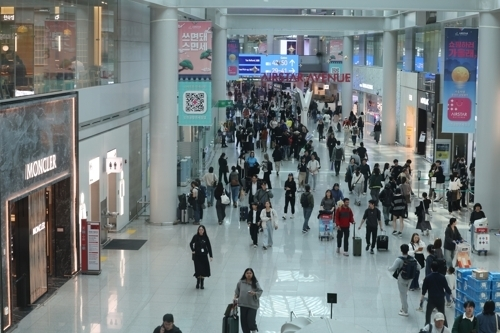
Lotte Duty Free and Hyundai Duty Free submitted applications for the DF1 zone for perfumes and cosmetics and the DF2 zone for liquor, tobacco, perfumes and cosmetics at Incheon International Airport.
Shilla Duty Free and Shinsegae Duty Free, which had previously returned their concessions due to the burden of rent, did not participate in the bidding.
“Given the continued uncertainty caused by changes in consumer patterns and the business environment, we decided not to take part in this bidding,” said a Shilla Duty Free official.
Employees of Shinsegae Duty Free, who had appeared at the site to submit bid applications, were reportedly deliberating until the very last moment but ultimately left without applying, source said.
Under the bid notice posted by the airport authority, the retnal system will maintain the per-passenger rent model under which rent is calculated by multiplying passenger traffic by the per-passenger rate proposed by the operator.
However, the minimum acceptable per-passenger rates were set lower than those in the 2022 open tender – at 5,031 won ($3.4) for DF1 and 4,994 won for DF2, down 5.9 percent and 11.1 percent, respectively.
Shilla Duty Free and Shinsegae Duty Free had previously paid per-passenger fees of 8,987 won and 9,020 won. Despite rising foreign visitor numbers, lower spending per customer led the companies to argue the rent burden was excessive. Both ultimately exited after paying penalties of about 1.9 trillion won each.
In the bidding process, the final operator will be selected based on a combined score of business proposal evaluation (60 points) and price evaluation (40 points).
In addition to price competitiveness, qualitative assessments – such as the feasibility of the business plan and operational capabilities in bonded areas – will also be considered.
After evaluating the proposals, the airport authority will select multiple qualified candidates for each concession and notify the Korea Customs Service.
The customs authority will then determine the preferred bidder through a licensing review, after which the airport operator will finalize the operator through negotiations.
Copyright © 매일경제 & mk.co.kr. 무단 전재, 재배포 및 AI학습 이용 금지
- 분식집하다가 ‘극단 선택’ 50대 의사…면허 박탈된 사연에 부글부글 - 매일경제
- “연비 20㎞/ℓ 기름 냄새만 맡아도 달린다”…하브 원조맛집의 위엄 - 매일경제
- “집값만 보면 강남인줄”…평당 1억 거래 속출한다는 경기도 ‘이 동네’ - 매일경제
- 오늘의 운세 2026년 1월 21일 水(음력 12월 3일) - 매일경제
- [단독] “제13차 연평해전, 들어보셨나요?” … 참전영웅에게 날아온 어이없는 ‘초청장’ [심층
- 암 진단받아도 74%는 5년 이상 산다…전립선암, 남성암 1위로 - 매일경제
- 트럼프 “알래스카 천연가스 사업, 한국과 일본 덕에 전례없는 자금 확보” - 매일경제
- “유산 10% 기부하면 세금 10% 감면” …여야, 법안 공동발의 추진 - 매일경제
- [속보] 군경, ‘북 무인기’ 피의자 3명 사무실·자택 압수수색 - 매일경제
- 벨트란·존스, 美 야구 명예의 전당 입성 확정...추신수는 아쉬운 탈락 - MK스포츠