Business lobbies resist forced treasury share cancellation
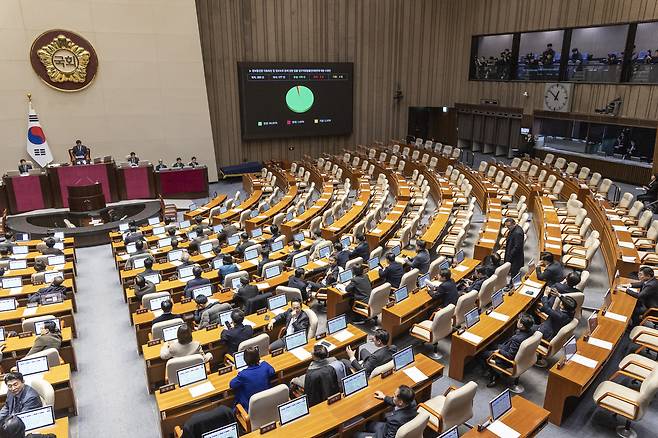
South Korea's eight major business groups urged lawmakers on Tuesday to amend a bill that would mandate companies cancel their treasury shares, raising concerns that further Commercial Act revisions could increase management uncertainty.
The coalition comprises the Korea Chamber of Commerce and Industry, the Federation of Korean Industries, the Korea International Trade Association, the Korea Enterprises Federation, the Korea Federation of SMEs, the Federation of Middle Market Enterprises of Korea, the Korea Listed Companies Association and the Kosdaq Listed Companies Association.
The group said they submitted their recommendations to the government and the National Assembly as the parliament seeks to pass a third revision to the Commercial Act, requiring listed companies to retire treasury shares within fixed deadlines. Treasury shares are those repurchased by the issuing company.
The calls come as the Democratic Party of Korea, leveraging its majority control in the unicameral parliament, is pushing the third revision after already passing two earlier rounds of amendments. The first revision strengthened directors' fiduciary duty to shareholders and the second mandated cumulative voting and expanded the separate election of audit committee members.
"Repeated amendments to the Commercial Act have increased uncertainty for management, while reforms to ease legal risks tied to breach of duty charges have been delayed, adding to confusion in corporate operations," the groups said in a statement.
Lawmakers backing the bill say it is designed to prevent companies from using treasury shares, which are acquired with company funds, in ways that unfairly benefit certain shareholders.
But the business lobby argues that treasury shares obtained involuntarily during mergers and other corporate actions should be exempt from mandatory cancellation, as they fall outside the bill's intended scope.
"Involuntarily acquired treasury shares frequently happen as an unavoidable byproduct of conversions to holding company structures promoted by the government," the group said in a statement. "Requiring mandatory cancellation of treasury shares obtained through M&A activities in industries needing restructuring, like petrochemicals, could delay corporate reorganization and undermine industrial competitiveness at a critical time."
The groups also called for waiving capital reduction procedures when companies cancel treasury shares. Under current rules, canceling shares acquired for specific purposes such as mergers require certain capital reduction steps, including creditor protection steps and approval by a special shareholder resolutions. Companies that fail to complete those step could be left in violation of the law.
An official at one of the business groups said companies could face recurring uncertainty if they fail to secure the shareholder resolution each year, potentially putting them at legal risk.
"Exempting capital reduction procedures and allowing cancellation through board resolutions alone would achieve the legislative purpose, while easing the burden on companies," the official said.
The bill would also mandate companies retaining or selling treasury shares rather than canceling them secure yearly shareholder approval for a "holding and disposal plan." The group suggested changing that approval requirement to once every three years if the plan remains unchanged.
The groups asked for a longer grace period to cancel existing treasury shares, arguing the current time frame is not sufficient. The proposal would give companies a six-month grace period and then require companies to cancel existing treasury shares within one year. The business groups proposed extending that grace period to one year, allowing up to two years to cancel or dispose of the shares.
Copyright © 코리아헤럴드. 무단전재 및 재배포 금지.