Hyundai Motor breaks W100tr mark as robotics bet pays off
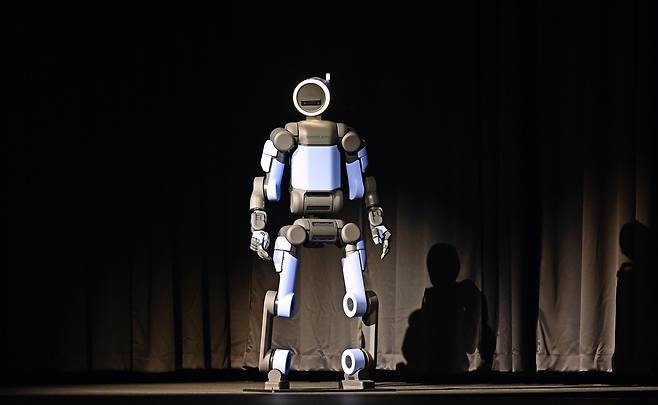
Hyundai Motor Company crossed the 100 trillion won ($67.7 billion) market capitalization mark Tuesday, fueled by rising investor optimism over its push into physical AI-powered robotics, led by the humanoid robot Atlas.
According to the Korea Exchange, Hyundai Motor shares rose 2.92 percent to 494,000 won at the open, lifting its market cap to 101.15 trillion won on the Kospi. The rally also propelled the automaker back to third place among Korea-listed companies, behind Samsung Electronics and SK hynix, for the first time in six and a half years.
Market watchers point to Hyundai’s strategy on physical AI robotics — AI systems embedded in robots that learn and act through real-world interaction — as the key catalyst. Earlier in January, Hyundai Motor Group’s robotics unit Boston Dynamics unveiled its humanoid Atlas at CES 2026 in Las Vegas, showcasing the robot autonomously sorting and arranging auto parts — a clear signal of industrial readiness.
Since CES, Hyundai’s stock has surged, closing above 400,000 won for the first time on Jan. 13. Between Dec. 30 and Jan. 16, the shares jumped 39.3 percent, more than 2.6 times the Kospi’s 14.9 percent gain over the same period.
Hyundai’s robotics roadmap extends beyond demonstrations. The group plans to build an annual capacity of 30,000 robots in the US by 2028, with initial deployment at Hyundai Motor Group Metaplant America in Georgia. Hyundai Mobis is expected to locally supply actuators for the robots, reinforcing vertical integration.
Analysts also highlighted Hyundai’s partnership with Google DeepMind as a decisive factor behind the valuation rerating. In a Jan. 14 report, Samsung Securities said competitiveness in physical AI increasingly depends on data generated from “best-in-class physical embodiments,” noting Hyundai’s rare combination of humanoid robotics capability, mass-production scale, real-world operational data, an integrated value chain, speed and security.
Reflecting the shift, Samsung Securities raised Hyundai Motor’s target price from 400,000 won to 650,000 won.
“Hyundai’s US investments driven by auto tariffs were previously seen as a cost burden,” said Kim Dae-jong, a business professor at Sejong University. “But sentiment improved as Hyundai partnered with Google on physical AI and focused on leveraging its manufacturing strengths rather than signaling heavier AI internalization.”
Daol Securities analyst Yoo Ji-woong lifted his target price from 470,000 won to 640,000 won on Tuesday, saying the commercialization of Boston Dynamics represents more than robot output.
“It is a bid to secure industrial leadership in US manufacturing,” he said. “Looking three years ahead, Tesla and Hyundai Motor Group will be the only players capable of deploying humanoid robots at scale in automotive factories.”
Investor confidence has also been bolstered by Hyundai’s aggressive recruitment of global tech talent. The group recently appointed Park Min-woo, a former Nvidia and Tesla executive, as head of its Advanced Vehicle Platform division and CEO of subsidiary 42dot. It also named Milan Kovac, who led Tesla’s Autopilot and Optimus programs, as a strategic advisor.
Until mid-2025, Hyundai had largely missed the semiconductor-led market rally amid concerns over a potential 25 percent US auto tariff under the second Donald Trump administration. That overhang eased in late October, when bilateral negotiations cut the tariff to 15 percent following a summit during Trump’s visit to Korea.
The deal marked a turning point. Hyundai shares, which had been stuck near 200,000 won, shifted into a sustained uptrend — now powered by a robotics narrative investors are treating as transformational.
Copyright © 코리아헤럴드. 무단전재 및 재배포 금지.