Lee orders probe, punishment over unauthorized drone flight into N. Korea
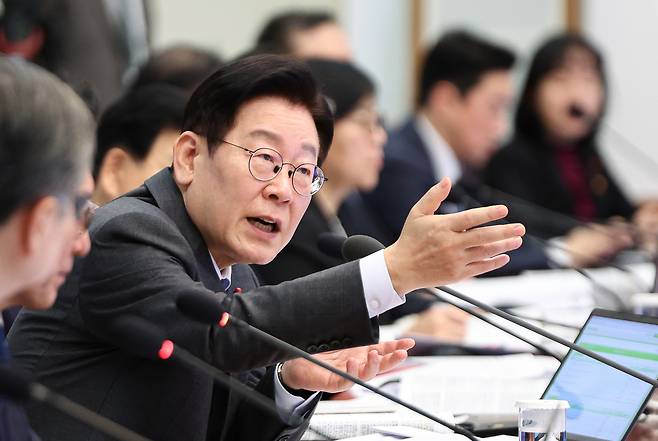
President Lee Jae Myung on Tuesday called for a thorough investigation and "stern punishment" over an unauthorized drone flight into North Korea, likening it to “firing shots into North Korean territory.”
Lee’s remarks came as a civilian suspect was questioned by a joint military-police task force, launched last week to investigate North Korea’s claim of intrusion by a South Korean drone. The military has said the drone was not a South Korean military asset.
Presiding over a Cabinet meeting at Cheong Wa Dae, Lee said that although the facts have yet to be fully confirmed, what has emerged so far indicates that "civilians arbitrarily sent drones into North Korea."
Lee, in his opening remarks, noted that the law provides for the punishment of individuals who intentionally commit acts that could trigger a war or amount to initiating hostilities.
“It is effectively no different from an act of initiating a war. It’s the same as firing shots into North Korean territory. I simply cannot understand how anyone could do something like this on their own,” he added.
Lee underscored that "we must conduct a thorough investigation andimpose stern punishment so this never happens again.”
Lee did not elaborate further. But Article 111 of South Korea’s Criminal Act, titled “Private War against Foreign Country,” states that “a person who wages a private war against a foreign country shall be punished by imprisonment without labor for a limited term of at least one year.” Those who attempt such crimes are also subject to punishment.
Lee then raised concerns with Defense Minister Ahn Gyu-back over apparent gaps in military surveillance, saying it was “surprising” that drones were able to cross the border multiple times despite advances in defense technology.
“According to what has been said, drones were sent three times. How could they cross without being detected during guard duty?” Lee asked, referring to a recent interview with a local broadcaster in which an individual claimed to have sent drones on three occasions since September last year.
Ahn responded that "detection is mainly carried out through local air defense radars but the objects appear only as tiny dots," adding that the matter remains under investigation.
Lee also instructed the South Korean military to upgrade its detection and surveillance capabilities when necessary, to cover any gaps in its monitoring systems.
The probe has been underway since North Korea claimed in a Jan. 10 statement that it had detected a drone flying north from Ganghwa in Incheon on Jan. 4 and brought it down in Kaesong. The North believed it was sent to photograph North Korea's “major targets,” according to the statement.
Investigators have since identified a civilian who claimed to have sent drones into North Korea and another civilian suspected of making the drone. Both are believed to have worked at the presidential office under former President Yoon Suk Yeol. This link has sparked political disputes over whether the alleged activity had a political backdrop.
The Cabinet meeting also covered follow-up measures to Lee’s summits with Chinese and Japanese leaders on Jan. 5 and 13.
Lee raised the need to secure suitable accommodations in his hometown of Andong, North Gyeongsang Province, to host Japanese Prime Minister Sanae Takaichi under what the two nations call "shuttle diplomacy," reciprocal leader-level visits.
Referring to the Korea-Japan summit held on Jan. 13 in Nara Prefecture, Takaichi’s hometown, Lee said Andong carries symbolic meaning and that he would like to host the Japanese leader there in return.
“I would like to meet the Japanese prime minister in my hometown of Andong as part of shuttle diplomacy, but I was told there is no suitable accommodation there,” Lee said.
“Andong has symbolic significance. We went to Nara, and next time, if possible, the Japanese prime minister said she would also like to go to Andong,” Lee added.
National Security Adviser Wi Sung-lac responded that protocol officials would conduct an on-site inspection and submit a comprehensive report after reviewing the conditions.
Lee also instructed the Foreign Ministry to hold talks with China to formalize preservation of the headquarters of the former Korean Provisional Government from the 1910-45 Japanese colonial period, as well as other independence movement sites in China.
“Relying solely on the other side’s goodwill is questionable,” Lee said. “Shouldn’t the Foreign Ministry at least put something in place with the Chinese government — some kind of preservation agreement or a memorandum of understanding between the Korean and Chinese governments?”
Foreign Minister Cho Hyun said Seoul plans to hold a foreign ministers’ meeting with China in the first quarter of this year, when asked by Lee about progress in restoring cultural exchanges.
Copyright © 코리아헤럴드. 무단전재 및 재배포 금지.