Is National Museum of Korea really among world's top 3 by visitors?
전체 맥락을 이해하기 위해서는 본문 보기를 권장합니다.
"What should really be assessed is how visitors actually engage with and benefit from exhibitions -- and those results should be built up over time."
President Lee Jae Myung suggested at a policy briefing in December that state-run museums reintroduce admission fees, noting that "free admission could diminish their prestige."
이 글자크기로 변경됩니다.
(예시) 가장 빠른 뉴스가 있고 다양한 정보, 쌍방향 소통이 숨쉬는 다음뉴스를 만나보세요. 다음뉴스는 국내외 주요이슈와 실시간 속보, 문화생활 및 다양한 분야의 뉴스를 입체적으로 전달하고 있습니다.
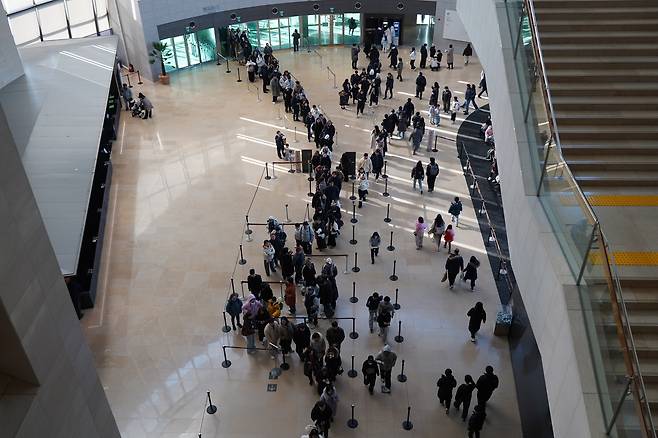
Whether to introduce admission fees at national museums, or raise them where they already exist, has become a hot-button issue in Korea, as many believe the time has come for the public to accept paying for cultural experiences as museums grow increasingly crowded.
At the center of the debate is the National Museum of Korea, which is preparing to introduce an online reservation system later this year -- a move widely seen as a precursor to paid admission for its permanent exhibitions.
The online reservation system is part of efforts to better monitor visitor flows and analyze audience data, according to the state museum.
The system is expected to roll out later this year and will be integrated with on-site ticketing. At present, visitors can enter the museum without tickets, except for special exhibitions or overseas touring exhibitions that require paid admission.
“Before introducing any admission fees, we first need to understand who our visitors are, when they come, and how the museum is actually being used,” said an official from the NMK on Jan. 13.
The move comes as the museum reported the highest visitor numbers since its opening in 1945 -- announcing that it drew 6.5 million visitors last year alone.
NMK claimed that it was surpassed only by the Louvre and the Vatican Museums in visitor numbers last year. Questions remain, however, over the accuracy of the figure due to its reliance on a surveillance camera-based automatic counting system at security checkpoints, which may result in double-counting.
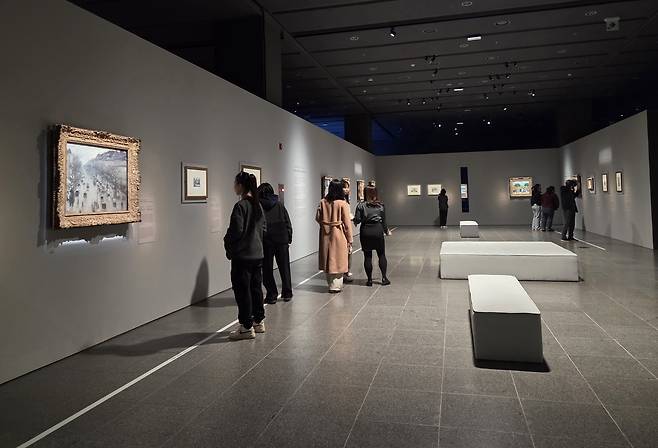
Once the reservation system is implemented, NMK -- after reviewing precise data on the demographics of its visitors -- will decide how to proceed with a paid admission system. If admission fees are implemented, students, senior citizens and socially vulnerable groups are likely to be exempt, according to the state museum.
“National museums focus too heavily on visitor numbers as everything at national museums is measured by quantified performance indicators,” a director of a private museum in Seoul, also a member of the Korean Private Museums Association, told The Korea Herald on Tuesday, requesting anonymity.
“What should really be assessed is how visitors actually engage with and benefit from exhibitions -- and those results should be built up over time.”
There has long been controversy over whether to introduce or raise admission fees at state-run museums, but discussions have stalled due to a lack of public consensus.
Free admission to permanent exhibitions was introduced in 2008 as part of the Lee Myung-bak administration’s policy to expand public access to culture. The move invited comparisons with leading international museums, where admission fees remain substantial: the Louvre charges 32 euros for non-European visitors and 22 euros for residents of the European Economic Area, while full admission to the Vatican Museums costs 20 euros.
The debate on paid admission in Korea was reignited last year as visitor numbers surged amid growing interest in cultural heritage and contemporary art among younger generations.
President Lee Jae Myung suggested at a policy briefing in December that state-run museums reintroduce admission fees, noting that “free admission could diminish their prestige.”
Prior to that, former Culture Minister Yu In-chon said in 2023 that "due to the free admission policy of national museums and state-run art museums, private art museums are losing competitiveness.”
The National Museum of Modern and Contemporary Art, Korea is also planning to raise its admission fee for “master exhibitions” this year -- from 5,000 to 8,000 won, an increase of 60 percent from last year.
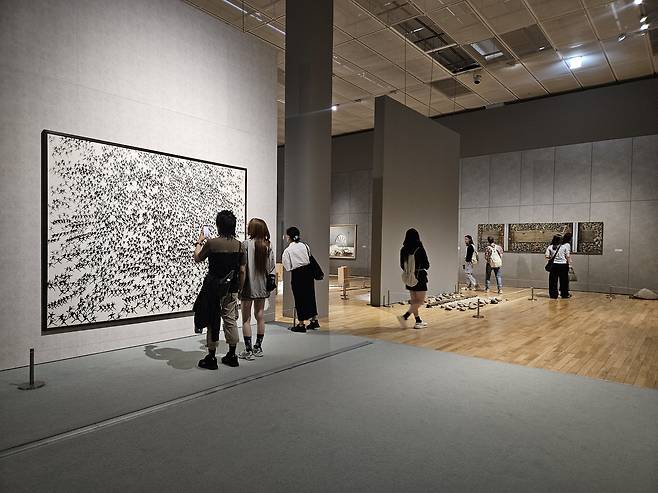
The criteria for a “master exhibition” include international recognition and the art-historical significance of the artist, according to the museum. Two large-scale exhibitions of Korean artist Suh Do-ho and English artist Damien Hirst are planned this year.
“After raising the admission fee for the Ron Mueck exhibition to 5,000 won, we still saw a record-breaking number of visitors, confirming a nationwide appetite for exhibitions featuring internationally acclaimed artists,” an official from MMCA told The Korea Herald.
The Ron Mueck exhibition was the most popular exhibition last year, attracting more than 530,000 visitors, with admission set at 5,000 won -- still an unprecedented price for the museum.
Any increase in the admission fee for permanent exhibitions, currently set at 2,000 won, will be discussed gradually, with options such as higher fees for foreign visitors still considered premature.
Another official from a state museum in Seoul -- who attended the seminar at the NMK gathering museum stakeholders in December -- told The Korea Herald on condition of anonymity that an institutional system needs to be established to ensure that museum revenue returned to the national treasury can be effectively reinvested in public museums.
“The higher museum admission fees rise, the greater the responsibility to ensure a corresponding level of quality. At the same time, a transitional policy period is needed to determine how the revenue will be used to improve museums,” the official said.
Copyright © 코리아헤럴드. 무단전재 및 재배포 금지.