UAE tops list of countries with favorable view of Korea, Thailand and Britain show increases
![Tourists take a selfie at the Gwanghwamun Square in central Seoul on Jan. 12, 2026. [NEWS1]](https://img4.daumcdn.net/thumb/R658x0.q70/?fname=https://t1.daumcdn.net/news/202601/20/koreajoongangdaily/20260120141216945gigr.jpg)
The United Arab Emirates (UAE) likes Korea the most but Thailand and Britain are growing a sudden crush on Korea, according to a government report released Tuesday.
The 2025 Korea National Image survey, published by the Ministry of Culture, Sports and Tourism, found that Korea’s favorability among foreigners reached 82.3 percent — the highest figure since the survey was first conducted in 2018. The number is up 3.3 percentage points from the previous year.
The results showed especially high favorability in the Middle East and parts of Asia. The UAE had the highest rate at 94.8 percent, followed by Egypt at 94 percent, the Philippines at 91.4 percent and Turkey at 90.2 percent.
Thailand and Britain saw a significant increase compared to the year prior. The percentage of Thai respondents with a favorable view of Korea jumped by 9.4 percentage points in 2025 compared to the year prior (from 76.8 percent to 86.2 percent), while the number from Britain jumped 9.2 percentage points to 87.4 percent — well above the average among European countries.
Japan, which has traditionally ranked low in favorability, recorded 42.2 percent — more than double its 2018 result of 20 percent. China also showed improvement, with 62.8 percent of respondents viewing Korea favorably.
Cultural content remained the most influential factor shaping Korea’s image, cited by 45.2 percent of respondents. The popularity of K-pop, television dramas and films helped boost favorability in countries like the Philippines, Japan and Indonesia.
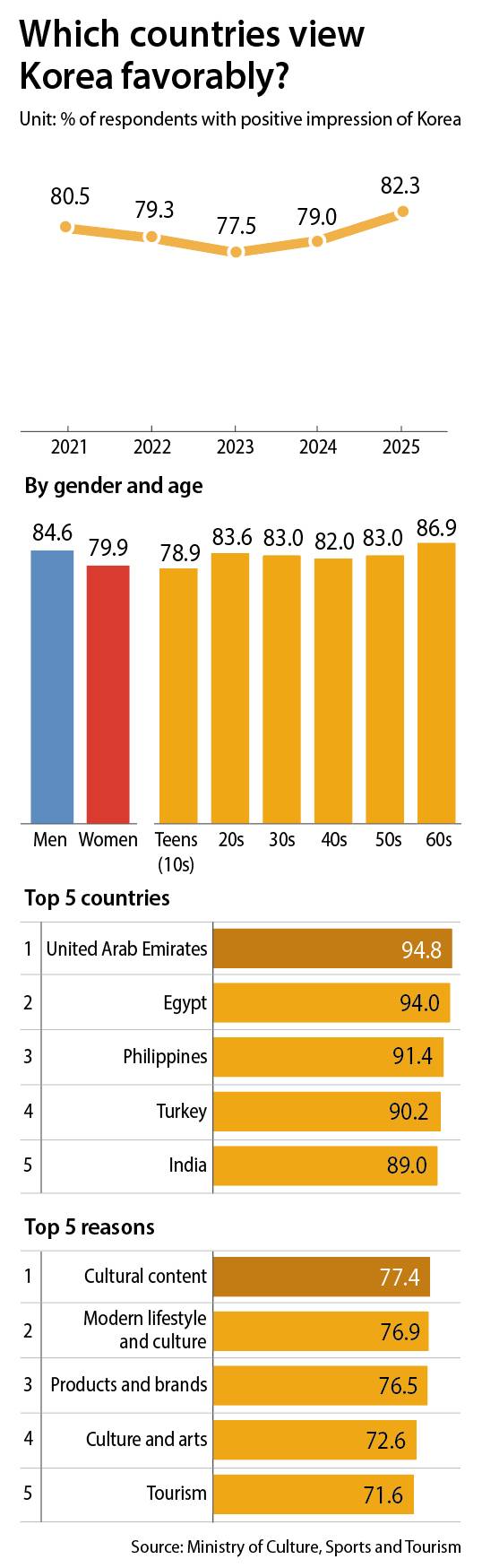
Modern lifestyle and culture, at 31.9 percent, and high-quality products and brands, at 28.7 percent, were also named as attractive elements. Korea’s economic development was also cited as positive by 21.2 percent. Respondents in the Middle East and Africa were especially likely to highlight Korea’s economic achievements in addition to its cultural appeal.
Digital platforms were the primary means through which foreigners encountered Korean content. Video platforms like YouTube and Netflix led the way at 64.4 percent, with YouTube alone cited by 77.4 percent and Netflix by 65.1 percent. Social media platforms such as Instagram and TikTok followed.
The results suggest that the global spread of Korean content through online media directly contributes to Korea’s national image. The Culture Ministry plans to hold expert panel discussions and conduct in-depth analysis of the data.
“We have once again confirmed Korea’s high favorability among global audiences and the influence of K-culture,” the ministry said in a press release. “We will actively support the use of this data in policymaking across a range of fields.”
![Foreign tourists take a look at clothes collaborated with Netflix's "KPop Demon Hunters" (2025) at a store in Myeong-dong in central Seoul in December, 2025. [YONHAP]](https://img2.daumcdn.net/thumb/R658x0.q70/?fname=https://t1.daumcdn.net/news/202601/20/koreajoongangdaily/20260120145645900cjwi.jpg)
This article was originally written in Korean and translated by a bilingual reporter with the help of generative AI tools. It was then edited by a native English-speaking editor. All AI-assisted translations are reviewed and refined by our newsroom. BY KO SEUNG-PYO, YOON SO-YEON [yoon.soyeon@joongang.co.kr]
Copyright © 코리아중앙데일리. 무단전재 및 재배포 금지.
- 179 dead after Jeju Air flight 7C2216 crashes at Muan International Airport — as it happened
- Man claims responsibility for drone allegedly sent into North Korea in media interview
- 'When Life Gives You Tangerines,' 'Harbin' honored at Baeksang Awards — as it happened
- Hwang Hee-chan scores as Korea ties 1-1 with Oman — as it happened
- Court orders release of Korean President Yoon Suk Yeol — as it happened
- Stray Kids, G-Dragon and Jennie triumph at 40th Golden Disc Awards — as it happened
- Court orders gov't to pay 10 million won to disability group head, care assistant after their unlawful arrest
- North's Kim dismisses vice premier 'on the spot' over machinery plant development 'difficulties'
- Chinese tourist uploads photos of Busan police station interior online, sparking security concerns
- Exclusive: Hyundai Mobis in talks with Volkswagen-owned Scout on multibillion-dollar deal