Telecom earnings top 4tn won despite cybersecurity setbacks
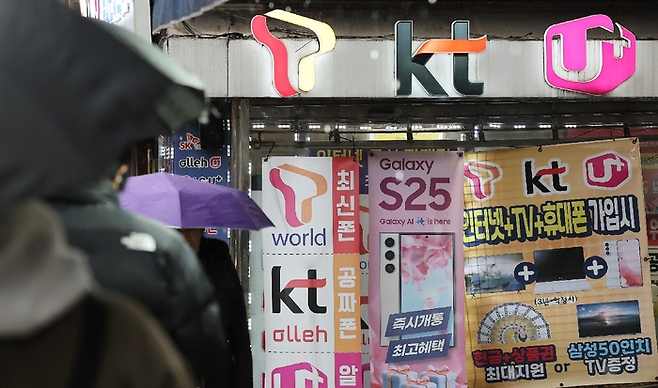
According to FnGuide on Monday, combined revenue for SK telecom, KT and LG Uplus last year is estimated at 60.91 trillion won, with aggregate operating profit reaching 4.38 trillion won. Compared with the previous year, revenue rose 3.25 percent and operating profit increased 25.4 percent, marking the first time since 2023 that sector-wide operating profit exceeded 4 trillion won.
SK telecom is forecast to post revenue of 17.15 trillion won and operating profit of 1.05 trillion won, down 4.39 percent and 42.04 percent, respectively, from a year earlier. KT is expected to record revenue of 28.24 trillion won and operating profit of 2.42 trillion won, up 6.86 percent and 199.53 percent, while LG Uplus is projected to generate revenue of 15.51 trillion won and operating profit of 901.5 billion won, increases of 6.11 percent and 4.46 percent.
SK telecom was hit hardest after a SIM card hacking and data breach incident in April last year, prompting the company to offer free SIM replacements, waive contract termination fees and provide one-off fee discounts. Marketing spending also rose significantly as the carrier sought to win back departing subscribers.
KT, by contrast, showed improved performance, supported by sales from real estate subsidiaries and land development projects, alongside expanding public-sector contracts tied to its artificial intelligence transformation strategy. This year, however, is expected to be more challenging, as one-off costs related to cybersecurity incidents are set to be reflected in earnings.
LG Uplus benefited from absorbing subscriber outflows from rivals as they focused on addressing hacking fallout. Solid performance across business units and cost-efficiency efforts have raised expectations that the company could surpass 1 trillion won in operating profit. LG Uplus has designated this year as the starting point for executing its AI strategy.
Choi Yoo-jin, a research analyst at Mirae Asset Securities, said that after passing a quarterly earnings trough in the fourth quarter, profitability is likely to improve meaningfully from the first quarter of this year, as previously invested AI-related businesses begin full-scale operations and portfolio optimization advances through the sale of non-core assets.
While growth in traditional wired and wireless services remains limited, new AI-driven businesses are expected to lift sentiment across the telecom sector, particularly AI data centers, which are emerging as a medium- to long-term growth engine.
SK telecom has reorganized its group structure around telecom and AI businesses and is building infrastructure for an AI data center in Ulsan, targeting operations by 2027 and AI-related revenue of 5 trillion won by 2030.
KT plans to complete a 48-megawatt AI data center in Bucheon within the year, while LG Uplus is constructing a 50-megawatt facility in Paju.
Ahn Jae-min, a senior analyst at NH Investment & Securities, said combined revenue from telecom operators’ data center businesses is expected to reach 1.55 trillion won this year and grow at an average annual rate of around 19 percent to 2.46 trillion won by 2028.
Copyright © 매일경제 & mk.co.kr. 무단 전재, 재배포 및 AI학습 이용 금지
- 파업으로 확보한 ‘정년 연장’...버스기사부터 경찰까지 청년 설자리 없다 - 매일경제
- “한국 사람들, 그 돈 주고 왜 포르쉐를?”...글로벌 시장선 갈수록 ‘외면’ - 매일경제
- [속보] 성장펀드 3년 이상 투자땐 최대 40% 소득공제…납입금 2억원 한도 - 매일경제
- “5km씩 30년 뛰었는데 허무하네요”...‘걷기족’ 보다 사망위험 높다는데 - 매일경제
- “할머니가 먹는 거 같다”…‘수척해진 얼굴’ 팬들 걱정에 안영미의 해명 - 매일경제
- “승진하고 연봉 5천이 깎였어요”...공공기관 직원들 ‘간부 포비아’ - 매일경제
- [단독] 조합-상가합의안 무효 판결에…개포주공 6·7단지 분양신청 일시중단 - 매일경제
- “매국베팅 욕해도 좋습니다”하더니…곱버스개미 올들어 26% 녹았다 - 매일경제
- 기억은 있는데 말이 안나오네… ‘깜빡깜빡’ 건망증 비밀 풀렸다 - 매일경제
- 162km 한국계 빅리거가 합류한다니…오브라이언, 류지현호 불펜 고민 덜게 하나 - MK스포츠