Opposition leader’s hunger strike enters fifth day, impact questioned
전체 맥락을 이해하기 위해서는 본문 보기를 권장합니다.
"If it means protecting South Korea, I will not abandon my resolve to fight at the risk of my life," Jang told reporters Monday at the National Assembly in Seoul, adding that he was "staking his life to appeal directly to the public."
"Even though there was room for dialogue within the National Assembly, he chose to seize on an issue and enter a hunger strike," he added. "At a time when calls to break with Yoon and sideline Han Dong-hoon are challenging his leadership, the hunger strike also functions as a performative effort to protect his position."
이 글자크기로 변경됩니다.
(예시) 가장 빠른 뉴스가 있고 다양한 정보, 쌍방향 소통이 숨쉬는 다음뉴스를 만나보세요. 다음뉴스는 국내외 주요이슈와 실시간 속보, 문화생활 및 다양한 분야의 뉴스를 입체적으로 전달하고 있습니다.
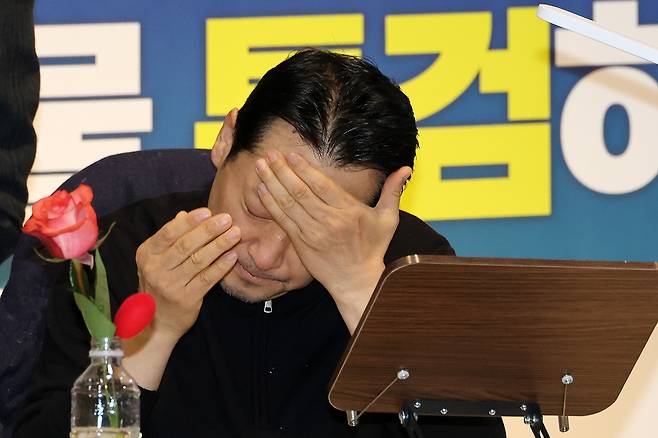
Rep. Jang Dong-hyeok, chair of the main opposition People Power Party, continued his hunger strike for a fifth consecutive day, pressing the ruling camp to accept a broader special counsel probe while rejecting a Democratic Party of Korea-backed bill targeting former President Yoon Suk Yeol and his wife Kim Keon Hee.
"If it means protecting South Korea, I will not abandon my resolve to fight at the risk of my life," Jang told reporters Monday at the National Assembly in Seoul, adding that he was "staking his life to appeal directly to the public."
Jang began an open-ended hunger strike Thursday. According to the party, he has consumed only water and small amounts of salt, and underwent a health check by medical staff Sunday.
The protest was launched in objection to the ruling Democratic Party-led push for a second round of comprehensive special counsel investigations into Yoon and Kim. The People Power Party fears these would burden the opposition ahead of the June local elections.
Instead, Jang has demanded that the ruling camp accept a separate special counsel investigation encompassing allegations related to the Democratic Party’s ties to the Unification Church and suspected illicit nomination funds.
The hunger strike has drawn criticism that it may only serve an internal political function, as the People Power Party continues to grapple with unresolved internal rifts. Some observers view the move as an attempt to consolidate Jang’s leadership amid lingering factional tensions.
Rep. Park Jee-hye, spokesperson for the Democratic Party of Korea, said the hunger strike appeared less focused on the external political agenda than on managing internal party dynamics.
"The demand to accept special counsel bills through a hunger strike may be presented as a matter of principle, but it is also fueling skepticism that this is a performative move aimed at diverting attention from internal discord within his own party," Park said in a statement released Sunday.
"What the public wants to see is not an opposition leader skipping meals, but responsible politicians coming together to overcome a national crisis," she added.
The hunger strike unfolded amid heightened internal tensions in the People Power Party, following its ethics committee’s decision to expel Han Dong-hoon, a former justice minister and ex-party leader who served under Yoon. Han is accused of posting defamatory remarks about Yoon on the party’s internal online forum.
Han rejected the decision as a "politically motivated maneuver," and has drawn support from a small group of lawmakers within the party, most of whom are in their first or second terms.
Rep. Jung Chung-rae, chair of the Democratic Party, also criticized Jang’s move, describing it as "childish." Chung urged him to end the strike and cooperate with efforts to address what the ruling party calls the insurrection issue stemming from Yoon’s martial law declaration on Dec. 3, 2024.
Hunger strikes have a long history in South Korean politics, particularly during the authoritarian era. Experts note, however, that their role has shifted with the country’s democratic transition.
In 1983, former President Kim Young-sam, then under house arrest imposed by Chun Doo-hwan’s military government, staged a 23-day hunger strike calling for political liberalization and direct presidential elections. The protest later became a rallying point for South Korea’s democratization movement. Kim Dae-jung, before taking office in 1998, also launched a hunger strike in 1990 to press for the introduction of local autonomy, a demand that was later institutionalized.
Political commentator Choi Yo-han said that while hunger strikes once served as one of the few available tools to resist military rule, they are now often used as a means of political pressure rather than resistance.
"Jang Dong-hyeok’s hunger strike can be seen as closer to a unilateral demand," Choi said.
"Even though there was room for dialogue within the National Assembly, he chose to seize on an issue and enter a hunger strike," he added. "At a time when calls to break with Yoon and sideline Han Dong-hoon are challenging his leadership, the hunger strike also functions as a performative effort to protect his position."
"As a party leader, he occupies a position that requires accountability to the public, and respect is earned through responsibility," Choi said. "Such an approach is unlikely to resonate with the public."
Choi also suggested that longer-term political calculations may be at play, noting that the move could be seen as an attempt to weaken rivals with an eye on the 2030 presidential race.
The longest hunger strike on record in South Korean politics was staged in 2007 by then-Democratic Labor Party lawmaker Hyun Ae-ja, who fasted for 27 days in opposition to the construction of a naval base on Jeju Island.
President Lee Jae Myung himself also staged a hunger strike in 2023 while serving as leader of the Democratic Party. His protest ended after 23 days following medical advice.
Copyright © 코리아헤럴드. 무단전재 및 재배포 금지.