Is US Navy MRO real growth market for Korean shipbuilders?
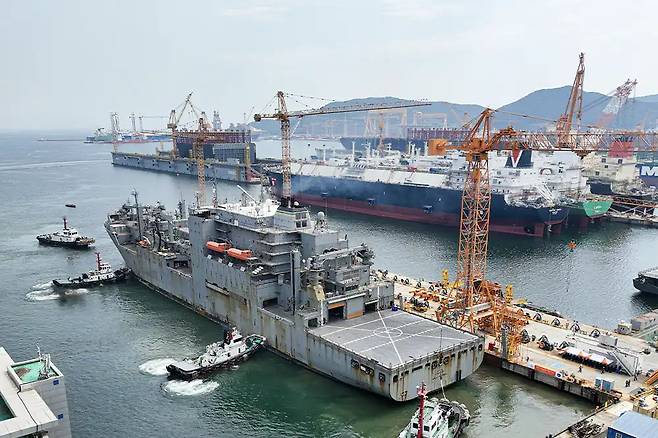
Major South Korean shipbuilders are piling into US Navy maintenance, repair and overhaul contracts, betting the work could evolve into a more stable revenue stream to cushion against the volatility brought by commercial shipbuilding's boom-and-bust cycle.
The momentum especially picked up steam after Seoul and Washington launched a joint shipbuilding cooperation project — "Make American Shipbuilding Great Again," or MASGA — under which Korean firms will take part in reviving US' commercial and military shipbuilding.
The country's largest shipbuilders, including Hanwha Ocean and HD Hyundai, have participated in the US Navy MRO project, with Hanwha securing three deals while HD Hyundai won two. Smaller players are racing to enter the market by obtaining Master Ship Repair Agreements, a US government contract that civil shipyards must obtain in order to do MRO work for US Navy vessels.
Midsized shipbuilder HJ Shipbuilding & Construction also secured an MRO contract in December, and has since signed an MSRA.
But the project is facing a reality check. Despite all the hype, industry officials question the market's long-term durability, citing dock capacity constraints, uncertain deal flow and rigid regulations.
They argue that if Washington is serious about addressing its overwhelming naval maintenance backlog, it will need to loosen regulatory constraints to allow Korean shipbuilders to participate more deeply in US Navy projects.
The recent moves reflect both sides' needs: South Korean shipbuilders are seeking new revenue streams, while the US is struggling to keep the world's largest fleet on its maintenance schedule due to aging shipyard infrastructure, skilled workforce shortages and rising costs.
The US Navy continues to experience "chronic delays and labor overruns" in maintenance on its large conventional ships, according to the December report from the US Congressional Budget Office, affecting deployment schedules and limiting the operational readiness of the US Navy's fleet.
For example, the US Navy's most widely used guided-missile destroyers, the Arleigh Burke-class, vessels now require an average of nine years of maintenance, more than a quarter of their planned service life and more than double the 2012 projection.
It added that maintenance for large conventional combat ships often takes 20 percent to 100 percent longer than planned.
A February report by the US Government Accountability Office found that insufficient infrastructure and workforce capacity were the primary constraints on ship repairs, limiting the ability to carry out emergency repairs and wartime needs.
To address these domestic backlogs, the US has turned to allies for repair work, as it cannot handle it all on schedule.
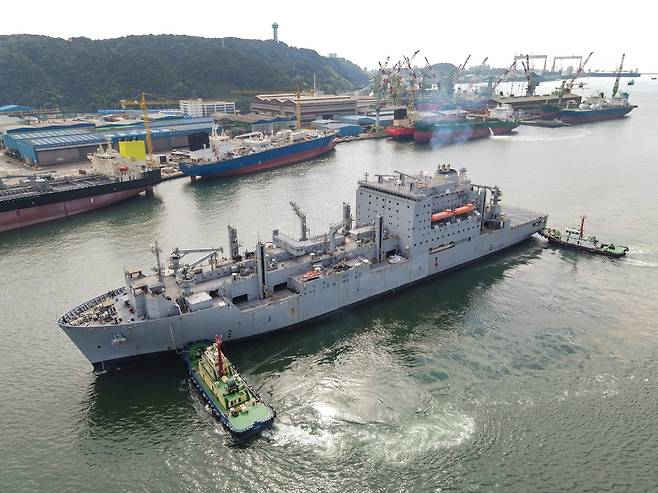
The US Navy spends an estimated $6 billion to $7.4 billion annually on MRO services, according to the US Government Accountability Office in a January 2025 report. Market estimates forecast the MRO budget to increase to $8 billion-$12 billion by 2030, while industry watchers expect the budget to keep climbing amid an intensifying rivalry with China. This has sparked competition among shipbuilders in South Korea, Japan and Singapore to win MRO contracts.
For Korean shipbuilders, MRO represents a strategic shift. After a prolonged industry slump through the early 2020s, yards that traditionally relied on building new were looking for revenue streams to withstand the shipping cycle.
"Commercial shipbuilding comes in cycles, but not so for MRO. There is always demand for naval maintenance," said Rhee Shin-hyung, a professor of naval architecture and ocean engineering at Seoul National University.
He added that the US Navy's maintenance demand is currently "piled up" and that Korean yards see an opportunity to absorb at least a portion of that backlog and diversify earnings.
Despite the rosy outlook, industry officials point to a strict US regulatory framework, which tightly controls foreign participation in naval work, raising concerns about the long-term viability of the projects.
Under US federal law governing the maintenance of naval vessels, US Navy ships are generally restricted from undergoing repairs in foreign shipyards, except in very limited cases. These exceptions include narrow cases of voyage repairs or battle-damage repairs for combatant ships.
The MRO contracts won by Hanwha Ocean and HD Hyundai involved noncombat auxiliary vessels assigned to the US Navy's 7th Fleet, based in Japan. Neither has yet secured work on front-line combat ships.
Experts argue that expectations of large-scale, long-term orders may be misplaced unless Washington fundamentally changes its regulations.
"Unless the law is further revised to explicitly support broader MRO cooperation with allies, Korean companies may remain cautious about making significant investments or pursuing active participation," said Kwon Nam-yeon, an associate research fellow at the Korea Institute for Defense Analysis, in a report published by the Center for Strategic and International Studies in June.
Rhee echoed this view, noting that Japan, despite handling US Navy maintenance for years, has primarily serviced auxiliary vessels and ships in the 7th Fleet.
"The US has kept sensitive naval work close to home or within tightly controlled arrangements," he said. "Even in Japan, the US does not outsource maintenance for its major combat ships."
The 7th Fleet MRO work, which is relatively small to begin with, has been concentrated in Japan, with South Korea and Singapore also taking a share. As of 2024, only about 40 of the Navy's 295 vessels are homeported abroad, meaning the vast majority must be serviced at US shipyards.
"The current US Navy's (shared) MRO pie is simply too small," said an industry official who requested anonymity. "It's essentially limited to the 7th Fleet due to regulations, and even that workload is divided among three countries. With both large and small Korean shipbuilders competing for it, the demand is too limited to pursue aggressively."
Some analysts argue that the bigger question is not whether Korean shipbuilders can win a handful of contracts, but whether they can generate repeated deal flow to turn MRO into a real business segment — not a side job — particularly given constraints on dock capacity and workforce availability.
While South Korean shipbuilders are the world's fastest and most efficient, their docks are now filled with lucrative liquefied natural gas carriers and other commercial contracts secured during the recent boom cycle, leaving little space for large, lengthy naval repair projects.
MRO projects are also labor-intensive and can be unpredictable, as the actual scope of work changes once inspections begin, making it difficult to plan, unlike new projects, where production schedules are planned years in advance.
For Korean shipbuilders, MRO opportunities will remain limited unless Washington establishes a larger and more steady pipeline of projects.
Observers call for the US Navy to move toward a package deal, bundling MRO contracts for multiple vessels into a single agreement and thereby creating a more durable business that could encourage companies to invest more in dedicated repair capacity, equipment and the workforce.
"Given the volatility of this industry, securing multiyear contracts and integrating MRO services into larger package deal is crucial," said Kwon. "Establishing a more predictable pipeline of projects through long-term contracts and bundled agreements would help mitigate these risks, ensuring more efficient utilization of facilities and labor."
Copyright © 코리아헤럴드. 무단전재 및 재배포 금지.