Could Seoul Station become Seoul's Hudson Yards?
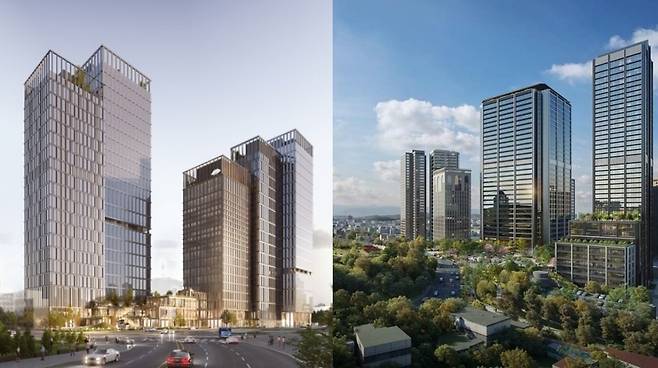
Seoul is edging closer to its own version of New York's Hudson Yards, as large redevelopment projects around Seoul Station gather momentum, reshaping the city's aging urban core into a new cluster of mixed-use landmarks combining prime offices, public green space and luxury hotels.
While not directly adjacent to Gwanghwamun, a cultural hub and the heart of Seoul's central business district, the Seoul Station area boasts unmatched connectivity. Anchored by KTX high-speed rail, multiple subway lines and the Airport Railroad Express linking downtown Seoul to Gimpo International Airport and Incheon Airport, the district has long been a logistical hub — and is now increasingly viewed as a business center.
That shift is being driven by a wave of major developments, led by Iota Seoul and the Seoul Station Northern District Development.
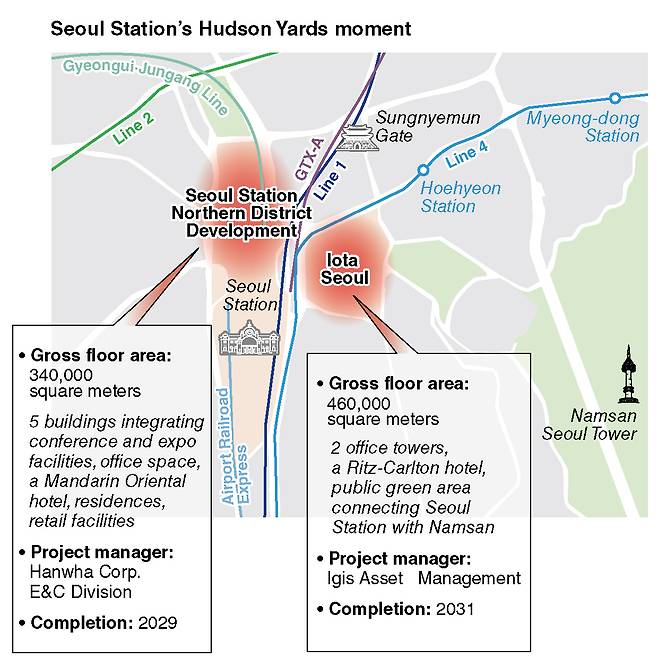
Igis Asset Management is spearheading Iota Seoul, a large-scale redevelopment spanning the area between Seoul Station and Namsan. The project encompasses the former Millennium Hilton Seoul site, Metro Tower and Seoullo Tower, and will be transformed into a mixed-use complex with a total floor area of about 460,000 square meters.
The development will feature two office towers, retail facilities, a luxury hotel and a public green space. Ritz-Carlton has been selected to operate the hotel, positioning the project at the high end of the market. Completion is targeted for 2031.
To the north of Seoul Station, Hanwha Corp. E&C Division is developing the Seoul Station Northern District Development project, another large mixed-use complex with a total floor area of 340,000 square meters. The project will comprise five high-rise towers housing conference and exhibition facilities, offices, retail space and residences, along with Korea's first Mandarin Oriental hotel. Construction began in December 2024, with completion scheduled for 2029.
Beyond these flagship projects, redevelopment is spreading to nearby sites, including the Seosomun Building and the former JoongAng Ilbo headquarters, reinforcing the area's transformation.
The new developments aim to attract top-tier tenants, with large floor plates, state-of-the-art amenities and premium services designed to offset any locational disadvantages of being removed from more central business districts.
"The scale and quality of the newly built buildings offer attributes that are highly attractive to prime tenants," said YJ Choi, head of office services at Cushman & Wakefield Korea. "These projects are expected to be very competitive in terms of marketability."
The Seoul Station area also stands out with substantial plot sizes enabling large development projects, according to industry experts.
"With relatively large average plot sizes enabling mixed-use developments, the Seoul Station area is poised to develop into a new business district, underpinned by fresh supply of high-grade office space," said Claire Choi, a senior director at CBRE Korea.
"Under Seoul city's high-density development policy, the average floor area ratio in the Seoul Station area is expected to exceed 1,000 percent, with average building heights topping 150 meters, positioning the district as a new urban landmark."
The surge in development around Seoul Station is expected to significantly expand office supply and ease long-standing shortages.
Like other major business districts in Seoul, the central business district has operated under tight supply conditions for years. In the third quarter of last year, the vacancy rate for offices in the district stood at just 6 percent, according to Cushman & Wakefield Korea.
Given that the local real estate industry typically considers a 5 percent vacancy rate as "natural" — reflecting normal tenant turnover — it has effectively been operating at full capacity.
The picture is expected to change in the coming years, as major development projects are set to deliver large volumes of new office space. The additional supply will push the vacancy rate higher, potentially easing upward pressure on rents.
According to CBRE Korea, a total of 4.71 million square meters of A-grade office space — properties with a gross floor area of at least 33,000 square meters — is scheduled to be supplied across Seoul's major business districts by 2031. Of that, 3.89 million square meters, or 83 percent, will be concentrated in the central business district.
Cushman & Wakefield Korea similarly expects that projects scheduled for completion over the next five years will add office space equivalent to roughly 40 percent of the district's existing stock.
"The Seoul Station area, once viewed as the outer edge of the central business district, is now undergoing a scale of development that effectively marks a full-fledged expansion of the district," Choi said.
Copyright © 코리아헤럴드. 무단전재 및 재배포 금지.