Tesla ignites EV price war in Korea with Model 3 cuts
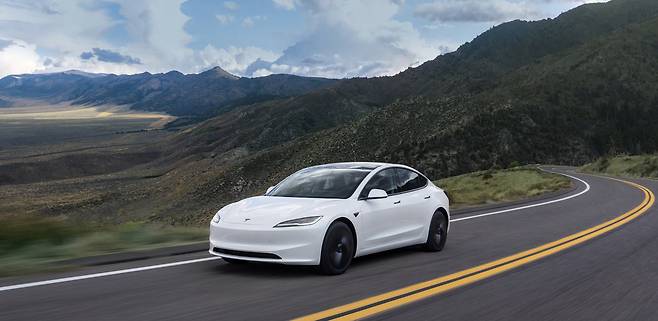
Tesla has slashed the price of its mass-market Model 3 in Korea, intensifying pricing pressure across an electric vehicle market already grappling with weakening demand.
Tesla Korea recently announced that the price of the Model 3 Standard RWD has been cut to 41.99 million won ($28,500) from 59.9 million won, while the newly introduced Premium Long Range RWD is priced at 52.99 million won.
With governmental EV subsidies of 1.68 million won and 4.2 million won, respectively, as well as factoring in local incentives, the effective price of the Standard RWD could drop to the 30 million-won range.
Tesla's aggressive pricing push reflects its bid to expand its footprint in the Korean EV market, which has long been dominated by Hyundai Motor Group and German luxury automakers.
Last year, Tesla's passenger car registrations in Korea more than doubled to 59,916 units, lifting its market share to 19.5 percent and placing it third among imported brands, behind BMW and Mercedes-Benz. Building on that momentum, Tesla Korea on Dec. 31 last year intensified its pricing strategy, cutting prices on key models — including the Model 3 Performance — by as much as 9.4 million won.
Given that EV prices in Korea typically centered in the 40 million to 50 million won range, industry watchers say Tesla's latest cuts could signal spillover from 2025's China-style "EV chicken game" into the domestic market.
In China, Tesla repeatedly reduced prices to defend volume and market share, challenging homegrown rivals such as BYD.
In September last year, Tesla China lowered the price of the Model 3 Long-Range RWD by about 10,000 yuan ($1,430) less than a month after its launch — roughly a 3.7 percent cut from its original price of 269,500 yuan — underscoring how quickly the company adjusts pricing in response to market conditions.
Hyundai Motor and Kia's entry-level EV models in the 40 million-won segment are expected to face the most immediate impact. While Hyundai's Ioniq 5 and Ioniq 6 and Kia's EV6 have become mainstays of the domestic market, a widening price gap with the Model 3 could make defending market share increasingly difficult.
According to the Korea Automobile & Mobility Association and the Korea Automobile Importers & Distributors Association, Tesla sold 55,594 vehicles in Korea from January to November 2025, edging out Kia's 55,037 units and Hyundai Motor's 42,789 — marking a rare case of an imported brand topping domestic automakers in sales.
Imported EV brands are also under pressure. Entry-level models such as the BMW iX1, Mercedes-Benz EQA and Polestar 2 — typically positioned in the 40 million to 50 million won range — may struggle to sustain current pricing.
Kim Pil-su, an automotive engineering professor at Daelim University, said, "Tesla's emphasis on volume over short-term profitability is closely tied to its highly scale-dependent manufacturing structure — the higher the volume, the lower the per-unit manufacturing costs. The move could force competitors to follow suit, triggering a prolonged price war and putting sustained pressure on profitability across the industry."
Meanwhile, the Model 3 Standard RWD — priced in the 30 million-won range after subsidies — comes with trade-offs. It omits several features favored by Korean consumers, including ventilated front seats, heated rear seats, ambient lighting, a rear-seat display and an upgraded audio system. The sound system is also reduced down from 13 to seven speakers and the radio function has been removed.
Copyright © 코리아헤럴드. 무단전재 및 재배포 금지.