Cashing out bank deposits to buy stocks gathers pace
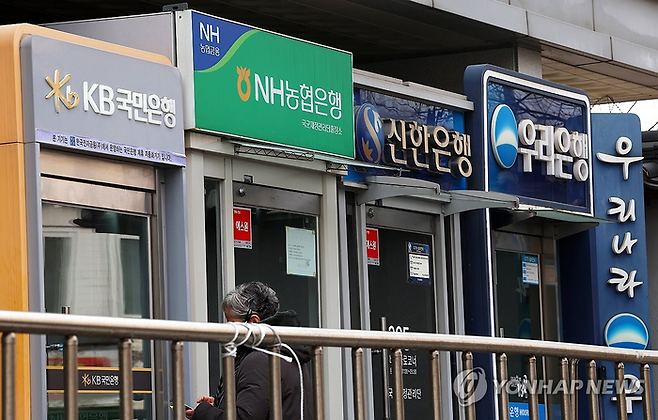
According to financial industry sources on Sunday, more than 30 trillion won ($20.4 billion) has flowed out of demand deposits and money market deposit accounts (MMDAs — checking-type accounts used as standby funds) in just the first half of January. Even time deposits, which had held relatively firm, have continued to shrink after seeing a 32 trillion won outflow at the end of last year, followed by an additional decline of more than 600 billion won so far this year. Observers say both the speed and scale of fund movements from banks to financial markets have increased sharply, amplifying volatility in bank funding.
Balances of demand deposits and MMDAs at South Korea’s five major banks — KB Kookmin Bank, Shinhan Bank, Hana Bank, Woori Bank and NH NongHyup Bank — fell from 674 trillion won at the end of last month to 643.59 trillion won as of Jan. 15, a drop of more than 30 trillion won in just two weeks.
Daily volatility has also intensified. An analysis by Maeil Business of daily fund movements through Jan. 15 showed that roughly 15.5 trillion won exited banks on Jan. 2, the first business day of the year, followed by another 10.5 trillion won on Jan. 5. In just two trading days, about 26 trillion won moved to alternative investment destinations. Large-scale flows continued thereafter, with a 9.2 trillion won outflow on Jan. 13, followed by a 7.7 trillion won inflow the next day. For banks, such sharp swings in demand deposits and MMDAs — key funding sources — are raising concerns over funding stability.
Time deposits, another core funding pillar, have not been immune. Outstanding time deposits stood at 926.7 trillion won at the end of 2024 and had risen steadily to 971.98 trillion won by November last year. However, as the KOSPI repeatedly hit record highs and investor sentiment toward equities strengthened, large-scale withdrawals took place at year-end. Time deposit balances fell by 32.7 trillion won in December alone and have declined by more than 600 billion won again so far this year.
A financial industry official said withdrawals from demand deposits typically increase in December as companies prepare for settlements and bonus payments, with funds shifting to individuals in January. “This year, individuals appear to be moving bonus and salary income directly into other assets instead of parking it in bank deposits,” the official said.
Market watchers believe much of the money leaving banks is flowing into the stock market and investment management accounts (IMAs) offered by securities firms. Maeil Business’ analysis of the KOSPI from July 1 to Dec. 31 last year showed net inflows of more than 14 trillion won during the period. So far this year, net inflows have already exceeded 1 trillion won.
Booming demand for securities firms’ IMAs has added to the trend. IMAs, which offer expected annual returns in the four percent range while guaranteeing principal repayment, have sold out rapidly since launch. Korea Investment & Securities completed sales of its first IMA product worth 1 trillion won and began accepting subscriptions for a second 1 trillion won product on Jan. 16. Other firms authorized to issue short-term notes have also launched products aggressively, drawing funds away from bank deposits.
The money move is likely to persist. Expectations for equities continue to build as the KOSPI moves toward the 5,000 mark. Last July, the index rose 5.66 percent in a single month. It slipped 1.83 percent in August but rebounded strongly in September with a 7.49 percent gain and surged 19.94 percent in October. After a 4.40 percent pullback in November, the market climbed 7.34 percent in December to end the year on a strong note.
As a result, standby liquidity poised to enter the stock market has reached record levels. Investor deposits held for stock purchases hit 92.85 trillion won on Jan. 8, breaking the 90 trillion won threshold for the first time — nearly double the level of around 50 trillion won a year earlier. Balances in cash management accounts (CMAs), another form of readily deployable funds, have also continued to grow, surpassing 100 trillion won for the first time since records began. Combined, roughly 200 trillion won in liquidity is now positioned on the sidelines of the equity market.
Meanwhile, bank time deposit rates continue to trend lower. According to the Bank of Korea’s economic statistics system, average time deposit rates hovered between 2.51 percent and 2.58 percent from July to October last year, before rising to 2.85 percent in November amid higher bond yields. Even then, the gap remained wide compared with monthly stock market returns in the second half. This year, banks have resumed cutting deposit rates. The 12-month rates on products such as KB Kookmin Bank’s “KB Star Time Deposit,” Woori Bank’s “WON Plus Deposit” and Hana Bank’s “Hana Time Deposit” slipped from 2.85 percent at the end of November to 2.8 percent as of Jan. 16, in line with declining bank bond yields.
Copyright © 매일경제 & mk.co.kr. 무단 전재, 재배포 및 AI학습 이용 금지
- 미국 경고에 놀란 K반도체…“용인 메모리 팹, 美로 옮겨야하나” - 매일경제
- 홍라희, 삼성전자 주식 2조 처분 - 매일경제
- “삼전이 계속 오를 순 없잖아요”...5천피 이후 국장 책임질 주도주는 - 매일경제
- “삼전 주식 2조 처분합니다”…상속세 납부·대출상환에 쓴다는 관장님 - 매일경제
- '똘똘한 한채' 장기보유공제 축소땐 … 양도세 최대 3배로 - 매일경제
- 아리수 정수센터 일일 직원으로 변신…420만 유튜버, 누구길래 - 매일경제
- 공매도 재개 후 첫 대규모 ‘철퇴’… 신한운용·파레토 등 6곳 과징금 40억 - 매일경제
- 중국 ‘예금액 1경원’ 빠져나간다…“돈이 복사되는데 왜 묶어놔?” - 매일경제
- [단독] 국민연금, 국내주식 투자비중 상향 추진 - 매일경제
- 충격, 김하성이 다쳤다! 오른손 가운데손가락 힘줄 파열로 수술...회복에 4~5개월 - MK스포츠