Domestic EV share falls to 52% as Tesla gains pace
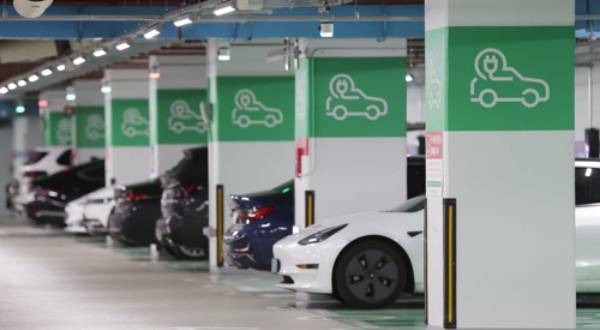
According to the Ministry of Climate, Energy and Environment on Sunday, domestically produced electric passenger cars accounted for 52 percent of the market in 2025. The figure has steadily declined from 69 percent in 2022 to 62.7 percent in 2023 and 59.6 percent in 2024.
The drop comes as the government pushes to expand EV adoption while consumer demand increasingly shifts toward imported models. Among younger buyers in particular, models such as the Tesla Model Y and BYD’s Atto 3 have gained strong popularity.
According to the Korea Automobile Importers & Distributors Association (KAIDA), Tesla and BYD ranked first and second, respectively, in EV sales by brand last year. Tesla sold 59,916 vehicles, while BYD posted sales of 6,107 units.
The Tesla Model Y, in particular, ranked as the most popular imported model across EVs, hybrids and internal combustion engine vehicles combined. Sales of the Model Y reached 48,187 units last year, making it the top-selling imported model overall.
Industry analysts attribute Tesla’s strong performance to aggressive price cuts made possible by production at its Shanghai plant. Tesla expanded its appeal among cost-conscious consumers by launching a lower-priced Model Y in 2023, roughly 20 million won ($13,600) cheaper than previous versions. The company reduced costs by adopting lithium iron phosphate batteries sourced from China and switching from a dual-motor to a single-motor configuration.
BYD is also accelerating its push into the South Korean market by emphasizing value for money. The Chinese automaker launched lower-priced EV models such as the Atto 3 and Seal last year. Priced in the 30 million won range, the Atto 3 can be purchased in the high-20 million won range after subsidies. Within just one year of entering the market, BYD climbed to second place in imported EV sales by brand.
With the government aiming to ensure that half of all new vehicles sold by 2030 are zero-emission models, concerns are growing that the current trajectory will only expand the market share of imported EVs.
“Tesla has been cutting prices and moving down from premium models to value-oriented ones, while BYD is pushing aggressively with vehicles priced in the 20 million won range,” said Kim Pil-soo, a professor who teaches automotive engineering at Daelim University College. “As a result, domestic models are steadily losing market share, heightening anxiety within the local auto industry.”
Experts argue that expanding the adoption of domestically produced EVs will require more decisive measures than the current subsidy system. Although Tesla and BYD receive significantly lower subsidies than domestic automakers such as Hyundai Motor and Kia, their sales continue to rise.
This year, the Tesla Model Y Premium Long Range was granted a national subsidy of 2.1 million won, while the BYD Atto 3 received 1.26 million won. In contrast, the Hyundai Ioniq 6 AWD Long Range with 18-inch wheels and the Kia EV6 Long Range 2WD with 19-inch wheels each qualify for subsidies of 5.7 million won. Despite higher subsidies for domestic EVs, consumer preference has increasingly tilted toward Tesla.
“To strengthen the competitiveness of South Korea’s EV industry, the government should allocate supplementary budgets to support future vehicle R&D and compensate exporters for U.S. tariffs,” Kim said, calling for the swift introduction of a domestic production incentive tax, often referred to as a Korean-style IRA.
An industry official echoed the view, noting that Chinese EV makers are rapidly expanding into global markets using facilities such as Tesla’s Shanghai Gigafactory as a hub. “Given the lack of support compared with China and other countries, South Korea needs to introduce a domestic production incentive tax to protect and nurture local manufacturing,” the official said.
Copyright © 매일경제 & mk.co.kr. 무단 전재, 재배포 및 AI학습 이용 금지
- 미국 경고에 놀란 K반도체…“용인 메모리 팹, 美로 옮겨야하나” - 매일경제
- 홍라희, 삼성전자 주식 2조 처분 - 매일경제
- “삼전이 계속 오를 순 없잖아요”...5천피 이후 국장 책임질 주도주는 - 매일경제
- “삼전 주식 2조 처분합니다”…상속세 납부·대출상환에 쓴다는 관장님 - 매일경제
- '똘똘한 한채' 장기보유공제 축소땐 … 양도세 최대 3배로 - 매일경제
- 아리수 정수센터 일일 직원으로 변신…420만 유튜버, 누구길래 - 매일경제
- 공매도 재개 후 첫 대규모 ‘철퇴’… 신한운용·파레토 등 6곳 과징금 40억 - 매일경제
- 중국 ‘예금액 1경원’ 빠져나간다…“돈이 복사되는데 왜 묶어놔?” - 매일경제
- [단독] 국민연금, 국내주식 투자비중 상향 추진 - 매일경제
- 충격, 김하성이 다쳤다! 오른손 가운데손가락 힘줄 파열로 수술...회복에 4~5개월 - MK스포츠