IMF warns Korea’s dollar exposure far exceeds FX market size
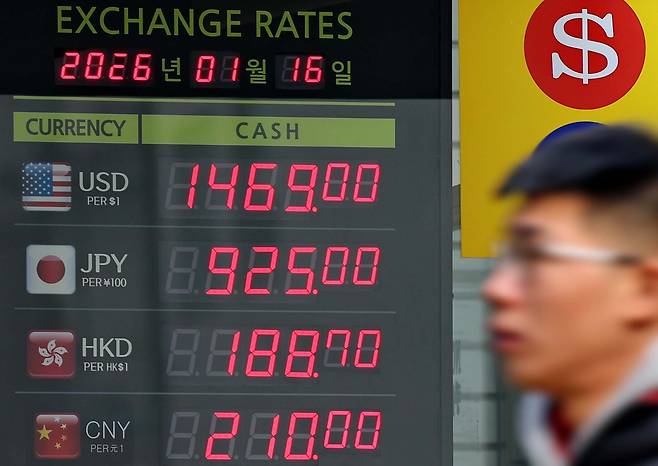
The International Monetary Fund’s warning that Korea’s US dollar assets exposed to foreign-exchange risk are “disproportionately large” is drawing renewed attention, as the won weakens again despite authorities’ efforts to stabilize the currency.
In its latest Global Financial Stability Report, the IMF said dollar asset exposure held by Korean companies and financial institutions amounts to nearly 25 times the size of the country’s onshore FX market, signaling heightened vulnerability to volatility and limited capacity to absorb sudden hedging demand.
The October report is being revisited as the won slides toward 1,480 per dollar, after rebounding to around 1,430 earlier this month following a Dec. 24 market intervention. When the IMF published the report, the currency was already under pressure, falling from about 1,400 per dollar to above 1,430 by month-end before plunging to near-crisis levels in late December.
Canada and Norway posted ratios similar to Korea’s at around 25 times, driven largely by large sovereign and pension portfolios. Taiwan ranked highest at more than 45 times, reflecting its smaller FX market relative to dollar asset holdings. Japan held the largest dollar assets by volume, but its ratio remained lower, at about 15 times, due to the depth of its FX market.
With most eurozone economies such as Germany, France and Spain recording single-digit ratios, and Canada and Japan benefiting from quasi-reserve currency status, the IMF’s findings underscore the greater FX vulnerability facing non-reserve currency economies such as Korea and Taiwan.
“In some economies, dollar exposures are disproportionately large relative to the depth of the local foreign exchange market,” the report said, warning that limited absorption capacity for hedging flows leaves FX markets more vulnerable to funding stress during periods of currency volatility.
The IMF also flagged a growing “rush to hedge” among global investors, warning that heavier selling of dollar forwards can intensify dollar funding pressures. Such activity accelerated after Washington’s sweeping tariff announcements in April, the report added.
In Korea, authorities recently extended the National Pension Service’s strategic currency hedging arrangement with the central bank to contain risks tied to its massive overseas investments amid prolonged FX volatility. The government is also preparing to roll out retail forward-selling products through major brokerages to rein in dollar demand driven by individual investors’ overseas stock buying.
Still, the policy impact has been limited. The won closed onshore trading Friday at 1,473.6 per dollar, giving back gains from the previous session that followed a rare intervention by US Treasury Secretary Scott Bessent, who said the currency’s recent slide “is not in line with Korea’s strong economic fundamentals.”
Market participants are calling for stronger policy action.
In a report Friday, Bank of America said Korea’s current measures are "insufficient to arrest the currency’s decline," warning that political pressure to stabilize the won is likely to intensify. With retail-driven portfolio outflows remaining the main drag, tax incentives could be a key lever to alter the flow dynamics, the bank said.
Citi highlighted the need for stronger international coordination, particularly with the US. Korean authorities could seek “symbolic FX backstops such as a form of FX swap” to support the US-Korea trade deal, the bank said after Bessent’s intervention, adding that while a crisis-style unlimited swap line is unlikely, Seoul could instead tap the Fed’s Foreign and International Monetary Authorities repo facility using its US Treasury holdings as collateral.
Copyright © 코리아헤럴드. 무단전재 및 재배포 금지.