KCCI chief warns Korea's growth is losing steam, urges policy shift
전체 맥락을 이해하기 위해서는 본문 보기를 권장합니다.
"Economic growth is directly linked to hope for the future for the younger generation, whether they can continue to live in this country," he said. "If growth stops and this becomes a place with little hope or even a place perceived as having no hope at all, dissatisfaction and exodus among young people will inevitably increase."
"If the growth stops, resources for redistribution will shrink, and social conflicts will expand, threatening the sustainability of democracy as well."
이 글자크기로 변경됩니다.
(예시) 가장 빠른 뉴스가 있고 다양한 정보, 쌍방향 소통이 숨쉬는 다음뉴스를 만나보세요. 다음뉴스는 국내외 주요이슈와 실시간 속보, 문화생활 및 다양한 분야의 뉴스를 입체적으로 전달하고 있습니다.
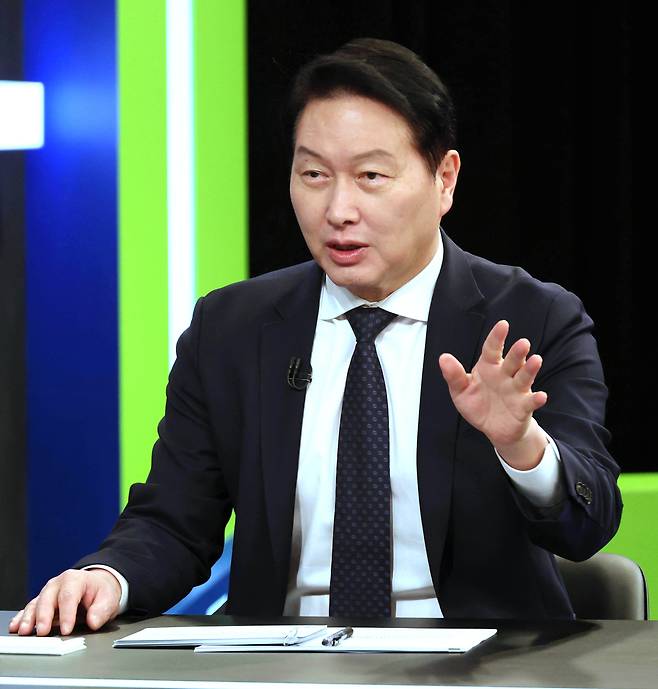
Chey Tae-won, chair of both the Korea Chamber of Commerce and Industry and SK Group, cautioned Sunday that South Korea’s economy is slipping into a structural slowdown, calling on the government to shift toward growth-focused policies and adopt an artificial intelligence-centered approach to restore momentum.
Chey described an economy that stops growing as “like a bicycle with the brakes on,” making it harder to start moving again, as he appeared on KBS’ current affairs program, “Sunday Diagnosis.”
“The Korean economy is already in a situation where the spark of growth is fading, and if we don’t make a transition now, economic recovery could become even more difficult due to a ‘resource exodus,’ such as the outflow of capital and talent,” he said.
Chey pointed to a steady decline in growth over the years, saying South Korea’s growth rate has dropped by approximately 1.2 percentage points every five years. He projected the country’s potential growth rate at around 1.9 percent, while actual growth remains closer to 1 percent, calling the gap a critical issue. He explained that the mismatch suggests the country has the capacity for growth, but current policies and actions are failing to translate that potential into actual results.
Chey also warned that prolonged stagnation could deepen social tensions, particularly among young people.
“Economic growth is directly linked to hope for the future for the younger generation, whether they can continue to live in this country,” he said. “If growth stops and this becomes a place with little hope or even a place perceived as having no hope at all, dissatisfaction and exodus among young people will inevitably increase.”
Chey added that South Korea is virtually the only country to have achieved both rapid economic development and democratization simultaneously.
“If the growth stops, resources for redistribution will shrink, and social conflicts will expand, threatening the sustainability of democracy as well.”
On the corporate front, he criticized what he described as a system in which companies face increasing burdens as they expand, describing them as “stair-step regulations” that discourage growth.
“If regulations and risks are greater than the rewards of growth, companies will choose to maintain the status quo,” he said.
Chey cited Taiwan as an example of the need for strategic investments, rather than current regulations that stifle companies’ willingness to grow. He said Taiwan created state-backed funding and made targeted investments, which helped build globally competitive firms such as Taiwan Semiconductor Manufacturing Company.
Looking ahead, Chey reiterated his earlier calls for deeper cooperation with Japan as another path to growth.
“If South Korea and Japan implement a single visa system similar to the EU’s Schengen Agreement, it would generate approximately 3 trillion won ($2.04 billion) in added value,” he said, adding that more diverse products and synergies could emerge if the two countries were to view themselves as a single “economic community.”
He also described AI as “not merely technological progress, but a civilizational transformation comparable to the shift from the Stone Age to the Iron Age,” saying it is “a core element of national strategy.”
He proposed building global-scale AI infrastructure, fostering a stronger AI startup ecosystem, and establishing a proof-of-concept support system to help companies quickly validate the business viability of ideas.
“Infrastructure made in Korea that can only be used in Korea has limits,” he said. “We must aim for global infrastructure that can be used worldwide to enable sustainable growth and investment in the AI industry."
He expressed hope that South Korea has sufficient potential to generate new growth and build a new future.
“While we have achieved growth centered on exports and manufacturing until now, it is time to create a new national model and economic narrative by combining diverse cultural assets such as K-culture, AI technology and soft power," he said.
Copyright © 코리아헤럴드. 무단전재 및 재배포 금지.