Borrowers to face increased interest burden as Cofix rises
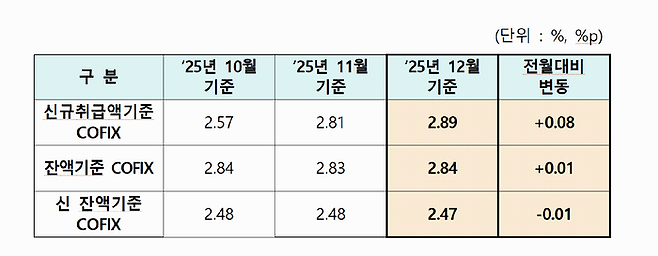
According to the Korea Federation of Banks said on Thursday, the Cofix, based on new loans, stood at 2.89 percent in December, up 0.08 percentage point from 2.81 percent in November. The index has been on an upward trend for four straight months since September 2025.
In November, the rate had already jumped sharply to 2.81 percent from 2.57 percent the month before, and the upward momentum continued into December.
The new-issuance Cofix reflects only funds newly raised during the relevant month, meaning it responds relatively quickly to changes in market rates and banks’ deposit rates.
By contrast, the outstanding-balanced Cofix rose only marginally, by 0.01 percentage point to 2.84 percent in December.
The new outstanding-balance Cofix slipped 0.01 percentage point to 2.47 percent.
Cofix is calculated as a weighted average interest rate of funds raised by eight major domestic banks – NH Nonghyup, Shinhan, Woori, SC First Bank, Hana, IBK, KB Kookmin, and Citibank Korea.
A rise in Cofix means banks are securing funds at higher interest costs, while a decline indicates they are raising funds more cheaply.
Commercial lenders are expected to begin applying the newly announced Cofix rate to variable-rate mortgage loans as early as Friday.
Copyright © 매일경제 & mk.co.kr. 무단 전재, 재배포 및 AI학습 이용 금지
- “주가 급등에 어닝쇼크 옵니다”…웃어야 할 기업들 등골 휘는 이유는? - 매일경제
- 호텔서 침구·전화 등 훔쳐간 절도범...잡고보니 미인대회 우승자였다 - 매일경제
- 10년 된 고장난 승마기가 30만원? 전현무, 기부 바자회 논란 - 매일경제
- “최태원 동거녀가 자녀 입사 방해” 유포한 70대 유튜버의 최후 - 매일경제
- 상가주인도 포기한 상가 …"재건축땐 입주권으로 달라" - 매일경제
- [속보] 역대최악 ‘경북산불’ 낸 50대 실화자, 징역형 집행유예 - 매일경제
- 신세계, 역삼 센터필드 매각 추진에 발끈한 이유...“랜드마크 호텔도 있는데” - 매일경제
- 평당 매맷값에 ‘억’…강남 재건축 아파트 오름폭에 ‘헉’ - 매일경제
- “비트코인, 지금이 바닥인가...18만달러까지 간다” - 매일경제
- WBSC, 프리미어12 출전팀 발표…‘4위’ 한국은 본선 직행 - MK스포츠