More than half of Korea’s mid-sized companies have no investment plans for 2026
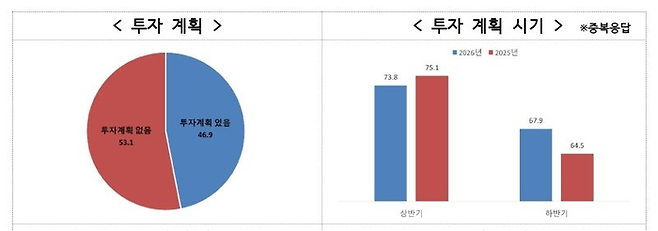
The Federation of Middle Market Enterprises of Korea (FOMEK) surveyed 650 mid-sized companies from November 17 to 28, 2025, on their investment outlook for 2026.
Of those surveyed, 46.9 percent said they have investment plans for this year, while 53.1 percent said they do not.
Among companies without investment plans, the main reasons cited were operating in sectors where investment is unnecessary (34.2 percent), uncertain market conditions (28.7 percent), deteriorating business performance (20.9 percent), having already completed investments (9.3 percent), and the lack of new investment opportunities (4.9 percent).
Mid-sized companies in the manufacturing sector particularly pointed to uncertain market conditions (30.9 percent) and worsening business performance (29.3 percent), while non-manufacturing mid-sized companies cited operating in sectors where investment is unnecessary (44.6 percent) and uncertain market conditions (27.5 percent) as key factors.
Among the 46.9 percent companies that said they do have investment plans, 46.2 percent said they would increase investment from last year, 37.4 percent said they would maintain spending at last year’s level, and 16.4 percent said they would reduce investment.
Companies planning to cut investment cited weak domestic demand at 42 percent, concerns about an economic downturn at 24 percent, rising production costs at 16 percent, and high interest rates and financing difficulties at 8 percent.
Those planning to expand investment said the spending would go toward expanding core businesses (29.1 percent), upgrading or replacing aging facilities (22 percent), strengthening entry into new businesses (21.3 percent), and expanding overseas operations (20.6 percent).
To encourage greater investment by mid-sized companies, respondents called for expanded tax incentives (40.3 percent), price stability and stronger domestic demand (18.9 percent), interest rate cuts (15.8 percent), expanded policy financing (11.7 percent), improvements in the business environment, such as labor conditions (9.1 percent), and easing of investment-related regulations such as site requirements (3.5 percent).
The federation said that while uncertainty has dampened sentiment, policy efforts should focus on forward-looking support measures, including tax and financial assistance, to quickly translate remaining investment willingness into action.
Copyright © 매일경제 & mk.co.kr. 무단 전재, 재배포 및 AI학습 이용 금지
- [단독] 무한리필인데 1만2천원밖에 안 한다고?…‘초가성비’ 승부수 띄운 이랜드이츠 - 매일경
- “하루도 같이 산 적 없어”…‘2번 이혼’ 이지현, 의사 남편과 재혼 생활 폭로 - 매일경제
- “아빠라 불러라” 16세 9차례 성폭행한 공무원, 징역형 집행유예 - 매일경제
- 트럼프 “반도체에 25% 관세…AI 데이터센터용은 제외” - 매일경제
- 오늘의 운세 2026년 1월 15일 木(음력 11월 27일) - 매일경제
- 올해 들어올 ‘13월의 월급’ 얼마나 될까?…15일 ‘연말정산 서비스’ 개통 - 매일경제
- [단독] ‘달러 유출’ 서학개미 탓했는데…국내상장 美ETF가 진짜 주범 - 매일경제
- [속보] 올해 첫 금통위…‘환율·물가’ 걱정에 기준금리 5연속 동결 - 매일경제
- “오천피, 그만 얘기하세요”…환율 발목잡힌 소비재株엔 딴나라 이야기 - 매일경제
- ‘밀라노 가자!’ 김민재 향한 AC밀란 러브콜, 현실적인 시나리오 되나?…“잔류 원하는 KIM, 뮌헨